 Back
BackGame Theory and Competitive Strategy: Oligopoly, Dominant Strategies, and the Prisoners’ Dilemma
Study Guide - Smart Notes
 Tailored notes based on your materials, expanded with key definitions, examples, and context.
Game Theory and Competitive Strategy
Introduction to Oligopoly and Strategic Behavior
In microeconomics, market structures with a few firms are known as oligopolies. Unlike perfectly competitive or monopoly markets, firms in an oligopoly must consider the actions and reactions of their rivals when making output and pricing decisions. To analyze such strategic interactions, economists use game theory, a mathematical framework for studying decision-making in situations where outcomes depend on the choices of multiple agents.
Oligopoly: A market structure with a small number of firms, each of which is aware that its decisions affect and are affected by the decisions of other firms.
Examples: Wireless carriers in the US.
Key Question: How do output, price, and welfare in oligopoly compare to those in competitive and monopoly markets?
Game Theory: Basic Concepts
Components of a Game
Game theory analyzes strategic situations using the following components:
Players: The decision-makers in the game (at least two agents).
Payoff: The value or utility associated with each possible outcome.
Strategy: A rule or plan of action for playing the game.
We focus on noncooperative games, where negotiation and enforcement of binding contracts are not possible.
Payoff Matrix
A payoff matrix is a table that shows the payoffs to each player for every possible combination of strategies. It is a standard way to represent games with discrete strategies.
Examples of Strategic Games
Split or Steal Game
Players: Two contestants (the man and the woman).
Strategies: Each can choose to "split" or "steal" the prize money.
Payoffs:
If both split: each gets £50,075.
If one steals and the other splits: the stealer gets £100,150, the splitter gets £0.
If both steal: both get £0.
Rock, Paper, Scissors
Players: Two.
Strategies: Rock, Paper, or Scissors (simultaneous choice).
Payoffs: Winner gets 1, loser gets -1, tie results in 0 for both.
Rock | Paper | Scissors | |
|---|---|---|---|
Rock | 0, 0 | -1, 1 | 1, -1 |
Paper | 1, -1 | 0, 0 | -1, 1 |
Scissors | -1, 1 | 1, -1 | 0, 0 |
Battle of the Sexes
Players: Girl and Boy.
Strategies: Each chooses between "Movie" and "Football".
Payoffs:
If both choose Movie: Girl gets 3, Boy gets 2.
If both choose Football: Girl gets 2, Boy gets 3.
If they choose differently: both get 0.
Movie | Football | |
|---|---|---|
Movie | 3, 2 | 0, 0 |
Football | 0, 0 | 2, 3 |
Prisoners' Dilemma
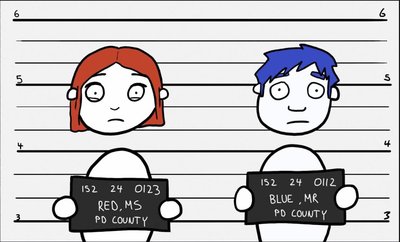
The Prisoners' Dilemma is a classic example of a game where individual rationality leads to a suboptimal outcome for both players. Two suspects are interrogated separately and must decide whether to confess to a crime or deny it. The police have enough evidence for a minor charge but need a confession for the major charge.
Players: Prisoner 1 and Prisoner 2.
Strategies: Confess or Deny.
Payoffs:
If both confess: each gets -5 (years in prison).
If one confesses and the other denies: confessor goes free (0), denier gets -10.
If both deny: each gets -1 (minor charge).
Confess | Deny | |
|---|---|---|
Confess | -5, -5 | 0, -10 |
Deny | -10, 0 | -1, -1 |
Dominant Strategies
Definition and Application
A dominant strategy is one that is optimal for a player, regardless of what the other player does. If a player has a dominant strategy, they will always choose it.
Split or Steal Game: For both players, "steal" is the dominant strategy because it yields a higher or equal payoff regardless of the other player's choice.
Battle of the Sexes: No dominant strategy for either player; the best choice depends on the other player's action.
Rock, Paper, Scissors: No dominant strategy; the optimal choice changes depending on the opponent's move.
Prisoners' Dilemma: "Confess" is the dominant strategy for both prisoners, even though mutual denial would lead to a better collective outcome.
Summary Table: Dominant Strategies in Example Games
Game | Dominant Strategy Exists? | Dominant Strategy |
|---|---|---|
Split or Steal | Yes | Steal (for both) |
Battle of the Sexes | No | None |
Rock, Paper, Scissors | No | None |
Prisoners' Dilemma | Yes | Confess (for both) |
Key Takeaways
Game theory provides a framework for analyzing strategic interactions in oligopoly and other economic contexts.
Payoff matrices help visualize the outcomes of different strategy combinations.
Dominant strategies simplify decision-making but do not always exist.
The Prisoners' Dilemma illustrates how rational individual choices can lead to collectively worse outcomes.
