 Back
BackGame Theory in Microeconomics: Strategic Decision-Making, Static and Dynamic Games
Study Guide - Smart Notes
 Tailored notes based on your materials, expanded with key definitions, examples, and context.
Game Theory: An Introduction
Overview of Game Theory
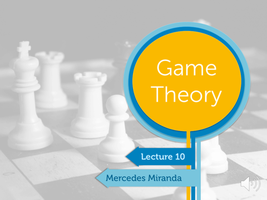
Game theory is a formal framework used to analyze strategic interactions among rational decision-makers, such as firms in oligopolistic markets. It is widely applied in economics, political science, and other disciplines to understand how players make decisions when their payoffs depend on the actions of others.
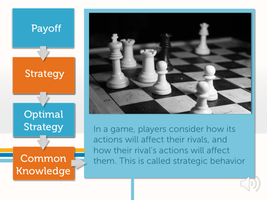
Strategic behavior: Occurs when each player considers how their actions affect others and how others' actions affect them.
Applications: Oligopoly pricing, advertising, elections, military strategy, and more.
Key Concepts in Game Theory
Payoff, Strategy, and Common Knowledge
Understanding game theory requires familiarity with several foundational concepts:
Payoff: The value a player assigns to an outcome (e.g., profit for firms, utility for individuals).
Strategy: A complete plan of action for every possible situation in a game.
Optimal Strategy: The strategy that maximizes a player's expected payoff.
Common Knowledge: Information that all players know and know that the others know as well.
Types of Games
Cooperative vs. Noncooperative Games
Games can be classified based on whether binding agreements are possible:
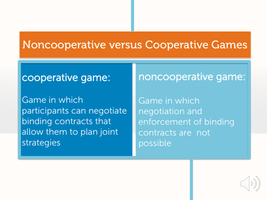
Cooperative Game: Players can negotiate and enforce binding contracts (e.g., cartels like OPEC).
Noncooperative Game: No binding contracts; players act independently and must anticipate rivals' responses.
Static vs. Dynamic Games
Another important distinction is between static and dynamic games:
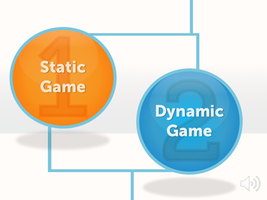
Static Game: Players choose actions simultaneously or without knowledge of others' choices; the game is played once.
Dynamic Game: Players move sequentially or repeatedly, often with knowledge of previous actions.
Static Games and Dominant Strategies
Dominant Strategy
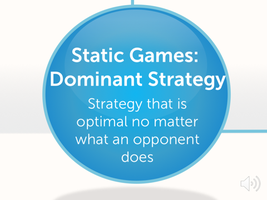
In static games, a dominant strategy is one that is optimal regardless of what the opponent does. If all players have a dominant strategy, the outcome is straightforward to predict.
Definition: A strategy is dominant if it yields the highest payoff for a player, no matter what the other players do.
Payoff Matrix Example: Advertising Game
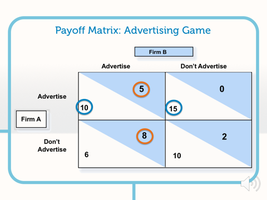
A payoff matrix summarizes the payoffs for each player for every combination of strategies. Consider two firms deciding whether to advertise:
Advertise (Firm B) | Don't Advertise (Firm B) | |
|---|---|---|
Advertise (Firm A) | 10, 5 | 15, 0 |
Don't Advertise (Firm A) | 8, 6 | 2, 10 |
Both firms have a dominant strategy to advertise, as it yields a higher payoff regardless of the rival's choice.
The Prisoners' Dilemma
Classic Example
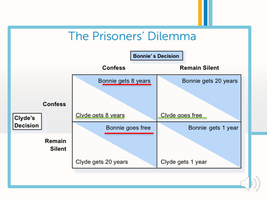
The prisoners' dilemma illustrates the challenge of maintaining cooperation. Two suspects must independently decide whether to confess. The payoffs are:
Confess (Clyde) | Remain Silent (Clyde) | |
|---|---|---|
Confess (Bonnie) | 8, 8 | 1, 20 |
Remain Silent (Bonnie) | 20, 1 | 1, 1 |
Dominant strategy for both: Confess.
Nash equilibrium: Both confess, each gets 8 years.
Cooperation would yield a better outcome, but is not stable.
Nash Equilibrium
Definition and Application
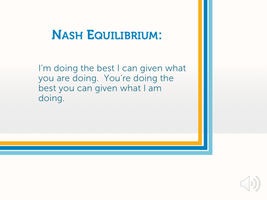
A Nash equilibrium occurs when each player chooses the best strategy given the strategies chosen by others. No player has an incentive to deviate unilaterally.
Key distinction: Dominant strategy is best no matter what; Nash equilibrium is best given what others do.
Dynamic Games
Sequential and Repeated Games
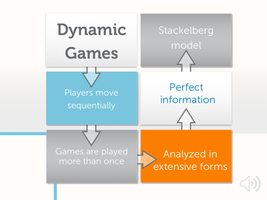
Dynamic games involve players making decisions in sequence or over multiple periods. These games are often represented in extensive form (game trees) and analyzed using backward induction.
Perfect information: Players know all previous moves.
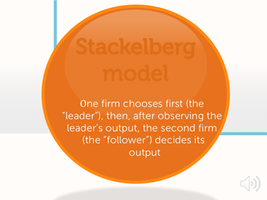
Stackelberg Model: One firm (leader) moves first, the other (follower) observes and responds.
Stackelberg Model Example
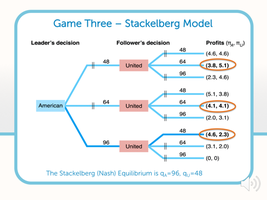
In the Stackelberg model, the leader anticipates the follower's best response and chooses its output accordingly. The equilibrium is found by analyzing the game tree.
Dynamic Game: Entry Deterrence
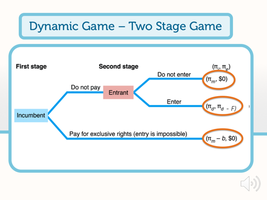
Consider a two-stage game where an incumbent firm decides whether to pay for exclusive rights to prevent entry, and a potential entrant decides whether to enter the market. The payoffs depend on these choices and can be represented in a game tree.
Repeated Games
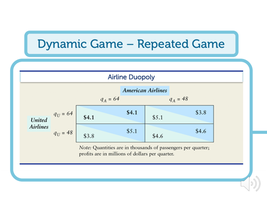
When static games are repeated, players can condition their strategies on past behavior, making cooperation (such as cartel formation) more likely. In a finitely repeated game, cooperation unravels as the end approaches, but with an indefinite horizon, collusion is more sustainable.
Summary Table: Game Types and Key Features
Game Type | Timing | Information | Example |
|---|---|---|---|
Static Game | Simultaneous | Complete | Advertising Game |
Dynamic Game | Sequential/Repeated | Perfect/Imperfect | Stackelberg Model, Entry Deterrence |
Cooperative Game | Varies | Varies | Cartel (OPEC) |
Noncooperative Game | Varies | Varies | Prisoners' Dilemma |
Key Equations and Concepts
Nash Equilibrium (general form):
Backward Induction (dynamic games): Start from the last move and determine the optimal strategy, then move backward to the first decision.
Conclusion
Game theory provides essential tools for analyzing strategic interactions in microeconomics, especially in oligopoly and other market structures where firms' decisions are interdependent. Understanding dominant strategies, Nash equilibrium, and the distinction between static and dynamic games is crucial for predicting outcomes and designing optimal strategies.
