 Back
BackGame Theory in Microeconomics: Strategic Decision Making, Nash Equilibrium, and Applications
Study Guide - Smart Notes
 Tailored notes based on your materials, expanded with key definitions, examples, and context.
Game Theory and Strategic Decision Making
Introduction to Game Theory
Game theory is a framework for analyzing situations in which the outcomes of a participant's choices depend on the actions of other participants. It is widely used in microeconomics to study strategic interactions among firms, consumers, and other economic agents.
Strategic Situation: A scenario where each participant must consider the potential decisions of others when making their own choices.
Application: Game theory is essential for understanding oligopoly, auctions, bargaining, and other market structures where interdependence is key.
Static vs. Dynamic Games
Games can be classified based on the timing of moves:
Static Games: Players choose their strategies simultaneously, without knowledge of the others' choices.
Dynamic Games: Players make decisions in sequence, with later players observing earlier actions.
Example: The classic prisoners' dilemma is a static game, while sequential entry into a market is a dynamic game.
The Prisoners' Dilemma and Oligopoly
Understanding the Prisoners' Dilemma
The prisoners' dilemma illustrates why two rational individuals might not cooperate, even if it appears that it is in their best interest to do so. This concept is central to understanding the challenges of collusion in oligopolistic markets.
Dominant Strategy: A strategy that is optimal for a player, regardless of what the other player does.
Nash Equilibrium: A set of strategies where no player can benefit by unilaterally changing their own strategy.
Example: In an oligopoly, firms would benefit from cooperating to restrict output and raise prices, but the dominant strategy is often to cheat on the agreement, leading to lower joint profits.
Applications of the Prisoners' Dilemma
Arms Races: Each country prefers safety but the dominant strategy is to arm, making the world less safe.
Advertising: Firms would prefer not to advertise and share profits, but the dominant strategy is to advertise, reducing joint profits.
Common Resources: Users would benefit from limiting use, but the dominant strategy is to overuse, depleting the resource.
Societal Impact: Lack of cooperation can be harmful to society, but in some cases (e.g., oligopolists failing to collude), it can benefit consumers through lower prices.
Repeated Games and Cooperation
While cooperation is difficult in one-shot games, repeated interactions can sustain cooperation through strategies like tit-for-tat:
Tit-for-Tat: Start by cooperating, then mimic the other player's previous action. This strategy can enforce cooperation over time.
Payoff Matrices and Nash Equilibrium
Analyzing Payoff Matrices
Payoff matrices summarize the outcomes for each combination of strategies in a game. They are used to identify dominant strategies and Nash equilibria.
Example Payoff Matrix:
B1 | B2 | |
|---|---|---|
A1 | 4, 2 | 1, 1 |
A2 | 2, 1 | 0, 0 |
To find dominant strategies, compare payoffs across each player's choices. Nash equilibrium occurs where neither player wants to deviate unilaterally.
Collusion and Outcomes
Collusion can sometimes improve joint outcomes, but only if both players can commit to the agreement. Otherwise, the dominant strategy often prevails.
Dynamic Games and Extensive Form Representation
Game Trees (Extensive Form)
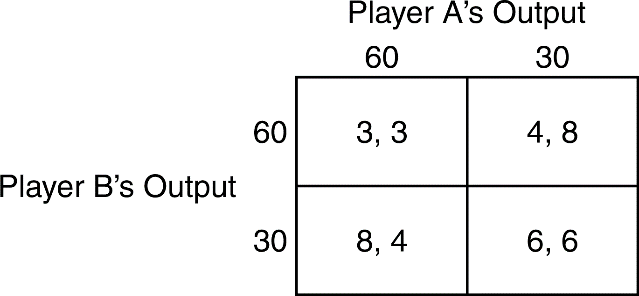
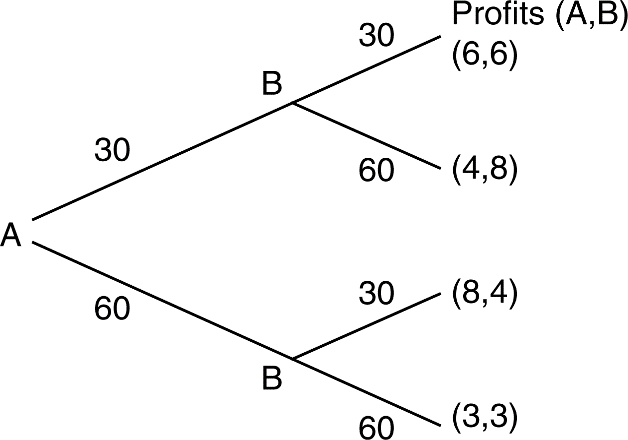
Dynamic games are often represented as game trees, showing the sequence of moves and possible outcomes. This helps analyze subgame perfect Nash equilibrium, where players optimize at every stage of the game.
Example: Sequential output decisions by two firms.
Subgame Perfect Nash Equilibrium
In dynamic games, the equilibrium is found by backward induction, ensuring that each player's strategy is optimal at every decision node.
Applications: Auctions, Sunk Costs, and Switching Costs
Auctions and Strategic Entry
Firms must decide whether to enter new markets, often considering sunk costs and government subsidies. Sunk costs are non-recoverable investments that can serve as credible commitments in strategic competition.
Sunk Cost: An investment that cannot be recovered once made. Sunk costs make threats to enter a market more credible.
Switching Costs: Costs incurred by consumers when changing from one product to another. High switching costs can create market power for firms.
Example: Developing software with a unique command structure can create switching costs, making it harder for competitors to attract users.
Advanced Example: Credible Threats and Sequential Games
Credible Threats in Sequential Games
In some games, one player may threaten another to influence their decision. For a threat to be credible, it must be in the threatening player's best interest to carry it out if challenged.
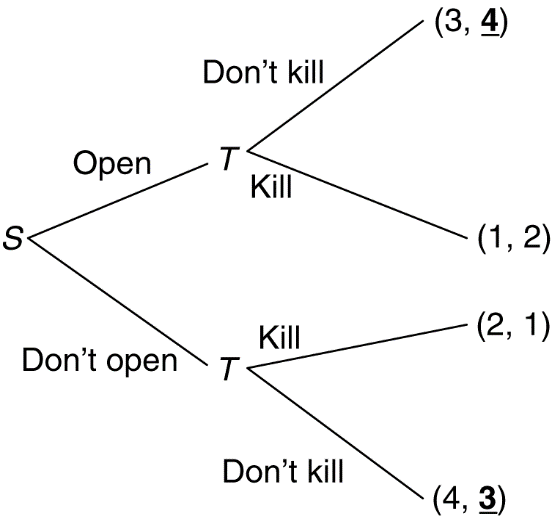
Subgame Perfect Nash Equilibrium: The equilibrium strategy is for the safe owner not to open the safe, and for the thug not to kill, as the threat is not credible.
Summary Table: Key Concepts in Game Theory
Concept | Definition | Example/Application |
|---|---|---|
Dominant Strategy | Best action regardless of opponent's choice | Confessing in prisoners' dilemma |
Nash Equilibrium | No player can benefit by changing strategy unilaterally | Both firms advertise |
Subgame Perfect Nash Equilibrium | Optimal strategy at every stage of a dynamic game | Backward induction in sequential games |
Sunk Cost | Non-recoverable investment | Building a specialized plant |
Switching Cost | Cost to consumers of changing products | Unique software command structure |
Formulas and Equations
Nash Equilibrium Condition: Where is the utility (payoff) for player , is the equilibrium strategy, and is the equilibrium strategy profile of other players.
Backward Induction (Dynamic Games): Start at the final decision node and determine the optimal action, then move backward to earlier nodes.
Conclusion
Game theory provides powerful tools for analyzing strategic interactions in microeconomics. By understanding dominant strategies, Nash equilibrium, and the role of repeated and dynamic games, students can better predict and explain firm behavior in competitive and cooperative environments.
