 Back
BackGame Theory: Nash Equilibrium, Dominant and Maximin Strategies
Study Guide - Smart Notes
 Tailored notes based on your materials, expanded with key definitions, examples, and context.
Game Theory in Microeconomics
Dominant Strategies and Equilibrium
In game theory, a dominant strategy is one that yields the highest payoff for a player, regardless of what the other players do. An equilibrium in dominant strategies occurs when each player in the game chooses their dominant strategy, resulting in a stable outcome where no player has an incentive to deviate.
Dominant Strategy: Optimal regardless of opponents' actions.
Equilibrium in Dominant Strategies: Each player plays their dominant strategy.
Pareto Dominance: Outcome x Pareto dominates outcome y if at least one player is better off in x and no player is worse off compared to y.
Prisoner's Dilemma: A game with an equilibrium in dominant strategies that is Pareto dominated by another feasible outcome.
Example: In the Prisoner's Dilemma, both players have a dominant strategy to confess, but mutual silence would make both better off.
Nash Equilibrium
A Nash equilibrium is a set of strategies where each player is doing the best they can, given the strategies chosen by the other players. Unlike dominant strategy equilibrium, Nash equilibrium does not require each strategy to be optimal against all possible actions of the opponent, only against the actual choices made.
Nash Equilibrium: Each player’s strategy is a best response to the other’s strategy.
Non-uniqueness: There may be multiple Nash equilibria in a game.
Example: Battle of the Sexes
Movie | Football | |
|---|---|---|
Movie | 3, 2 | 0, 0 |
Football | 0, 0 | 2, 3 |
(Movie, Movie) and (Football, Football) are both Nash equilibria.
No equilibrium in dominant strategies exists in this game.
Identifying Nash Equilibria: The Quick Method
To systematically find all Nash equilibria in a payoff matrix:
For each strategy of the column player, underline the row player’s best response(s).
For each strategy of the row player, underline the column player’s best response(s).
Cells with two underlines (one from each player) are Nash equilibria.
Example Matrix:
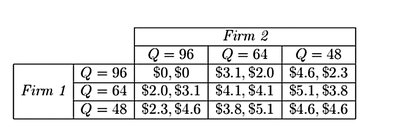
This matrix shows the payoffs for Firm 1 and Firm 2 under different quantity choices. Applying the quick method helps identify Nash equilibria.
Practice: Applying the Quick Method
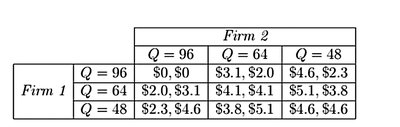
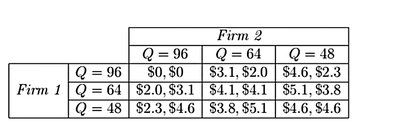
Follow the steps above to underline best responses and identify Nash equilibria in the matrix. This method is especially useful for larger games where equilibria are not immediately obvious.
Nash Equilibrium May Not Exist
Some games have no Nash equilibrium in pure strategies. For example, in a matching pennies or zero-sum game, no cell is a mutual best response.
Movie | Gym | |
|---|---|---|
Movie | -1, 1 | 1, -1 |
Gym | 1, -1 | -1, 1 |
None of the four outcomes is a Nash equilibrium in this case.
Dominant Strategies vs Nash Equilibrium
Every equilibrium in dominant strategies is a Nash equilibrium.
Not every Nash equilibrium is an equilibrium in dominant strategies.
Dominant strategy: Best regardless of what others do.
Nash equilibrium: Best given what others are doing.
Maximin Strategies
A maximin strategy is one that maximizes the minimum gain a player can guarantee themselves, reflecting a conservative or risk-averse approach. The equilibrium in maximin strategies occurs when all players choose their maximin strategies.
Maximin strategy: Maximizes the worst-case payoff.
Equilibrium in maximin strategies: All players play their maximin strategy.
Example:
Don't Invest | Invest | |
|---|---|---|
Don't Invest | 0, 0 | -10, 10 |
Invest | -100, 0 | 20, 10 |
Firm 1’s maximin strategy: Don’t Invest (worst-case payoff is -10, better than -100).
Firm 2’s maximin strategy: Invest (worst-case payoff is 10, better than 0).
(Don’t Invest, Invest) is the equilibrium in maximin strategies.
Practice Problems: Dominant, Nash, and Maximin Strategies
Consider the following payoff matrix:

Does this game have an equilibrium in dominant strategies? Answer: No. Player 1 has a dominant strategy (D), but Player 2 does not.
How many Nash equilibria are there in the game?

Answer: Only one Nash equilibrium, (D, R).
What is the maximin strategy of Player 2?

Player 2’s maximin strategy is L, as it maximizes their worst-case payoff (-5 vs. -10).
Summary Table: Key Concepts in Game Theory
Concept | Definition | Example |
|---|---|---|
Dominant Strategy | Best action regardless of opponent’s choice | Confess in Prisoner’s Dilemma |
Nash Equilibrium | Best response to opponent’s strategy | (Movie, Movie) in Battle of the Sexes |
Maximin Strategy | Maximizes minimum possible payoff | Don’t Invest in investment game |
