 Back
Government Actions in Markets: Price Controls, Taxes, Quotas, and Subsidies
Study Guide - Smart Notes
 Tailored notes based on your materials, expanded with key definitions, examples, and context.
Government Actions in Markets
Price Controls
Price controls are government-imposed restrictions on how high or low prices can go in a market. They are used to regulate the market but often lead to inefficiencies by preventing the market from reaching equilibrium.
Types of Price Controls:
Price Ceiling: Maximum price sellers can charge.
Price Floor: Minimum price buyers must pay.
Market Inefficiency: Price controls disrupt equilibrium, causing shortages or surpluses.
Price Ceiling (Price Cap)
A price ceiling is the maximum price sellers are allowed to charge. It is typically set below the equilibrium price, leading to several inefficiencies:
Inefficiently Low Quantity: Quantity supplied is less than quantity demanded, resulting in shortages.
Increased Search Activity: Consumers spend more time searching for goods.
Illegal Trading: Black markets may emerge.
Inefficient Allocation: Not all consumers who value the good most get it.
Wasted Resources: Time and effort spent waiting or searching for goods.
Example: Rent control can lead to long waiting lists and wasted time for renters.
Price Floor
A price floor is the minimum price buyers are allowed to pay. It must be set above the equilibrium price to be effective, resulting in excess supply (surplus).
Surplus: Quantity supplied exceeds quantity demanded.
Inefficiently Low Quantity: Fewer transactions occur than at equilibrium.
Search Costs: Job seekers may spend more time searching for employment.
Example: Minimum wage laws are a price floor in the labor market.
Taxes
Excise Taxes and Tax Incidence
An excise tax is a per-unit tax on the sale of a good or service. The tax incidence refers to how the burden of the tax is divided between buyers and sellers, depending on the relative elasticities of supply and demand.
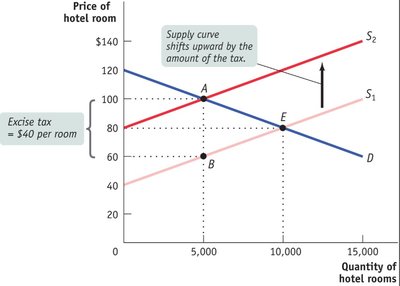
Tax on Sellers: Shifts the supply curve upward by the amount of the tax.
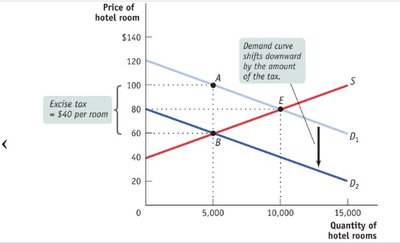
Tax on Buyers: Shifts the demand curve downward by the amount of the tax.
Elasticity: The party with less elastic (more inelastic) demand or supply bears a greater share of the tax burden.
Example: If demand is inelastic and supply is elastic, buyers bear most of the tax.
Formula: The effect of an excise tax can be shown as:
Types of Taxes:
Income tax
Payroll tax
Sales tax
Profits tax
Property tax
Wealth tax
Tax on Sellers: Supply Curve Shifts Upward
When an excise tax is imposed on sellers, the supply curve shifts upward by the amount of the tax. This increases the price buyers pay and decreases the equilibrium quantity.
Tax on Buyers: Demand Curve Shifts Downward
When an excise tax is imposed on buyers, the demand curve shifts downward by the amount of the tax. This decreases the price sellers receive and reduces the equilibrium quantity.
Price Elasticities and Tax Incidence
To determine who bears the burden of a tax, examine the elasticities of supply and demand:
If both are equally elastic, the tax burden is shared equally.
If demand is inelastic and supply is elastic, buyers bear more of the tax.
If supply is inelastic and demand is elastic, sellers bear more of the tax.
Example: For a $40 tax, if elasticities are equal, buyers and sellers each pay $20.
Quantity Controls (Quota)
Quota
A quota is a government-imposed limit on the quantity of a good that can be bought or sold. Quotas create inefficiency and a wedge between the price consumers pay and the price producers receive.
Quota Rent: The difference between demand price and supply price, captured by license holders.
Effects:
Decrease in supply
Increase in price
Decrease in marginal cost
Inefficient underproduction
Incentive to cheat
Subsidies
Effects of Subsidies
A subsidy is a payment by the government to encourage production or consumption of a good. Subsidies increase supply, lower prices, and increase quantity produced, but can lead to inefficient overproduction.
Increase in Supply: Producers supply more at every price.
Fall in Price: Buyers pay less, sellers receive more.
Increase in Marginal Cost: More production increases costs.
Government Payment: Cost to government equals subsidy per unit times quantity.
Inefficient Overproduction: More is produced than is socially optimal.
Example: A subsidy of $0.375 per gallon for ethanol increases quantity and lowers price.
Markets for Illegal Goods
Effects of Penalties
Government penalties on illegal goods affect supply and demand:
Penalty on Sellers: Shifts supply curve to the left (higher prices, lower quantity).
Penalty on Buyers: Shifts demand curve to the left (lower prices, lower quantity).
Penalty on Both: Both curves shift, reducing equilibrium quantity further.
Example: Penalties on cocaine sellers and buyers reduce market activity.
