 Back
BackInflation, Interest Rates, Economic Growth, and the Business Cycle
Study Guide - Smart Notes
 Tailored notes based on your materials, expanded with key definitions, examples, and context.
Measuring Inflation
Price Indexes and the Consumer Price Index (CPI)
Inflation is measured by tracking changes in the average price level of a basket of goods and services over time. The most common measure is the Consumer Price Index (CPI), which compares the cost of a fixed basket of goods in the current year to the cost in a base year.
Price Index: A measure of the average price of a set of goods and services in a given period relative to a base year.
Consumer Price Index (CPI): Measures the average change in prices paid by consumers for a market basket of goods and services.
Base Year: The reference year against which other years are compared (e.g., 2002 in Canada).
Formula for CPI:
Inflation Rate: The percentage change in the CPI from one year to the next.
Interpretation: If the CPI increases by 45%, the cost of living has risen by 45% since the base year.
Biases in the CPI
Substitution Bias: Consumers substitute cheaper goods for more expensive ones, but the CPI basket is fixed.
Increase in Quality Bias: Improvements in product quality may be interpreted as price increases.
New Product Bias: New products are not immediately included in the basket.
Outlet Bias: Changes in where consumers shop (e.g., discount stores) are not reflected quickly.
Adjusting for Inflation
To compare purchasing power across years, convert nominal values to real values using the CPI.
Core Inflation
Core Inflation: Excludes volatile items like food and energy to better reflect underlying inflation trends.
Real vs Nominal Interest Rates
Definitions and Calculations
Nominal Interest Rate: The percentage increase in money that the borrower pays the lender, not adjusted for inflation.
Real Interest Rate: The nominal interest rate adjusted for inflation, reflecting the true increase in purchasing power.
Example: If the nominal interest rate is 5% and inflation is 2%, the real interest rate is approximately 3%.
Types of Interest Rates
Prime Rate: Rate for creditworthy businesses.
Conventional Mortgage Rate: Rate for creditworthy individuals.
Overnight Rate: Rate at which banks lend to each other for 24 hours.
Bank Rate: Rate at which the central bank lends to commercial banks.
Long-Run Economic Growth
Measuring Economic Growth
Real GDP per Capita: The best measure for long-run economic growth, as it accounts for population changes.
The Rule of 70
Estimates the number of years for a variable to double, given a constant growth rate.
where T is the doubling time in years and g is the annual growth rate (in percent).
Example: If China’s growth rate is 6%, it will take about 11.7 years to double its GDP ().
Determinants of Long-Run Growth
Labour Productivity: Output per worker or per hour worked.
Capital: Manufactured goods used to produce other goods and services.
Technological Innovation: Advances that improve productivity.
Property Rights: Legal protection for ownership and investment.
Potential vs Actual GDP
Potential GDP: The level of real GDP when all firms are producing at capacity.
Output Gap: The difference between actual and potential GDP.
Savings, Investment, and the Financial System
Functions of the Financial System
Matching Savers with Borrowers: Reduces transaction costs and allocates funds efficiently.
Risk Reduction and Allocation: Diversifies and manages risk according to investor preferences.
Liquidity Provision: Makes it easier to convert assets into cash.
Financial Intermediaries
Include banks, mutual funds, pension funds, and insurance companies.
They borrow from savers and lend to borrowers.
Saving and Investment
Private Saving: Income remaining after households pay taxes and consume.
Public Saving: Government saving, calculated as tax revenue minus government spending and transfers.
Total Saving: The sum of private and public saving.
Does Savings Equal Investment?
In a closed economy, total saving equals total investment.
The Market for Loanable Funds
Supply and Demand for Loanable Funds
Supply: Comes from savers; increases with higher real interest rates.
Demand: Comes from borrowers (firms and government); decreases with higher real interest rates.
Shifts in Supply
Caused by changes in preferences, wealth, or government saving.
Shifts in Demand
Caused by changes in profit expectations or government policies affecting investment costs or benefits.
The Business Cycle
Phases of the Business Cycle
The business cycle describes the fluctuations in real GDP over time, consisting of periods of expansion and recession. Expansions are periods of rising real GDP, while recessions are periods of declining real GDP. The cycle includes peaks (high points) and troughs (low points).
Expansion: Real GDP increases, unemployment falls.
Peak: The highest point before a downturn.
Recession: Real GDP decreases, unemployment rises.
Trough: The lowest point before recovery begins.
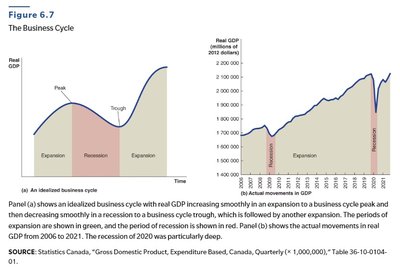
Additional info: The left panel of the image shows an idealized business cycle, while the right panel shows actual real GDP movements in Canada from 2006 to 2021, highlighting expansions and recessions, including the significant recession in 2020.
Output Gap
The difference between actual and potential GDP, often associated with the business cycle.
Example Table: Comparison of Key Economic Indicators
Indicator | Definition | Formula |
|---|---|---|
Inflation Rate | Percentage change in CPI | |
Real Interest Rate | Nominal rate adjusted for inflation | |
GDP Growth Rate | Percentage change in real GDP | |
Rule of 70 | Years to double at growth rate g |
