 Back
Input Demand: The Capital Market and the Investment Decision – Microeconomics Study Notes
Study Guide - Smart Notes
 Tailored notes based on your materials, expanded with key definitions, examples, and context.
Input Demand: The Capital Market and the Investment Decision
Capital and Investment
Capital is a fundamental concept in microeconomics, referring to goods produced by the economic system that are used as inputs to produce other goods and services in the future. Investment is the process of adding new capital to a firm's capital stock, which is measured as a flow over time.
Capital: Goods used to produce other goods and services in the future.
Tangible (Physical) Capital: Material things such as nonresidential structures, durable equipment, residential structures, and inventories.
Social Capital (Infrastructure): Capital that provides services to the public, including public works and services.
Intangible Capital: Nonmaterial assets like human capital (skills and knowledge acquired through education and training).
Capital Stock: The current market value of a firm’s plant, equipment, inventories, and intangible assets at a point in time.
Investment: The flow of new capital added to a firm’s capital stock.
The Demand for New Capital and the Investment Decision
Firms decide to invest in new capital based on the expected returns and the cost of capital, which is influenced by market interest rates. The investment decision involves comparing the present value of expected future earnings to the cost of the investment.
Marginal Revenue Product of Capital: The additional revenue earned by using one more unit of capital.
Interest: Payments made for the use of money.
Present Discounted Value (PDV): The value of a stream of future payments discounted at an interest rate.
Risk Premium: The extra return required to compensate for risk.
Expected Rate of Return: The average return an asset should earn.
Internal Rate of Return: The discount rate that makes the net present value of an investment zero.
Investment Rule: If the present value of expected earnings exceeds the cost of investment, the investment should be undertaken.
Formula for Present Discounted Value
The present value of R dollars to be received in t years at interest rate r:
The Capital Market
The capital market is where households supply savings to firms, which use these funds to purchase capital goods. Financial markets facilitate the flow of capital from savers to investors.
Capital Market: The input/factor market for savings and investment funds.
Bond: A contract between a borrower and lender, often with regular payments.
Financial Capital Market: Institutions where suppliers and demanders of capital interact.
Capital Income: Income earned on savings through financial markets.
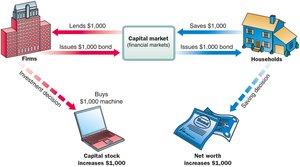
Capital Income: Interest and Profits
Capital income includes interest and profits earned on savings and investments. Interest rates can be fixed or adjustable, and profits are distributed to shareholders as dividends or retained earnings.
Interest Rate: Interest payments as a percentage of the loan.
Fixed Rate Loans: Loans with unchanging interest rates.
Adjustable Rate Loans: Loans with periodically changing interest rates.
Common Stock: Ownership claim on a firm, entitling the owner to a share of profits.
Dividend: Payment to shareholders.
Capital Gain: Increase in the value of stock above its purchase price.
Functions of Interest and Profit:
Interest incentivizes saving and postponing consumption.
Profit rewards innovation and risk-taking.
Financial Markets in Action
Financial markets link household savings to firm investments through various mechanisms, including business loans, venture capital, retained earnings, and the stock market.
Business Loans: Banks lend funds deposited by households to firms.
Venture Capital: Household funds enable firms to undertake risky investments.
Retained Earnings: Firms reinvest profits, increasing capital stock and shareholder net worth.
Stock Market: Households' shares become part of their net worth.
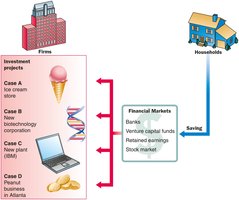
Capital Accumulation and Allocation
Capital accumulation is the process by which savings are transformed into productive investments. Allocation decisions are made by firms, but are constrained by household savings.
Households decide how much to save, limiting the amount of investment possible.
The capital market directs savings into profitable investment projects.
Appendix: Calculating Present Value
Present value calculations are essential for investment decisions. The present value of future earnings is compared to the cost of investment to determine whether a project should be undertaken.
Present Discounted Value (PDV): The current value of a future payment.
Net Present Value (NPV): The sum of present values of all expected profits minus the initial investment.
Where is the expected profit in year t, r is the interest rate, and C is the initial investment cost.
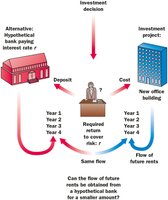
Review Terms and Concepts
bond
capital
capital income
capital market
capital stock
common stock
dividend
expected rate of return
financial capital market
human capital
intangible capital
interest
interest rate
internal rate of return
investment
marginal revenue product of capital
physical, or tangible, capital
present discounted value (PDV)
risk premium
social capital, or infrastructure
