 Back
Input Demand: The Labor and Land Markets – Microeconomics Study Guide
Study Guide - Smart Notes
 Tailored notes based on your materials, expanded with key definitions, examples, and context.
Input Markets: Basic Concepts
Derived Demand and Productivity
Input markets are fundamental to microeconomics, as they determine how resources such as labor and land are allocated and priced. The demand for inputs is known as derived demand, meaning it depends on the demand for the final goods and services produced by those inputs. The productivity of an input refers to the amount of output produced per unit of that input.
Derived Demand: Firms demand inputs only if households demand the goods or services produced by those firms.
Productivity: Higher productivity increases the value of an input to a firm.
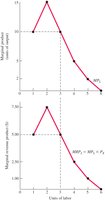
Marginal Product of Labor: The additional output produced by one more unit of labor.
Marginal Revenue Product (MRP): The additional revenue earned by employing one more unit of input, holding other factors constant.
Formula:
Where is the marginal revenue product of labor, is the marginal product of labor, and is the price of output.
Labor Markets
Supply and Demand in Labor Markets
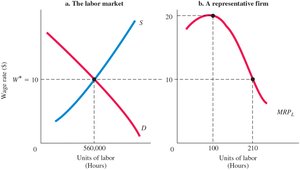
The labor market determines wage rates and the number of hours workers are willing to supply. The market labor supply curve is the horizontal aggregation of individual labor supply curves. Firms hire labor as long as the value of the product produced by the last unit of labor exceeds the wage paid.
Labor Supply Curve: Shows the relationship between wage rates and labor supplied.
Competitive Labor Markets: Wages are determined by the interaction of supply and demand.
Profit Maximization: Firms compare the marginal revenue product of labor to the wage rate.
Example: A firm will hire labor up to the point where , with being the wage rate.
Labor Market Flexibility
Flexibility in work hours can affect labor supply. Some workers are willing to accept lower wages for flexible hours, especially those with family responsibilities.
Flexible Hours: Valued by certain groups, influencing labor supply decisions.
Employer-Directed Hours: May require higher wages to attract workers.

Land Markets
Demand-Determined Price and Pure Rent
Land is a unique input because its supply is fixed. The price of land is demand-determined, meaning it depends entirely on what buyers are willing to pay. Pure rent is the return to any factor of production that is in fixed supply.
Fixed Supply: Represented by a vertical, perfectly inelastic supply curve.
Rent: Determined exclusively by demand.
Example: The price of land in a city is higher if demand for housing is high, regardless of construction costs.

Rent and Output Value
A firm will use land as long as the revenue from selling the product produced on that land covers the price of the land. The allocation of land among competing uses depends on the trade-off between products that can be produced.
Location Value: The value of a parcel depends on the uses of adjoining parcels.
Input Demand Curves
Shifts in Factor Demand Curves
Factor demand curves can shift due to changes in product demand, the quantity of complementary and substitutable inputs, input prices, and technological change.
Product Demand: Increased demand for output shifts the MRP curve right; decreased demand shifts it left.
Complementary Inputs: More capital can increase labor demand.
Input Prices: Firms may substitute cheaper inputs.
Technological Change: New methods or products can increase productivity and shift demand curves.
Formula:
Shifts occur when or changes.
The Firm’s Profit-Maximizing Condition in Input Markets
Profit Maximization Across Inputs
Firms maximize profit by equating the marginal revenue product of each input to its price. This applies to labor, capital, and land.
Profit-Maximizing Condition: For each input, .
Inputs: Labor (L), Capital (K), Land (A).
Formula:
Where is wage, is the rental rate of capital, and is the price of land.
Review Terms and Concepts
Demand-determined price
Derived demand
Marginal product of labor
Marginal revenue product (MRP)
Market labor supply curve
Productivity of an input
Pure rent
Technological change
