 Back
BackInput Demand: The Labor and Land Markets – Study Notes
Study Guide - Smart Notes
 Tailored notes based on your materials, expanded with key definitions, examples, and context.
Input Demand: The Labor and Land Markets
Introduction to Input Demand
Firms in microeconomics must decide how much of each input (such as labor, capital, and land) to employ in order to maximize profit. The demand for these inputs is called derived demand because it depends on the demand for the final goods and services produced using these inputs.
Derived demand: The demand for a resource that arises from the demand for the product the resource helps to produce.
Productivity of an input: The amount of output produced per unit of input.
Example: If the demand for cars increases, the demand for welders (an input in car production) also increases.
Input Decision in the Short Run
In the short run, capital is fixed, but firms can adjust the amount of labor they employ. The central question is: How many units of labor should a firm use to maximize profit, given its fixed capital?
Marginal Revenue Product of Labor (MRPL): The additional revenue generated by employing one more unit of labor, holding other inputs constant.
Profit-maximizing condition: A firm hires labor up to the point where the marginal revenue product of labor equals the wage rate ().
Marginal Revenue Product (MRP)
The marginal revenue product (MRP) is the extra revenue a firm earns by employing one additional unit of an input, ceteris paribus. For labor, this is calculated as:
Formula:
Where MPL is the marginal product of labor and PX is the price of output.
Units: MRP is measured in dollars; MP is measured in units of output.
Labor Markets and Competitive Firms
When both the product and labor markets are competitive, all firms are price takers in the product market and wage takers in the labor market. This means they cannot influence the market price or wage rate.
Profit maximization: Occurs when , where MEL is the marginal expense of labor. In a competitive labor market, .
Labor demand curve: The MRPL curve represents the firm's short-run demand for labor, showing the quantity of labor demanded at each wage rate.
Labor Demand in the Short Run
The marginal revenue product of labor (MRPL) curve is the firm's short-run demand curve for labor. It shows how many workers the firm will hire at different wage rates.
Downward sloping: As the wage rate falls, the quantity of labor demanded increases, and vice versa.
Input Demand with Multiple Variable Factors
When a firm can vary more than one input (e.g., both labor and capital), the analysis becomes more complex. A change in the price of one input can affect the demand for other inputs.
Factor substitution effect: Firms substitute away from an input whose price has risen and toward an input whose price has fallen.
Output effect: A change in input price affects the firm's output level, which in turn affects the demand for all inputs.
Example: If the wage rate decreases, firms may substitute labor for capital (factor substitution), and lower costs may lead to increased output and higher demand for all inputs (output effect).
Table: The Substitution Effect of an Increase in Wages
The following table illustrates how a firm producing 100 units of output responds to an increase in wages by substituting away from labor and toward capital.
Input Combination | Labor (units) | Capital (units) | Total Cost |
|---|---|---|---|
Before Wage Increase | 10 | 5 | $1,000 |
After Wage Increase | 8 | 7 | $1,000 |
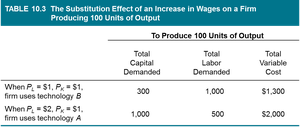
Interpretation: After the wage increase, the firm uses less labor and more capital to produce the same output at the same total cost. This demonstrates the substitution effect.
Profit-Maximizing Condition for Multiple Inputs
For a firm using multiple inputs, profit maximization requires that the marginal revenue product of each input equals its price:
Where L is labor, K is capital, A is land (acres), X is output, and PX is the price of output.
If all these conditions hold simultaneously, the firm is allocating its resources efficiently in the input markets.
