Back
Interdependence & the Gains from Trade: Absolute vs. Comparative Advantage, Specialization, and International Trade
Study Guide - Smart Notes
 Tailored notes based on your materials, expanded with key definitions, examples, and context.
Interdependence & the Gains from Trade
Introduction
This chapter explores the fundamental microeconomic concepts of interdependence, absolute and comparative advantage, specialization, and the gains from trade. It uses real-world examples and economic models to illustrate how nations and individuals benefit from trading goods and services, and how these benefits are determined by opportunity costs and terms of trade.
Economic Interdependence
The Global Journey of Your Daily Life
Economic interdependence describes how individuals and nations rely on each other for goods and services. Everyday products often involve global supply chains, with components and labor sourced from multiple countries.
Your Smartphone: Designed in California, chips from Taiwan, assembled in Vietnam.
Your Daily Outfit: US cotton spun in China, stitched in Vietnam, sold by Japanese Uniqlo.
Morning Coffee: Vietnamese beans, condensed milk, packaged in recyclable polymers.
Digital Apps: Streaming from Sweden, chatting from the US, scrolling from Singapore.

Key Question: Why do we choose to be economically interdependent with strangers across the globe?
Trade Foundations
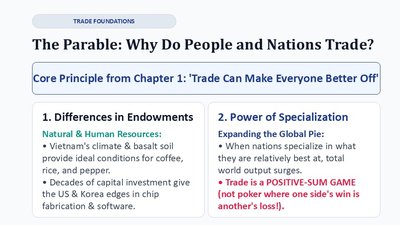
The Parable: Why Do People and Nations Trade?
Trade is based on the principle that it can make everyone better off. Two main reasons drive trade:
Differences in Endowments: Natural and human resources vary by country, affecting production capabilities.
Power of Specialization: When nations specialize in what they produce most efficiently, total world output increases. Trade is a positive-sum game, not a zero-sum game.
Economic Concepts
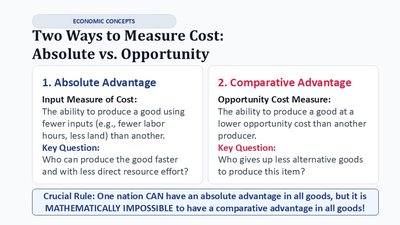
Absolute vs. Comparative Advantage
There are two ways to measure cost in economics:
Absolute Advantage: The ability to produce a good using fewer inputs (e.g., labor hours) than another producer.
Comparative Advantage: The ability to produce a good at a lower opportunity cost than another producer.
Crucial Rule: One nation can have an absolute advantage in all goods, but it is mathematically impossible to have a comparative advantage in all goods.
Economic Model Setup
A Tale of Two Economies: Vietnam and the US
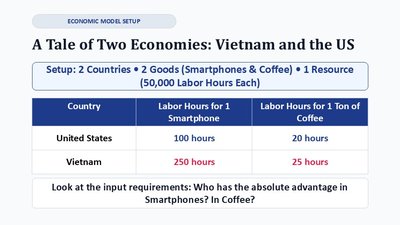
Model setup: Two countries (US and Vietnam), two goods (smartphones and coffee), one resource (labor hours).
Country | Labor Hours for 1 Smartphone | Labor Hours for 1 Ton of Coffee |
|---|---|---|
United States | 100 | 20 |
Vietnam | 250 | 25 |
Input Comparisons
Analyzing Absolute Advantage
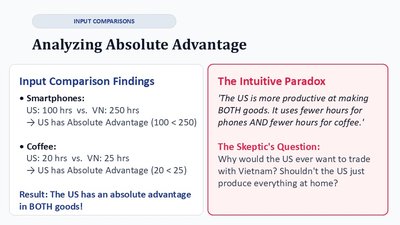
Smartphones: US uses fewer hours (100 vs. 250) → US has absolute advantage.
Coffee: US uses fewer hours (20 vs. 25) → US has absolute advantage.
Result: US has absolute advantage in both goods. Intuitive Paradox: Why would the US trade with Vietnam if it is more productive in both goods?
Autarky Baseline
Production Without Trade (Autarky)
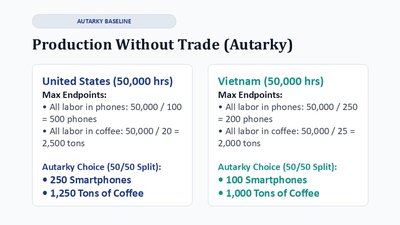
Each country produces only for itself, splitting labor between goods:
United States: 250 smartphones, 1,250 tons of coffee
Vietnam: 100 smartphones, 1,000 tons of coffee
PPF Graphs
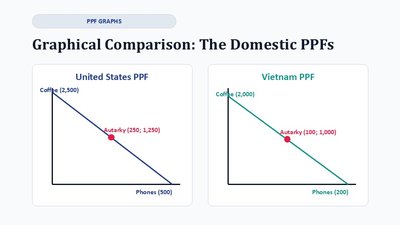
Graphical Comparison: The Domestic PPFs
The Production Possibility Frontier (PPF) shows the maximum possible output combinations for each country.
Mathematical Formula
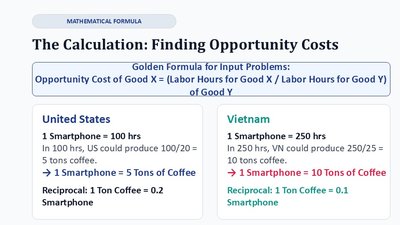
Finding Opportunity Costs
Opportunity cost formula for input problems:
United States: 1 smartphone = 5 tons coffee; 1 ton coffee = 0.2 smartphone
Vietnam: 1 smartphone = 10 tons coffee; 1 ton coffee = 0.1 smartphone
Opportunity Cost Table
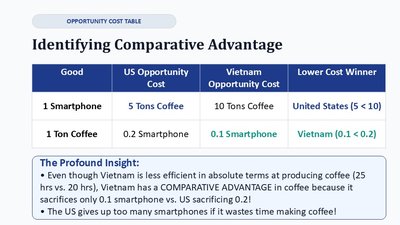
Identifying Comparative Advantage
Good | US Opportunity Cost | Vietnam Opportunity Cost | Lower Cost Winner |
|---|---|---|---|
1 Smartphone | 5 Tons Coffee | 10 Tons Coffee | United States (5 < 10) |
1 Ton Coffee | 0.2 Smartphone | 0.1 Smartphone | Vietnam (0.1 < 0.2) |
Profound Insight: Vietnam has a comparative advantage in coffee, even though it is less efficient in absolute terms.
Specialization Strategy
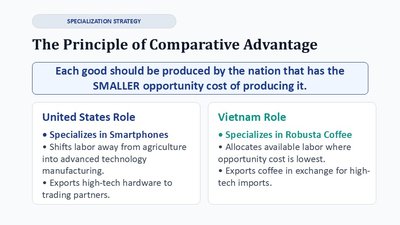
The Principle of Comparative Advantage
Each good should be produced by the nation with the smaller opportunity cost.
United States: Specializes in smartphones, exports high-tech hardware.
Vietnam: Specializes in robusta coffee, exports coffee for tech imports.
World Output Expansion
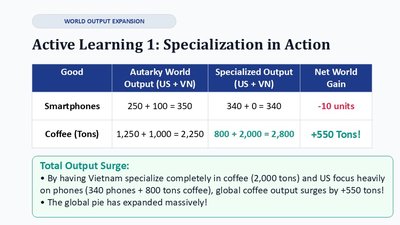
Specialization in Action
Good | Autarky World Output (US + VN) | Specialized Output (US + VN) | Net World Gain |
|---|---|---|---|
Smartphones | 350 | 340 | -10 units |
Coffee (Tons) | 2,250 | 2,800 | +550 Tons! |
Total Output Surge: Specialization increases global coffee output by 550 tons.
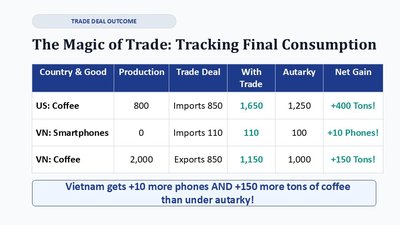
Trade Deal Outcome
Tracking Final Consumption
Country & Good | Production | Trade Deal | With Trade | Autarky | Net Gain |
|---|---|---|---|---|---|
US: Coffee | 800 | Imports 850 | 1,650 | 1,250 | +400 Tons! |
VN: Smartphones | 0 | Imports 110 | 110 | 100 | +10 Phones! |
VN: Coffee | 2,000 | Exports 850 | 1,150 | 1,000 | +150 Tons! |
Graphical Proof
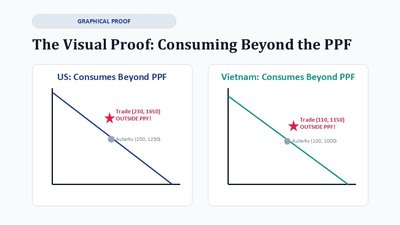
Consuming Beyond the PPF
Trade allows countries to consume combinations of goods beyond their domestic PPFs, demonstrating the gains from trade.
Mutual Gain Range
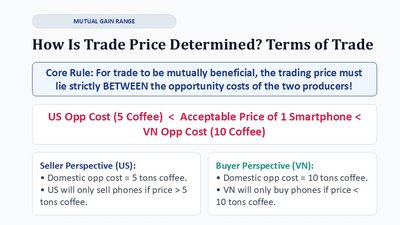
Terms of Trade
For trade to be mutually beneficial, the trading price must fall strictly between the opportunity costs of the two producers:
Seller Perspective (US): Will only sell phones if price > 5 tons coffee.
Buyer Perspective (VN): Will only buy phones if price < 10 tons coffee.
Case Study
Modern Real-Life Application
Scenario: Should a highly productive individual (e.g., an esports champion) mow their own lawn?
Faker (Esports Champion): Can mow lawn in 2 hours, but could earn 50,000,000 VND in that time.
Neighborhood Gardener: Can mow lawn in 4 hours, alternative job pays 400,000 VND.
Opportunity cost: Faker: 50,000,000 VND; Gardener: 400,000 VND.

Exam Preparation
Practice Exam Problem
Example: Vietnam and Korea produce microchips and textiles. Calculate opportunity costs and mutually acceptable trade prices.
Vietnam: 1 microchip = 4 textiles
Korea: 1 microchip = 1 textile
Mutually acceptable price: 1 < price < 4 textiles. Correct answer: 2.5 textiles.

Political Economy
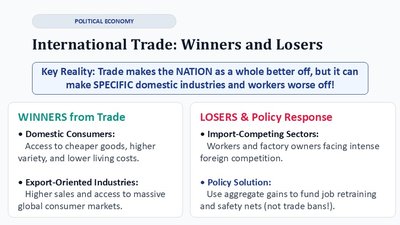
International Trade: Winners and Losers
Trade makes the nation as a whole better off, but can negatively impact specific domestic industries and workers.
Winners: Domestic consumers (cheaper goods, higher variety), export-oriented industries (access to global markets).
Losers: Import-competing sectors (workers facing intense foreign competition).
Policy Solution: Use aggregate gains to fund job retraining and safety nets, not trade bans.
Chapter Review
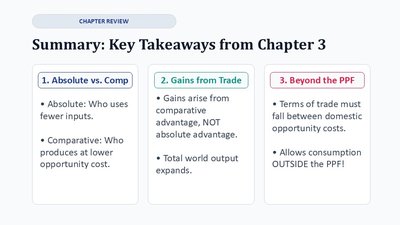
Summary: Key Takeaways from Chapter 3
Absolute vs. Comparative Advantage: Absolute: Who uses fewer inputs. Comparative: Who produces at lower opportunity cost.
Gains from Trade: Gains arise from comparative advantage, not absolute advantage. Total world output expands.
Beyond the PPF: Terms of trade must fall between domestic opportunity costs, allowing consumption outside the PPF.