 Back
BackIntermediate Microeconomics: Chapter 3 Homework Study Guide
Study Guide - Smart Notes
 Tailored notes based on your materials, expanded with key definitions, examples, and context.
Q1. Explain why economists assume that the firms in order to understand property rights and social choice must make the same assumptions as the firms in the Appleton 'How You Can't Have Too Many Apples' case study.
Background
Topic: Property Rights and Social Choice
This question tests your understanding of how economists use assumptions about rational behavior, information, and preferences to analyze property rights and social choice, similar to the Appleton case study.
Key Terms:
Property rights: Legal rights to use, transfer, and benefit from resources.
Social choice: Decision-making processes that aggregate individual preferences into collective outcomes.
Rational behavior: The assumption that individuals maximize their utility given constraints.
Step-by-Step Guidance
Identify the assumptions economists make about firms: rationality, complete information, and well-defined preferences.
Consider why these assumptions are necessary for analyzing property rights and social choice—think about how they simplify complex interactions.
Relate these assumptions to the Appleton case study, where firms' behavior is modeled based on maximizing outcomes under constraints.
Reflect on how these assumptions help economists predict outcomes and design policies.
Try solving on your own before revealing the answer!
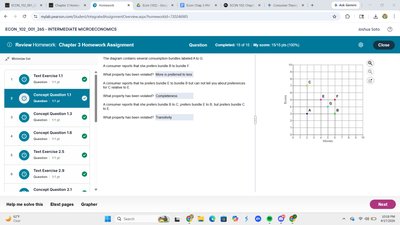
Q2. Which property best describes consumer preferences? (Refer to the graph shown.)
Background
Topic: Consumer Preferences and Indifference Curves
This question tests your understanding of the properties of consumer preferences, such as completeness, transitivity, and monotonicity, using a graphical representation.
Key Terms:
Completeness: Consumers can compare and rank all possible bundles.
Transitivity: If a consumer prefers A to B and B to C, then they prefer A to C.
Monotonicity: More of a good is always preferred to less.
Step-by-Step Guidance
Examine the graph to identify how bundles are ranked or compared.
Determine which property is illustrated by the consumer's choices on the graph.
Consider whether the consumer's preferences are consistent and logical.
Think about how the property affects the shape and position of indifference curves.
Try solving on your own before revealing the answer!
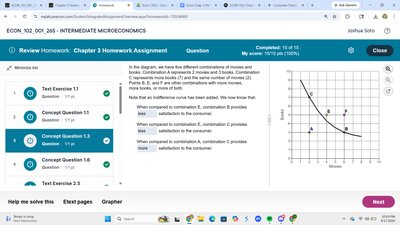
Q3. In the diagram, as we move from combination A to combination B, what happens to the consumer's satisfaction?
Background
Topic: Indifference Curves and Consumer Satisfaction
This question tests your ability to interpret indifference curves and understand how moving between combinations affects consumer satisfaction.
Key Terms:
Indifference curve: A curve representing combinations of goods that provide equal satisfaction to the consumer.
Utility: A measure of satisfaction or happiness from consuming goods.
Step-by-Step Guidance
Identify the positions of combinations A and B on the indifference curve diagram.
Determine whether B is on a higher or lower indifference curve compared to A.
Recall that higher indifference curves represent greater satisfaction.
Analyze the direction of movement and what it implies about the consumer's utility.
Try solving on your own before revealing the answer!
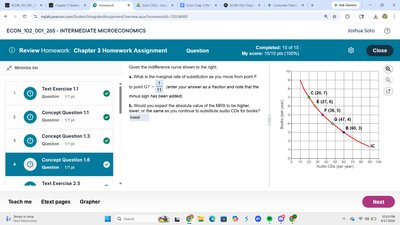
Q4. What is the marginal rate of substitution (MRS) as you move from point F to point G on the indifference curve?
Background
Topic: Marginal Rate of Substitution (MRS)
This question tests your understanding of how to calculate the MRS between two points on an indifference curve, which measures the rate at which a consumer is willing to substitute one good for another.
Key Formula:
Where is the change in the quantity of good y, and is the change in the quantity of good x.
Step-by-Step Guidance
Identify the coordinates of points F and G on the indifference curve.
Calculate the change in each good as you move from F to G.
Apply the MRS formula to find the rate of substitution.
Interpret the result in terms of consumer preferences.
Try solving on your own before revealing the answer!
Q5. A consumer can spend $600 as a composite bundle for two consumer choice variables (x1 and x2). What is the equation for the opportunity set?
Background
Topic: Budget Constraint and Opportunity Set
This question tests your ability to formulate the budget constraint equation for a consumer given prices and income.
Key Formula:
Where and are prices of goods 1 and 2, and are quantities, and is income.
Step-by-Step Guidance
Identify the prices of each good and the total income available.
Write the budget constraint equation using the given values.
Express the opportunity set as all combinations of and that satisfy the equation.
Consider how changes in prices or income would affect the opportunity set.
Try solving on your own before revealing the answer!
Q6. Explain why Sanghoon and Linh have the same ordering over any two bundles and therefore have the same ordinal preferences.
Background
Topic: Ordinal Utility and Preference Ordering
This question tests your understanding of ordinal utility and how different utility functions can represent the same preference ordering.
Key Terms:
Ordinal utility: Ranking bundles by preference, not by exact utility values.
Utility function: Mathematical representation of preferences.
Step-by-Step Guidance
Compare the utility functions of Sanghoon and Linh.
Determine whether the functions are monotonic transformations of each other.
Explain how monotonic transformations preserve preference ordering.
Discuss why ordinal preferences are unaffected by the specific form of the utility function.
Try solving on your own before revealing the answer!
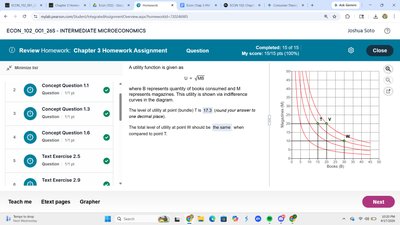
Q7. A utility function is given as . What is the level of utility at bundle (3, 12)? Should your answer be rounded to one decimal place?
Background
Topic: Utility Functions and Bundle Evaluation
This question tests your ability to evaluate a utility function at a specific bundle and interpret the result.
Key Formula:
Where and are quantities of two goods.
Step-by-Step Guidance
Identify the values of and for the bundle (3, 12).
Substitute these values into the utility function.
Calculate the result and round to one decimal place if required.
Interpret what the utility value means for the consumer.
Try solving on your own before revealing the answer!
Q8. Boyd has the following utility function: . His total budget is . If the price of x is $20, which mix would Boyd prefer?
Background
Topic: Utility Maximization and Budget Constraint
This question tests your ability to maximize utility given a budget constraint and prices for two goods.
Key Formula:
Budget constraint:
Step-by-Step Guidance
Write the budget constraint equation using the given prices and budget.
Set up the utility maximization problem using the utility function and constraint.
Use the method of Lagrange multipliers or substitution to solve for the optimal mix.
Stop before plugging in the final values for and .
Try solving on your own before revealing the answer!
Q9. What is the effect of a 50% increase in Dario's budget on his opportunity set?
Background
Topic: Budget Constraint and Opportunity Set
This question tests your understanding of how changes in income affect the budget constraint and opportunity set.
Key Terms:
Budget constraint: The set of all affordable combinations of goods given prices and income.
Opportunity set: All possible combinations of goods a consumer can afford.
Step-by-Step Guidance
Consider how a 50% increase in income affects the budget constraint equation.
Analyze how the opportunity set expands as a result.
Think about whether the slope of the budget line changes.
Reflect on the implications for consumer choice.
Try solving on your own before revealing the answer!
Q10. A consumer has $20 in monthly income to be spent on two goods. The price of good 1 is $2, the price of good 2 is $1. The Marginal Rate of Transformation (MRT) is equal to 2. How many units of good 2 can be purchased if all income is used for that good?
Background
Topic: Marginal Rate of Transformation and Budget Constraint
This question tests your ability to use the budget constraint to determine the maximum quantity of a good that can be purchased.
Key Formula:
Budget constraint:
MRT: The rate at which one good can be transformed into another.
Step-by-Step Guidance
Set to maximize .
Substitute into the budget constraint to solve for .
Calculate the result and round to two decimal places if required.
Interpret what this means for the consumer's choices.
Try solving on your own before revealing the answer!
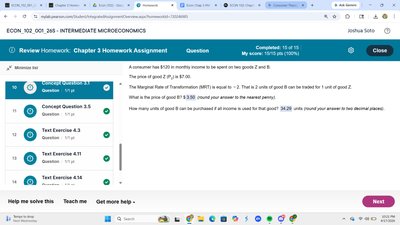
Q11. Given the following data: Consumer income = $40, Price of good 1 = $5, Price of good 2 = $4. Which of the following bundles are attainable with these prices and income?
Background
Topic: Budget Constraint and Feasible Bundles
This question tests your ability to determine which bundles are affordable given prices and income.
Key Formula:
Budget constraint:
Step-by-Step Guidance
List the bundles provided in the question.
For each bundle, calculate the total cost using the prices.
Compare the total cost to the consumer's income.
Identify which bundles are attainable.
Try solving on your own before revealing the answer!
Q12. Andy purchases only two goods, apples and kumquats. He has an income of $100 and can buy apples at $4 per pound and kumquats at $2 per pound. What is Andy's marginal utility for apples and kumquats?
Background
Topic: Marginal Utility and Budget Constraint
This question tests your ability to calculate marginal utility for each good given a utility function and budget constraint.
Key Formula:
Marginal utility:
Budget constraint:
Step-by-Step Guidance
Write the utility function for Andy (if provided).
Calculate the partial derivatives for apples and kumquats.
Interpret the marginal utility values.
Relate the marginal utility to Andy's consumption choices.
Try solving on your own before revealing the answer!
Q13. Diego has a utility function. If the price of chocolate candy is $5.50, the price of chocolate cookies is $8.50, and income is $19.50, what is Diego's optimal bundle?
Background
Topic: Utility Maximization and Budget Constraint
This question tests your ability to find the optimal bundle given prices, income, and a utility function.
Key Formula:
Budget constraint:
Utility function: (as given in the question)
Step-by-Step Guidance
Write the budget constraint equation.
Set up the utility maximization problem.
Use the method of Lagrange multipliers or substitution to solve for the optimal bundle.
Stop before plugging in the final values for and .
Try solving on your own before revealing the answer!
Q14. Given , describe the location of various optimal bundles if the price of x is $4, and income is $20$.
Background
Topic: Linear Utility Functions and Budget Constraint
This question tests your ability to analyze optimal bundles with a linear utility function and budget constraint.
Key Formula:
Utility function:
Budget constraint:
Step-by-Step Guidance
Write the budget constraint equation.
Analyze the utility function to determine the consumer's preferences.
Find the combinations of and that maximize utility given the constraint.
Stop before calculating the exact values for and .
Try solving on your own before revealing the answer!
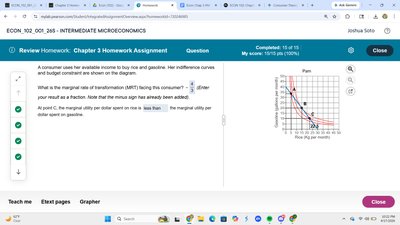
Q15. What is the marginal rate of transformation (MRT) facing this consumer? At point C, is the marginal utility per dollar spent on rice less than the marginal utility per dollar spent on gasoline?
Background
Topic: Marginal Rate of Transformation and Marginal Utility per Dollar
This question tests your ability to calculate the MRT and compare marginal utility per dollar for two goods.
Key Formula:
MRT:
Marginal utility per dollar: and
Step-by-Step Guidance
Identify the coordinates of point C on the diagram.
Calculate the MRT using the slope of the budget line or indifference curve at point C.
Calculate the marginal utility per dollar for rice and gasoline.
Compare the two values to determine which is greater.
Try solving on your own before revealing the answer!
