 Back
BackInternational Trade, Comparative Advantage, and Trade Policy
Study Guide - Smart Notes
 Tailored notes based on your materials, expanded with key definitions, examples, and context.
Comparative Advantage and Specialization
Understanding Comparative Advantage
Comparative advantage is the ability of a country to produce a good at a lower opportunity cost than another country. According to the principle of comparative advantage, countries should specialize in producing goods for which they have the lowest opportunity cost and trade for other goods. This specialization and subsequent trade can increase overall economic welfare.
Comparative Advantage: Producing a good at a lower opportunity cost than others.
Specialization: Focusing resources on the production of goods where a country has comparative advantage.
Trade: Allows countries to consume beyond their production possibilities frontiers.
Example: If the U.S. has a comparative advantage in producing airplanes and Brazil in coffee, both benefit by specializing and trading.
Additional info: In reality, countries may produce goods for which they do not have a comparative advantage due to political, strategic, or social reasons.
Market Outcomes Under Autarky
Consumer and Producer Surplus Without Trade
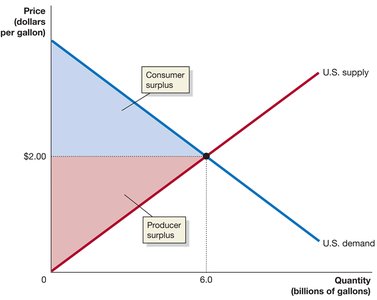
Autarky refers to a situation where a country does not engage in international trade. In this scenario, all domestic consumption is met by domestic production, and the market equilibrium is determined solely by domestic supply and demand.
Consumer Surplus: The area above the equilibrium price and below the demand curve.
Producer Surplus: The area below the equilibrium price and above the supply curve.
Market Equilibrium: Occurs where domestic supply equals domestic demand.
Free Trade and Economic Surplus
Effects of Opening to Trade
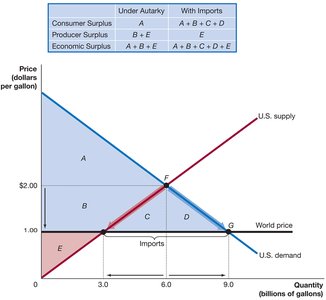
When a country opens its markets to international trade, the domestic price adjusts to the world price. If the world price is lower than the domestic price, the country will import the good, benefiting consumers but harming domestic producers. The overall economic surplus increases as the gains to consumers outweigh the losses to producers.
World Price: The price at which goods are traded internationally.
Imports: The difference between domestic consumption and domestic production at the world price.
Economic Surplus: The sum of consumer and producer surplus, which increases with free trade.
Example: If the world price of ethanol is $1.00 per gallon (lower than the U.S. autarky price), U.S. consumers import ethanol, increasing consumer surplus and total economic welfare.
Trade Restrictions: Tariffs and Quotas
Tariffs
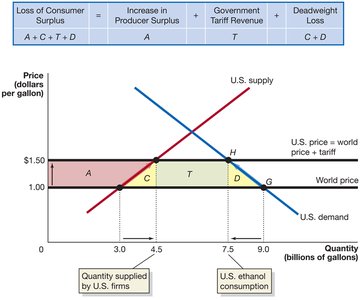
Tariffs are taxes imposed on imported goods. They raise the domestic price of the imported good, benefiting domestic producers and generating government revenue, but reducing consumer surplus and creating deadweight loss.
Tariff: A tax on imports, raising the domestic price above the world price.
Effects: Increases producer surplus and government revenue, but decreases consumer surplus and creates deadweight loss.
Deadweight Loss: The loss of economic efficiency when the equilibrium outcome is not achieved.
Formula for Deadweight Loss: (areas on the supply-demand diagram).
Quotas and Voluntary Export Restraints (VERs)
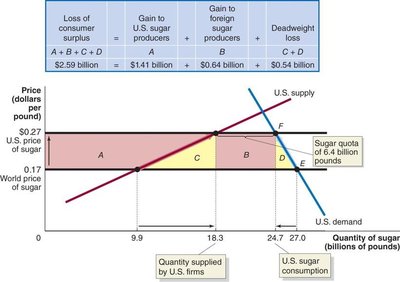
Quotas are numerical limits on the quantity of a good that can be imported. VERs are similar but are negotiated between countries. Both policies restrict imports, raise domestic prices, and benefit domestic producers at the expense of consumers, while also creating deadweight loss.
Quota: A limit on the quantity of a good that can be imported.
VER: A negotiated limit on exports from one country to another.
Effects: Higher domestic prices, increased producer surplus, gains to foreign producers (if they can sell at the higher price), and deadweight loss.
Example: The U.S. sugar quota keeps the domestic price above the world price, benefiting U.S. sugar producers and some foreign producers, but harming consumers.
Economic Costs of Trade Restrictions
High Cost of Preserving Jobs
Trade restrictions are often justified as a means to protect domestic jobs. However, the cost per job saved is typically very high, and these policies can have unintended negative effects on other industries and overall economic welfare.
Cost per Job Saved: Calculated by dividing the total cost to consumers by the number of jobs saved.
Example: U.S. sugar quotas cost consumers $2.59 billion to save 3,000 jobs, or $863,333 per job.
Unintended Effects: Higher prices for protected goods reduce consumer spending on other goods, potentially causing job losses elsewhere.
Additional info: Similar high costs are observed in other industries, such as shoes and tires, where tariffs cost hundreds of thousands of dollars per job saved.
Arguments For and Against Trade Restrictions
Arguments in Favor of Trade Barriers
Protecting Domestic Jobs: Prevents job losses in industries facing foreign competition.
Infant Industry Argument: New industries may need temporary protection to become competitive.
National Security: Ensures domestic production of critical goods in times of crisis.
Health and Safety Standards: Restricts imports that do not meet domestic standards.
Arguments Against Trade Barriers
Higher Consumer Prices: Trade barriers raise prices for consumers.
Deadweight Loss: Reduces overall economic welfare.
Special Interest Influence: Benefits are concentrated among a few producers, while costs are spread across many consumers.
Global Efficiency: Free trade allows resources to be allocated more efficiently worldwide.
Trade Agreements and Globalization
Major Trade Agreements
International agreements have played a significant role in reducing trade barriers and promoting globalization.
GATT (General Agreement on Tariffs and Trade): Established in 1948 to promote multilateral tariff reductions.
WTO (World Trade Organization): Replaced GATT in 1995, overseeing international trade agreements and dispute resolution.
Globalization: The process of increasing openness to international trade and investment.
Controversies and Opposition to Trade
Sources of Opposition
Anti-globalization Forces: Concerned about labor standards, environmental issues, and cultural impacts.
Protectionists: Argue for saving jobs, protecting wages, and supporting infant industries.
Dumping: Selling goods below cost to drive out competitors; difficult to prove and regulate.
Positive vs. Normative Analysis in Trade Policy
Understanding the Debate
Trade policy debates often involve both positive analysis (what is) and normative analysis (what ought to be). While most economists support free trade based on positive analysis, normative concerns about distributional effects and values can lead to support for protectionist policies.
Positive Analysis: Objective, fact-based evaluation of trade outcomes.
Normative Analysis: Subjective judgments about what policies should be pursued based on values and ethics.
Special Interest Groups and Trade Policy
The Role of Lobbying
Special interest groups, such as domestic producers in protected industries, often lobby for trade barriers. These groups are motivated by concentrated benefits, while the costs are dispersed among the general population, making it difficult to remove inefficient policies.
Lobbying: Efforts by interest groups to influence government policy in their favor.
Policy Persistence: Trade barriers often remain due to political influence, even when they reduce overall welfare.
