 Back
Introduction to Microeconomics: Foundations, Questions, and Careers
Study Guide - Smart Notes
 Tailored notes based on your materials, expanded with key definitions, examples, and context.
Introduction to Microeconomics
What is Economics?
Economics is a social science concerned with how individuals, businesses, governments, and societies make choices to cope with scarcity and the incentives that influence these choices. Scarcity refers to the limited nature of resources, which forces people to make decisions about how to allocate them.
Scarcity: The fundamental economic problem of having limited resources to meet unlimited wants.
Incentives: Rewards or penalties that influence the choices people make.
Microeconomics vs. Macroeconomics
Economics is divided into two main branches:
Microeconomics: The study of choices made by individuals and businesses, how these choices interact in markets, and the influence of government policies.
Macroeconomics: The study of the performance of national and global economies.
Example: Microeconomic question: Why are people buying more e-books and fewer hard copy books? Macroeconomic question: Why does the unemployment rate fluctuate?
The Two Big Economic Questions
What, How, and For Whom?
Economics seeks to answer two fundamental questions:
How do choices determine what, how, and for whom goods and services are produced?
When do choices made in self-interest also promote the social interest?
Goods and Services: Objects people value and produce to satisfy human wants.
Factors of Production: Resources used to produce goods and services, grouped into land, labour, capital, and entrepreneurship.
Patterns of Production
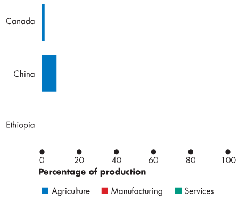
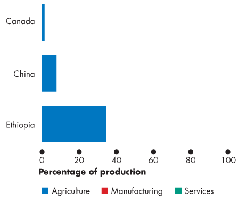
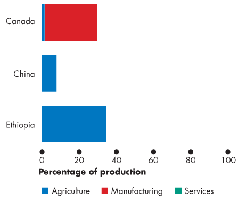
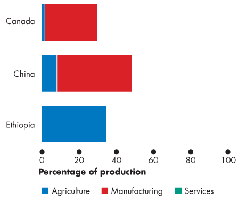
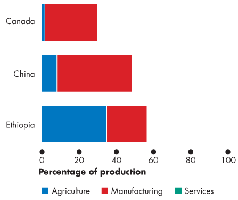
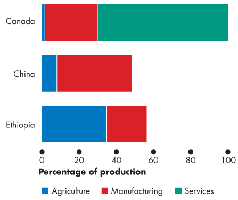
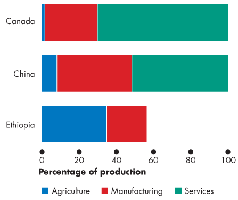
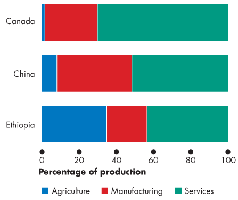
Different countries allocate resources differently, resulting in varying patterns of production.
Canada: Agriculture (2%), Manufacturing (28%), Services (70%)
Ethiopia: Agriculture (35%), Manufacturing (21%), Services (44%)
Factors of Production
Land: Natural resources used in production.
Labour: Human effort, including work time and skill.
Capital: Tools, machines, and buildings used to produce goods and services.
Entrepreneurship: The human resource that organizes land, labour, and capital.
Growth of Human Capital
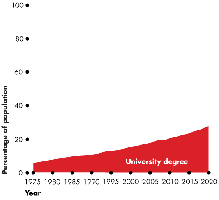
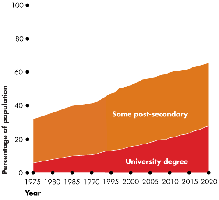
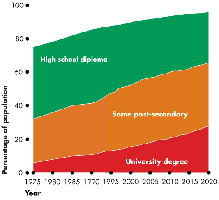
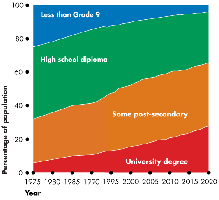
Human capital, measured by education levels, has grown significantly in Canada over the last century.
For Whom?
Distribution of goods and services depends on the incomes earned by the factors of production:
Land earns rent
Labour earns wages
Capital earns interest
Entrepreneurship earns profit
Self-Interest vs. Social Interest
Choices made in self-interest may or may not promote the social interest. Social interest is defined by efficiency and equity:
Efficiency: Resource use is efficient if it is not possible to make someone better off without making someone else worse off.
Equity: Fairness in the distribution of resources.
Examples of Tension Between Self-Interest and Social Interest
Globalization
Information-age monopolies
Climate change
Gender pay gap
The Economic Way of Thinking
Key Ideas
A choice is a tradeoff.
People make rational choices by comparing benefits and costs.
Benefit is what you gain from something.
Cost is what you must give up to get something.
Most choices are "how-much" choices made at the margin.
Choices respond to incentives.
Tradeoff
Every choice involves giving up one thing to get another. This is called a tradeoff.
Rational Choice
A rational choice compares costs and benefits to achieve the greatest benefit over cost for the decision-maker.
Benefit and Preferences
The benefit of an action is determined by preferences, which are what a person likes and dislikes.
Opportunity Cost
The opportunity cost of something is the highest-valued alternative that must be given up to get it.
Opportunity cost has two components: what you can't buy and what you can't do with your time.
Choosing at the Margin
Marginal analysis involves evaluating the consequences of incremental changes in the use of resources.
Marginal Benefit: The benefit from an incremental increase in an activity.
Marginal Cost: The opportunity cost of an incremental increase in an activity.
If marginal benefit exceeds marginal cost, the rational choice is to do more of the activity.
Incentives
Changes in marginal cost or benefit alter incentives and lead to changes in choices.
Economics as a Social Science and Policy Tool
Positive vs. Normative Statements
Positive statements: Describe what is and can be tested against facts.
Normative statements: Describe what ought to be and express opinions.
Economic Models
Economists use models to describe aspects of the economic world, focusing only on relevant features. Models are tested by comparing predictions with facts, using natural experiments, statistical investigations, and economic experiments.
Economist as Policy Adviser
Economics provides tools for advising governments and businesses, helping to evaluate alternative solutions by comparing marginal benefits and costs.
Careers in Economics
Jobs for Economics Majors
A degree in economics opens opportunities in academia, private firms, government, and international organizations. Economists collect and analyze data, predict trends, and study resource use efficiency.
Skills Needed
Critical-thinking skills
Analytical skills
Math skills
Writing skills
Oral communication skills
Earnings and Job Growth
Economists with a PhD can expect to earn about $100,000 a year by mid-career. Analyst positions typically earn above the national average. Job growth forecasts are positive for economists, financial analysts, and market research analysts.
Diversity, Equity, and Inclusion in Economics
Economics has less diversity than STEM fields. Efforts to improve representation focus on fairness and efficiency, aiming to enhance the quality of research and policy advice.
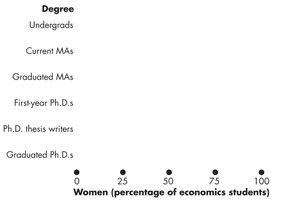
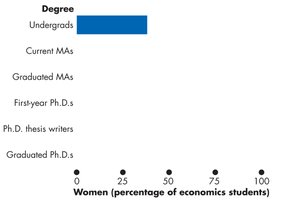
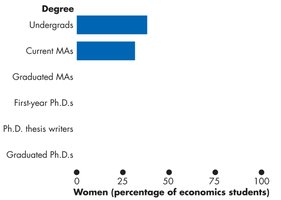
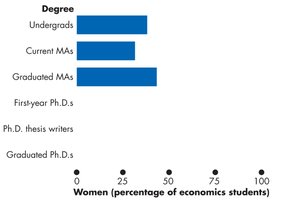
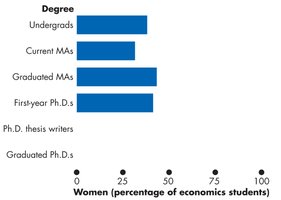
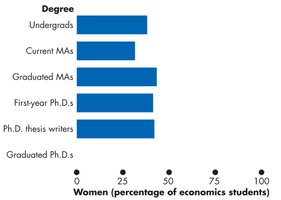
Additional info: Diversity and inclusion are essential for attracting the best talent and making the economics profession more prosperous.
