 Back
Introduction to Microeconomics: Scarcity, Production Possibilities, and Gains from Trade
Study Guide - Smart Notes
 Tailored notes based on your materials, expanded with key definitions, examples, and context.
What is Economics?
Definition and Core Concepts
Economics is a social science that studies the choices of individuals, businesses, governments, and societies in the face of scarcity. Scarcity means that resources are limited, so people must make choices about how to allocate them. These choices are influenced by incentives, which can be rewards or penalties that motivate behavior.
Scarcity: The fundamental economic problem of having limited resources to meet unlimited wants.
Incentives: Rewards or penalties that influence choices.
Example: If you have $10 and want both a popcorn and a T-shirt (each costing $10), you must choose one due to scarcity.
Two Big Economic Questions
Economists seek to answer two main questions:
What, how, and for whom are goods and services produced? This involves examining the allocation of resources (land, labor, capital, entrepreneurship) and the distribution of goods.
Do choices made for self-interest also promote social interest? Self-interest refers to actions taken for personal benefit, while social interest refers to outcomes that benefit society as a whole.
Example: Distributing coins between two people can be efficient if all coins are allocated, but inefficient if some are left undistributed.
The Economic Way of Thinking
Principles of Economic Reasoning
Economists use a systematic approach to analyze choices:
Trade-offs: Every choice involves giving up something to get something else.
Rational Choices: People compare benefits and costs to make decisions.
Marginal Analysis: Most decisions involve considering "how much" at the margin.
Response to Incentives: Choices change as incentives change.
Production Possibilities and Opportunity Cost
Production Possibilities Frontier (PPF)
The Production Possibilities Frontier (PPF) illustrates the maximum combinations of two goods that an economy can produce using its resources efficiently. Points on the PPF are attainable and efficient, while points inside are inefficient and points outside are unattainable.
Efficient Production: On the PPF, producing more of one good requires producing less of another.
Opportunity Cost: The value of the next best alternative forgone when making a choice.
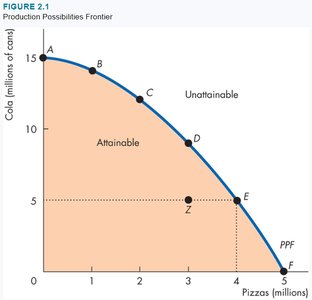
Possibility | Pizzas (millions) | Cola (millions of cans) |
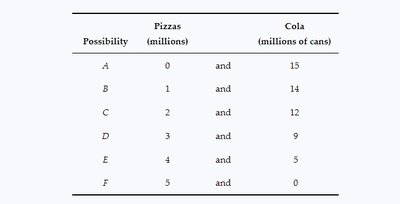
|---|---|---|
A | 0 | 15 |
B | 1 | 14 |
C | 2 | 12 |
D | 3 | 9 |
E | 4 | 5 |
F | 5 | 0 |
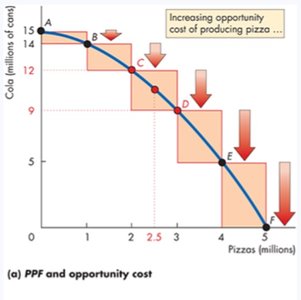
Opportunity Cost and Increasing Costs
Moving along the PPF, the opportunity cost of producing more pizzas increases. This is illustrated by the decreasing amount of cola that can be produced as more pizzas are made.
Formula:
Example: Moving from C to D: Gain 1 million pizzas, lose 3 million colas. Opportunity cost = 3 colas per pizza.
Using Resources Efficiently
Allocative Efficiency
Allocative efficiency occurs when resources are used to produce the combination of goods and services most desired by society. This is achieved when the marginal benefit equals the marginal cost.
Marginal Cost: The opportunity cost of producing one more unit of a good.
Marginal Benefit: The benefit received from consuming one more unit of a good.
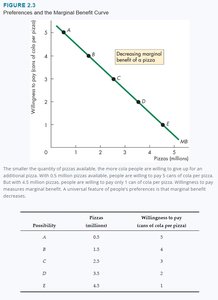
Possibility | Pizzas (millions) | Willingness to pay (cans of cola per pizza) |
|---|---|---|
A | 0.5 | 5 |
B | 1.5 | 4 |
C | 2.5 | 3 |
D | 3.5 | 2 |
E | 4.5 | 1 |
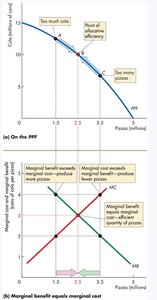
Allocative Efficiency: Achieved at the point where marginal benefit equals marginal cost, ensuring the optimal allocation of resources.
Gains from Trade
Comparative and Absolute Advantage
Trade allows individuals or entities to specialize in the production of goods for which they have a comparative advantage, leading to greater overall efficiency and gains from trade.
Comparative Advantage: The ability to produce a good at a lower opportunity cost than another producer.
Absolute Advantage: The ability to produce more of a good with the same resources than another producer.
Item | Minutes to produce 1 | Quantity per hour |
|---|---|---|
Smoothies (Joe) | 10 | 6 |
Salads (Joe) | 2 | 30 |
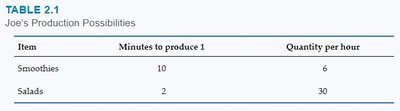
Item | Minutes to produce 1 | Quantity per hour |
|---|---|---|
Smoothies (Liz) | 2 | 30 |
Salads (Liz) | 2 | 30 |
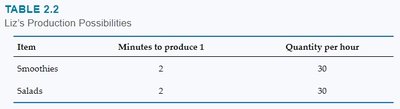
Specialization and Trade
When Joe and Liz specialize according to their comparative advantages and trade, both can achieve higher consumption levels than they could alone.
Smoothies (Liz) | Smoothies (Joe) | Salads (Liz) | Salads (Joe) | |
|---|---|---|---|---|
Initially | 15 | 5 | 15 | 5 |
After specialization | 30 | 0 | 0 | 30 |
Trade | sell 10 | buy 10 | buy 20 | sell 20 |
After trade | 20 | 10 | 10 | 20 |
Gains from trade | +5 | +5 | +5 | +5 |
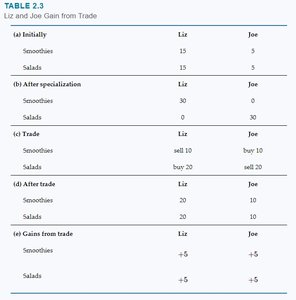
Economic Growth
Expansion of Production Possibilities
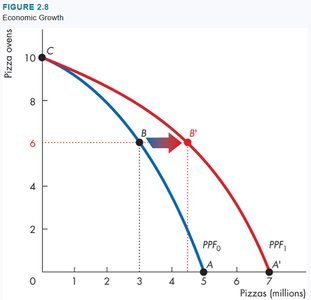
Economic growth is the expansion of an economy's production possibilities, often illustrated by an outward shift of the PPF. Growth can be caused by increased resources, improved technology, or better education.
Economic Growth: Allows for more production of goods and services, increasing the standard of living.
PPF Shift: Outward movement of the PPF represents growth.
Economic Coordination
Central vs Decentralized Coordination
Economic coordination can be achieved through central planning or decentralized markets. Decentralized coordination relies on four key social institutions: firms, markets, property rights, and money.
Firms: Organize production of goods and services.
Markets: Facilitate exchange between buyers and sellers.
Property Rights: Ensure ownership and control over resources.
Money: Serves as a medium of exchange.
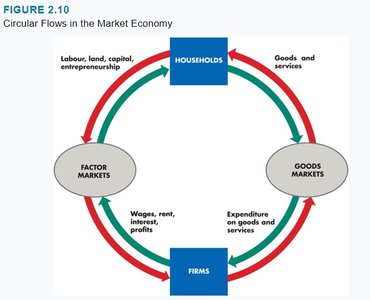
Example: The circular flow diagram shows how households and firms interact in factor and goods markets, exchanging resources, goods, and money.
