 Back
BackLabor Markets and Wage Determination: Microeconomics Study Notes
Study Guide - Smart Notes
 Tailored notes based on your materials, expanded with key definitions, examples, and context.
Labor Markets: Overview
Introduction to Labor Markets
Labor is a fundamental factor of production, alongside capital, natural resources, and other inputs. Labor markets are crucial for understanding how wages are determined and why different workers receive different pay. In these markets, firms act as buyers of labor, while workers are the sellers. The interaction between labor supply and demand determines equilibrium wages and employment levels.
The Demand for Labor
Marginal Revenue Product of Labor (MRP)
The marginal product of labor (MP) is the additional output produced by hiring one more worker. However, firms are interested in the additional revenue generated, known as the marginal revenue product of labor (MRP). For a competitive firm, MRP is calculated as:
P: Price of the output
MP: Marginal product of labor
Firms maximize profit by hiring workers up to the point where the wage (W) equals the MRP:
If MRP > W, the firm should hire more workers. If MRP < W, the firm should hire fewer workers.
Labor Demand Curve
The firm's demand for labor is represented by its MRP curve. The market demand for labor is the horizontal sum of all firms' labor demand curves at each wage rate.
Factors That Shift Labor Demand
Increases in human capital: More skilled workers increase productivity and MRP.
Technological changes: New technology can increase worker productivity, shifting demand right.
Changes in product price: Higher output prices increase MRP and labor demand.
Quantity of other inputs: More capital or resources can make labor more productive.
Number of firms: More firms increase total labor demand.
The Supply of Labor
Labor Supply Decisions
Individuals allocate their limited time between labor (work) and leisure. The labor supply curve shows the relationship between the wage rate and the quantity of labor supplied. As wages rise, leisure becomes more expensive relative to consumption, so individuals tend to work more (substitution effect).
Backward-Bending Labor Supply Curve
At very high wage rates, the income effect may dominate the substitution effect, causing individuals to work less as wages rise further. However, for most labor markets, the supply curve is upward sloping.
Market Supply Curve of Labor
The market supply curve sums the labor supplied by all individuals at each wage rate. It is generally upward sloping, as higher wages attract more workers to the market.
Factors That Shift Labor Supply
Population changes: Immigration, birth rates, and death rates affect the number of available workers.
Demographics: Age, gender, and other population characteristics influence labor supply.
Alternatives: Availability and attractiveness of alternative jobs or benefits can shift labor supply.
Equilibrium in the Labor Market
Determination of Equilibrium Wage and Employment
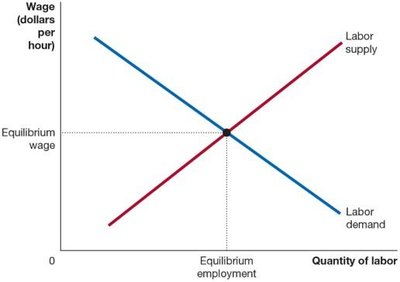
Equilibrium in the labor market occurs where the labor demand and supply curves intersect. At this point, the equilibrium wage and employment level are established.
Shifts in Labor Demand and Supply
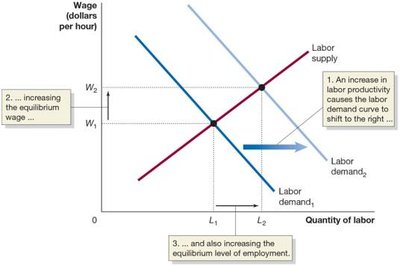
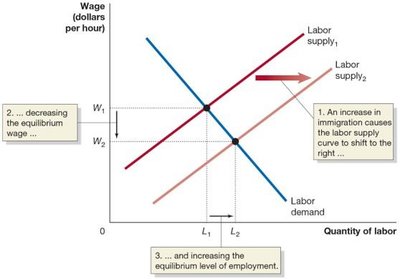
Changes in labor demand or supply shift the respective curves, altering equilibrium wage and employment:
Increase in labor demand: Raises both equilibrium wage and employment.
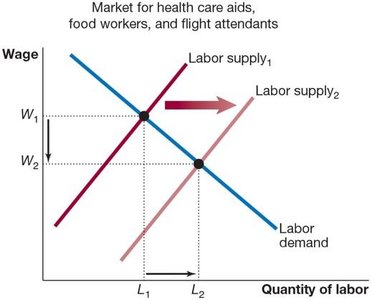
Increase in labor supply: Lowers equilibrium wage but increases employment.
Technology, Immigration, and Labor Markets
Technology as a Complement or Substitute
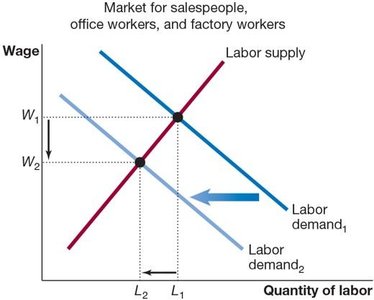
Technological change can either complement labor (increasing productivity and wages) or substitute for labor (reducing demand and wages). The effect depends on the nature of the job and the technology involved.
Sectoral Effects of Labor Market Shocks
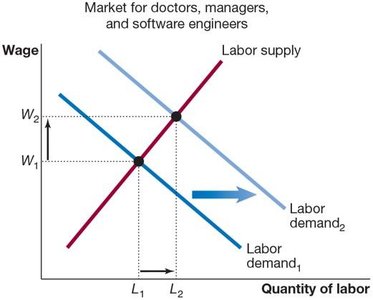
Different labor markets (e.g., for doctors vs. factory workers) respond differently to changes in demand and supply. For example, increased demand for skilled workers raises their wages, while increased supply of low-skill workers (e.g., through immigration) can lower wages in those markets.
Explaining Wage Differentials
Supply and Demand in Wage Determination
Wage differences across occupations can often be explained by differences in supply and demand. For example, Major League Baseball players earn much more than college instructors due to the limited supply of elite athletes and the high marginal revenue product they generate.

Superstar Effect
Advances in technology and media have increased the marginal revenue product of superstars in sports and entertainment, leading to much higher earnings for top performers compared to others in their field.
Compensating Differentials
Jobs that are unpleasant or dangerous typically pay higher wages to compensate workers for the risks or discomfort. This is known as a compensating differential.
Discrimination in Labor Markets
Wage Differentials by Group
Wage differences exist across gender and racial groups. For example, median weekly earnings data show that white men earn more than women and minority men, on average. Some of these differences can be explained by education, experience, and job preferences, but a portion may be due to economic discrimination.
Measuring Discrimination
To assess discrimination, economists control for factors like education, experience, and occupation. Advanced statistical analysis reveals that discrimination has a small but non-zero effect on wages.

Market Effects of Discrimination
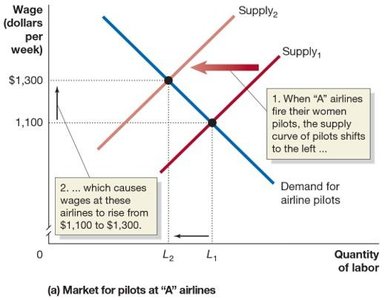
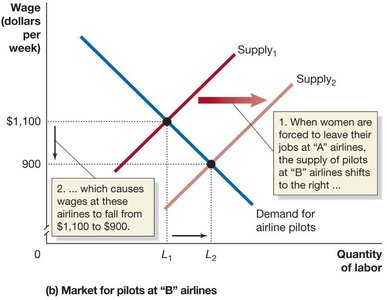
When firms discriminate (e.g., refuse to hire women), the supply of labor decreases for those firms, raising wages for remaining workers but increasing costs. Non-discriminating firms benefit from a larger labor pool and lower wages, gaining a competitive advantage.
Persistence of Discrimination
Market forces may reduce employer discrimination over time, but discrimination can persist due to worker or customer preferences and negative feedback loops (e.g., underrepresentation discouraging entry into certain professions).
Labor Unions and Monopsony
Labor Unions
Labor unions are organizations that bargain collectively with employers over wages and working conditions. Unionized workers typically earn higher wages than non-unionized workers, with studies showing a union wage premium of about 10%.
Monopsony in Labor Markets
A monopsony is a market with a single buyer of labor. Monopsonists can use their market power to pay lower wages and employ fewer workers. Labor unions can help offset monopsony power by negotiating higher wages.
Marginal Productivity Theory of Income Distribution
Income Distribution
According to marginal productivity theory, each factor of production earns income equal to its marginal revenue product. Thus, individuals receive income based on the value of the productive resources they own, including their own labor.
