 Back
Long-Run Costs and Output Decisions in Perfect Competition
Study Guide - Smart Notes
 Tailored notes based on your materials, expanded with key definitions, examples, and context.
Chapter 9: Long-Run Costs and Output Decisions
Overview
This chapter explores how firms make output decisions in the long run, focusing on cost structures, profit maximization, and industry dynamics under perfect competition. It covers the transition from short-run to long-run decisions, economies and diseconomies of scale, and the adjustment mechanisms that drive industry equilibrium.
Short-Run Conditions and Long-Run Directions
Short-Run Firm Behavior
Firms in the short run face three main circumstances:
Economic Profits: Firms earn profits when total revenue exceeds total cost.
Economic Losses (but continue operating): Firms may operate at a loss if total revenue exceeds total variable cost, using excess revenue to offset fixed costs.
Shutdown Decision: Firms shut down if total revenue is less than total variable cost, bearing losses equal to fixed costs.
Breaking even occurs when a firm earns exactly a normal rate of return, covering all costs including opportunity costs.
Profit Maximization in Perfect Competition
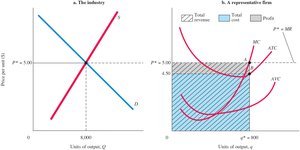
A perfectly competitive firm maximizes profit by producing up to the point where marginal cost equals marginal revenue (price). Profit is the difference between total revenue and total cost.
Profit Formula:
Average Total Cost (ATC):
Minimizing Losses and the Shutdown Point
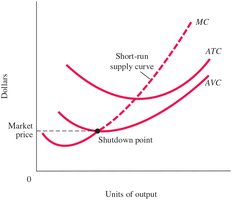
If total revenue exceeds total variable cost, the firm should continue operating to minimize losses. If total revenue is less than total variable cost, the firm should shut down.
Shutdown Point: The lowest point on the average variable cost (AVC) curve. Below this, the firm cannot cover variable costs and should shut down.
Short-Run Industry Supply Curve
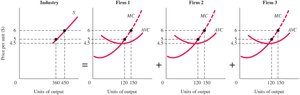
The industry supply curve in the short run is the horizontal sum of the marginal cost curves (above AVC) of all firms in the industry.
Short-Run Industry Supply Curve: (for MC above AVC)
Long-Run Costs: Economies and Diseconomies of Scale
Long-Run Average Cost Curve (LRAC)
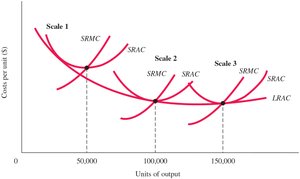
The LRAC shows how per-unit costs change with output in the long run, when all inputs are variable and firms can adjust their scale of operation.
Economies of Scale (Increasing Returns): Costs per unit decrease as output increases.
Constant Returns to Scale: Costs per unit remain unchanged as output increases.
Diseconomies of Scale (Decreasing Returns): Costs per unit increase as output increases.
Sources of Economies of Scale
Economies of scale can arise from technological advantages, firm-level efficiencies, and bargaining power. Larger firms can spread fixed costs over more units and negotiate better deals.
Minimum Efficient Scale (MES): The smallest output level at which LRAC is minimized.
Example: Walmart's Economies of Scale
Walmart leverages its size to buy in bulk, spread fixed costs, and lower average costs per unit, enabling its low-price strategy.

Diseconomies of Scale: Hospital Example
As hospitals grow, they initially reduce average costs by spreading fixed costs. However, beyond a certain size, management becomes inefficient and costs rise.

U-Shaped Long-Run Average Cost Curve
The LRAC is often U-shaped, reflecting economies of scale at low output, constant returns at intermediate output, and diseconomies at high output. The optimal scale of plant minimizes LRAC.
Optimal Scale of Plant: The output level where LRAC is at its minimum.
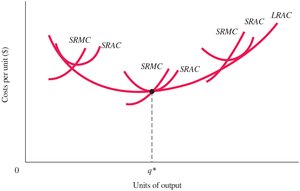
Shape of the Long-Run Average Cost Curve
Historically, the LRAC was drawn as the envelope of short-run average cost curves. Empirical studies suggest LRAC may slope down and then flatten, rather than being strictly U-shaped.

Long-Run Adjustments to Short-Run Conditions
Industry Equilibrium and Adjustment Mechanism
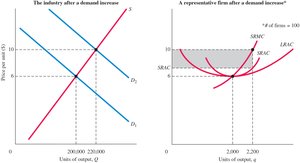
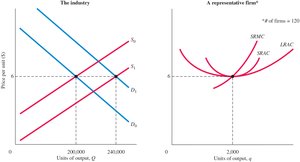
When demand increases in a long-run equilibrium, firms earn profits, attracting new entrants and expanding output. Over time, supply increases, prices fall, and profits return to zero.
Long-Run Competitive Equilibrium: Occurs when firms earn zero economic profit and supply equals demand.
Capital Market Dynamics
Investment flows toward industries with profit opportunities, leading to entry and expansion. Industries with losses contract as capital exits.
Example: Hot Dog Prices in Central Park
Higher license costs in Central Park increase the price of hot dogs, illustrating how fixed costs affect pricing in competitive markets.

Appendix: External Economies and Diseconomies and the Long-Run Industry Supply Curve
External Economies and Diseconomies
Industry growth can affect average costs through external economies (costs decrease) or external diseconomies (costs increase).
Decreasing-Cost Industry: LRAC decreases as industry expands; long-run supply curve slopes downward.
Increasing-Cost Industry: LRAC increases as industry expands; long-run supply curve slopes upward.
Constant-Cost Industry: LRAC remains unchanged; long-run supply curve is flat.
Key Terms and Concepts
Breaking even
Constant returns to scale
Diseconomies of scale
Economies of scale
Long-run average cost curve (LRAC)
Long-run competitive equilibrium
Minimum efficient scale (MES)
Optimal scale of plant
Short-run industry supply curve
Shutdown point
Long-run industry supply curve (LRIS)
External economies and diseconomies
Summary Table: Types of Industry Cost Structures
Industry Type | Cost Behavior | Long-Run Supply Curve |
|---|---|---|
Decreasing-Cost Industry | Average costs decrease as industry expands | Downward sloping |
Increasing-Cost Industry | Average costs increase as industry expands | Upward sloping |
Constant-Cost Industry | Average costs remain unchanged | Flat (horizontal) |
Additional info: Academic context was added to clarify the role of cost curves, industry adjustment mechanisms, and the significance of external economies and diseconomies in shaping long-run supply curves.
