 Back
BackMarket Failures and Government Intervention – Study Notes
Study Guide - Smart Notes
 Tailored notes based on your materials, expanded with key definitions, examples, and context.
Chapter 16: Market Failures and Government Intervention
16.1 Basic Functions of Government
The government plays a foundational role in the functioning of a market economy. Its core responsibilities include maintaining order, protecting property rights, and providing essential services that markets alone cannot efficiently supply.
Monopoly of Violence: The government is the only institution permitted to use force legitimately (e.g., army, police, jails). This monopoly is essential for maintaining social order and enforcing laws.
Protection from External and Internal Threats: According to Adam Smith, the government must protect society from external threats and internal injustices.
Defining and Enforcing Property Rights: Secure property rights are necessary for economic activity, including the rights of individuals and organizations.
Balancing Markets and Intervention: The real-world choice is not between pure free markets and total government control, but the optimal mix of both.
16.2 The Case for Free Markets
Free markets are often defended on both formal and informal grounds, emphasizing efficiency, innovation, and the decentralization of power.
Allocative Efficiency: In perfectly competitive markets, prices equal marginal costs, leading to efficient allocation of resources.
Automatic Coordination: Decentralized markets adjust quickly to changes through price signals, coordinating the actions of many individuals without central direction.
Innovation and Growth: The pursuit of profit encourages innovation and economic growth, as successful innovations are rewarded and resources are reallocated accordingly.
Decentralization of Power: Free markets distribute economic power broadly, reducing the need for coercion compared to centralized systems.
16.3 Market Failures
Market failures occur when free markets do not lead to efficient or desirable outcomes. Four main types are identified: market power, externalities, common-property resources and public goods, and asymmetric information.
Market Power
Definition: Market power arises when firms can influence prices, often due to economies of scale, product differentiation, or innovation.
Result: Market power can lead to inefficient allocation of resources and justify government intervention.
Externalities
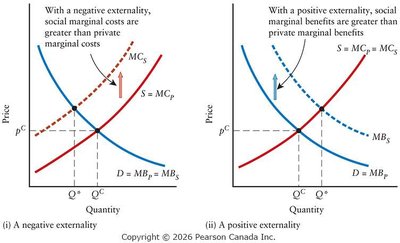
Definition: Externalities are costs or benefits of an economic activity experienced by third parties, not reflected in market prices.
Negative Externality: Social marginal cost (MCs) exceeds private marginal cost (MCp), leading to overproduction.
Positive Externality: Social marginal benefit (MBs) exceeds private marginal benefit (MBp), leading to underproduction.
Allocative Inefficiency: Externalities cause market outcomes to diverge from the social optimum.
Types of Goods
Excludable: Providers can prevent non-payers from consuming the good.
Non-excludable: Providers cannot prevent non-payers from consuming the good.
Rivalrous: One person's consumption reduces availability for others.
Non-rivalrous: One person's consumption does not affect others' ability to consume.
Goods are classified as follows:
Excludable | Non-Excludable | |
|---|---|---|
Rivalrous | Private Goods Examples: Food, a seat on an airplane, a house | Common-Property Resources Examples: Fisheries, rivers, wildlife, clean air |
Non-Rivalrous | Club Goods Examples: Art galleries, roads (up to capacity), cable TV | Public Goods Examples: National defence, public information, radio signal |
Free-Rider Problem: Public goods are non-excludable and non-rivalrous, making it difficult to charge users and leading to underprovision by markets. Government provision is often necessary.
Common-Property Resources
Definition: Resources that are non-excludable but rivalrous (e.g., fisheries, clean air).
Problem: Overexploitation due to lack of ownership incentives ("tragedy of the commons").
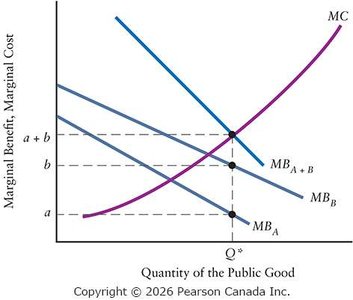
Optimal Provision of Public Goods
The allocatively efficient quantity of a public good is where the sum of individual marginal benefits equals marginal cost.
Asymmetric Information
Definition: When one party in a transaction has more or better information than the other, leading to market failure.
Moral Hazard: Occurs after a transaction; one party takes more risks because they do not bear the full consequences.
Adverse Selection: Occurs before a transaction; one party has information that the other does not, leading to the selection of undesirable outcomes (e.g., "lemons" in used car markets).
Summary of Market Failures
Firms with market power
Externalities
Common-property resources and public goods
Asymmetric information
16.4 Broader Social Goals
Governments may intervene in markets to achieve social goals beyond correcting market failures, such as income redistribution and social justice.
Income Distribution: Tax-and-transfer systems and social programs redistribute income, often at the cost of reduced efficiency.
Okun's "Leaky Bucket": Redistribution is compared to carrying water in a leaky bucket—some value is lost in the process, but the goal may still be worthwhile.
Paternalism: Government may intervene to protect individuals from their own decisions (e.g., mandatory seat belts).
Social Responsibility: Some rights and duties (e.g., voting, national service) are not for sale, reflecting societal values.
Tradeoff: Achieving social goals often involves a tradeoff with allocative efficiency.
16.5 Government Intervention
Government intervention can address market failures and pursue social goals, but it also involves costs and risks of failure.
Cost-Benefit Analysis
Definition: A systematic approach to evaluating policies by comparing total (opportunity) costs and total benefits.
Tools of Government Intervention
Public Provision: Government supplies goods and services (e.g., national defence, public schools).
Redistribution Programs: Taxes and transfers to redistribute income.
Regulation: Laws and standards to protect public welfare (e.g., safety standards, prohibitions).
Costs of Government Intervention
Direct Costs: Use of real resources (e.g., administrative expenses).
Indirect Costs: Additional burdens such as changes in production costs, compliance costs, and rent seeking.
Government Failure
Definition: When government intervention leads to inefficient or undesirable outcomes.
Public Choice Theory: Analyzes the incentives of elected officials (maximize votes), civil servants (maximize salaries/influence), and voters (maximize utility).
Governments as Monopolists: Governments may be inefficient due to lack of competition and slow adaptation to change.
Evaluation: The effectiveness of intervention should be judged by comparing real-world market outcomes with actual government performance, not idealized versions of either.
