 Back
Market Failures and the Public Sector: Microeconomics Study Notes
Study Guide - Smart Notes
 Tailored notes based on your materials, expanded with key definitions, examples, and context.
Chapter 5: Market Failures and the Public Sector
5.1 Market Failures and Externalities
Market failures occur when the price system does not allocate resources efficiently, often due to externalities. Externalities are costs or benefits from an economic activity that affect third parties not directly involved in the transaction.
External Costs: When negative externalities (e.g., pollution) are present, the market overproduces the good, as producers do not bear the full societal cost.
External Benefits: When positive externalities (e.g., vaccination) are present, the market underproduces the good, as individuals do not account for the full societal benefit.
Government Intervention: Governments can correct externalities through taxes, subsidies, regulation, or direct production.
Example: Pollution from a steel mill imposes health and cleaning costs on nearby residents, leading to overproduction unless regulated.
Example: Vaccinations provide herd immunity, a benefit not fully captured by private demand, leading to underproduction unless subsidized or mandated.
Key Formulas:
Social Cost:
Social Benefit:
Government Correction Methods:
Pollution Tax: Charges polluters for emissions, aligning private and social costs.
Regulation: Sets maximum allowable pollution levels.
Subsidies: Encourages production of goods with positive externalities.
5.2 The Other Economic Functions of Government
Beyond correcting externalities, governments perform several economic functions to support market operations and societal welfare.
Providing a Legal System: Establishes rules, enforces contracts, and protects property rights, incentivizing efficient resource use.
Promoting Competition: Prevents monopolies and anticompetitive practices through antitrust laws (e.g., Canada's Competition Act).
Providing Public Goods: Public goods are non-excludible and non-rivalrous, making them difficult for the private sector to supply efficiently.
Ensuring Economy-Wide Stability: Uses fiscal and monetary policy to smooth economic cycles, address unemployment, and control inflation.
Classification of Goods:
Excludible: Owners can prevent non-payers from using the good.
Non-excludible: Cannot economically exclude non-payers.
Rivalrous: One person's consumption reduces availability for others.
Non-rivalrous: Consumption does not reduce availability for others.
Public Goods: Both non-excludible and non-rivalrous. Examples include national defense and public parks.
The Free-Rider Problem: Occurs when individuals benefit from a public good without paying, leading to underprovision by the private sector.
5.3 The Political Functions of Government
Governments also intervene in markets for political or normative reasons, influencing consumption and redistributing income.
Government-Sponsored Goods: Goods deemed socially desirable (e.g., museums, affordable housing) are subsidized or produced by the government.
Government-Inhibited Goods: Goods deemed socially undesirable (e.g., heroin, tobacco) are discouraged through regulation, taxes, or bans.
Income Redistribution: Achieved through progressive taxes, transfer payments (e.g., Old Age Security), and transfers in kind (e.g., health care, education).
5.4 Public Spending and Transfer Programs
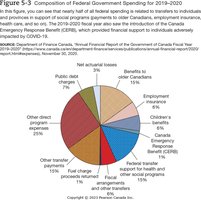
The public sector's size is measured by government outlays, including expenditures and transfer payments. Health care (Medicare) is a major component of Canadian government spending.
Medicare: Canada's publicly funded health care system, managed by provinces/territories and regulated by the federal government.
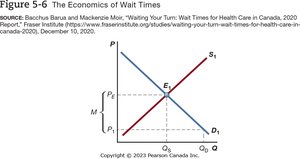
Scarcity in Health Care: When price signals are removed, scarcity is addressed through non-price rationing, such as wait times.
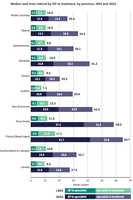
Wait Times: Increased demand at subsidized prices leads to shortages, confirmed by rising wait times for health care services.
5.5 Paying for the Public Sector: Systems of Taxation
Government funding comes from user fees, taxes, and borrowing. Tax systems can be proportional, progressive, or regressive.
Proportional Taxation: All income levels pay the same percentage of income in taxes.
Progressive Taxation: Higher income results in a higher percentage paid in taxes.
Regressive Taxation: Higher income results in a lower percentage paid in taxes (e.g., GST).
Marginal Tax Rate: The tax rate applied to the next dollar earned.
Average Tax Rate: Total tax paid divided by total income.
Key Formulas:
Average Tax Rate:
Marginal Tax Rate:
Example: For $52,000 income, marginal tax rate is 22%, average tax rate is 16.08%. For $125,000 income, marginal tax rate is 26%, average tax rate is 20.73%.
Summary Discussion of Learning Objectives
Market Failure: Occurs when free markets misallocate resources due to externalities.
Private vs. Public Goods: Private goods are rivalrous; public goods are not, leading to free-rider problems.
Political Functions: Government influences consumption and redistributes income through sponsored/inhibited goods and transfer payments.
Public Spending: Programs like Medicare increase consumption incentives and are rationed by non-price mechanisms.
Tax Rates: Marginal tax rate applies to the last dollar earned; average tax rate is total tax divided by income.
