 Back
BackMarkets for Factors of Production: The Labor Market
Study Guide - Smart Notes
 Tailored notes based on your materials, expanded with key definitions, examples, and context.
Markets for Factors of Production
Introduction to Labor Markets
The labor market is a fundamental component of microeconomics, where households supply labor and firms demand labor services to produce goods and services. The wage rate is the price of labor, determined by the interaction of supply and demand in competitive markets.
Labor services: The physical and mental work effort supplied by people.
Labor market: A collection of buyers (firms) and sellers (workers) trading labor services.
Wage rate: The price paid for labor services, typically per hour.
Most labor markets are competitive, with many buyers and sellers.
Demand for Labor
Marginal Revenue Product of Labor (MRPL)
Firms decide how much labor to hire based on the additional revenue generated by each worker, known as the Marginal Revenue Product of Labor (MRPL).
Marginal Revenue Product of Labor (MRPL): The change in total revenue from hiring one more unit of labor.
Formula:
In a competitive market:
Profit Maximization and Labor Demand
A profit-maximizing firm hires workers up to the point where the MRPL equals the wage rate.
Hire workers as long as .
The optimal number of workers is where .
Example Table:
Labor (workers) | Output (Hourly) | Marginal Product | Marginal Revenue Product |
|---|---|---|---|
1 | 5 | 5 | $50 |
2 | 10 | 5 | $50 |
3 | 14 | 4 | $40 |
4 | 17 | 3 | $30 |
5 | 19 | 2 | $20 |
6 | 20 | 1 | $10 |
Application: If the wage rate is $20, the firm hires 5 workers. If the wage is $30, the firm hires 4 workers.
Labor Demand Curve
The firm's demand curve for labor is the MRPL curve. The market demand for labor is the horizontal sum of all firms' labor demand curves.
The demand for labor depends on the marginal product of labor and the price of the product.
Formula:
Shifts in Labor Demand
Factors that shift the demand for labor include:
Price of the firm's output: Higher output prices increase labor demand.
Prices of other factors of production: Substitutes or complements in production affect labor demand.
Technology: Can increase or decrease demand for specific types of labor.
Example: Automation in bakeries reduces demand for bakery workers but increases demand for machine technicians.
Supply of Labor
Individual Labor Supply Decisions
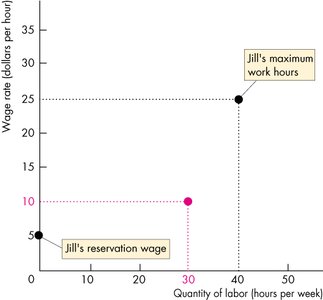
Individuals allocate time between labor and leisure. The decision to supply labor depends on the wage rate and the individual's reservation wage.
Reservation wage: The lowest wage at which a person is willing to work.
As the wage rises above the reservation wage, more labor is supplied.
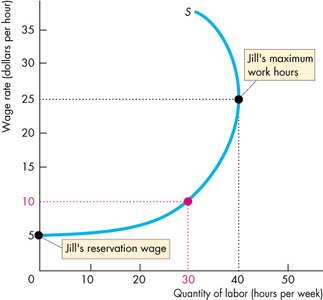
Labor Supply Curve
The individual labor supply curve shows the relationship between the wage rate and the quantity of labor supplied. It can be backward-bending at higher wage rates.
At low wages, higher wages increase labor supplied (substitution effect dominates).
At high wages, higher wages may decrease labor supplied (income effect dominates).
Substitution and Income Effects
Two effects explain changes in labor supply as wages change:
Substitution effect: Higher wages make leisure more costly, so people work more.
Income effect: Higher wages increase income, so people may choose more leisure and work less.
Example: If a wage increase leads someone to work fewer hours, the income effect dominates the substitution effect.
Market Supply of Labor
The market supply curve is the horizontal sum of all individuals' labor supply curves. It generally slopes upward, even if individual curves bend backward.
Labor Market Equilibrium
Determination of Wage and Employment
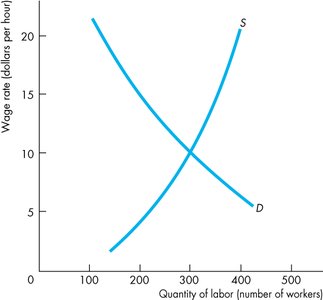
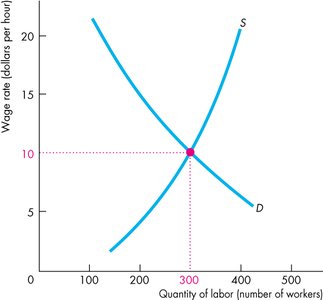
Equilibrium in the labor market occurs where the market demand and supply curves intersect, determining the equilibrium wage rate and quantity of labor employed.
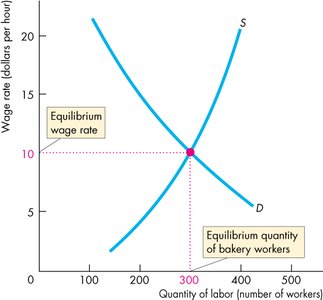
Wage Differentials
Explaining Wage Differences
Wages differ across occupations due to differences in required skills, education, and the cost of acquiring human capital.
Occupations requiring more training and education (e.g., surgeons) have higher reservation wages and higher market wages.
Jobs with lower skill requirements (e.g., fast-food workers) have lower reservation wages and lower market wages.
Example Table: Salaries by Occupation and Skills
Occupation | Hourly Wage | Annual Salary |
|---|---|---|
Fast Food Worker | $18.57 | $35,654 |
Construction Worker | $24 | $46,000 |
Plumber | $33.97 | $65,000 |
Windmill Technician | $31.17 | $64,000 |
Higher Education and Professional Degrees
Degree/Occupation | Median Salary |
|---|---|
Bachelor's Degree | $77,000 |
Master's Degree | $90,324 |
Economics | $107,000 |
Petroleum Engineer | $137,000 |
Lawyer (NYC) | $212,000 |
Orthopaedic Surgeon | $466,000 |
Practice Problems and Applications
Marginal Product and Hiring Decisions
Example: The Red Brick Company produces bricks in a competitive market. Each pound sells for $20, and the wage rate is $30/hour.
Workers | Output (lbs/hr) |
|---|---|
0 | 0 |
1 | 10 |
2 | 16 |
3 | 19 |
4 | 21 |
5 | 22 |
Marginal product of 4th worker: 2 lbs/hr
Value of marginal product: $40/hr
Red Brick hires 4 workers and produces 21 lbs/hr
Income and Substitution Effects in Practice
Example: Teddy receives an 8% wage increase and reduces hours worked from 30 to 25 per week.
Opportunity cost of leisure increases by 8%.
Income effect dominates substitution effect; Teddy chooses more leisure and works fewer hours.
Summary
Labor markets allocate labor resources through the interaction of supply and demand.
Wages are determined by the marginal revenue product of labor and the supply of labor.
Wage differentials arise due to differences in human capital, skills, and job requirements.
