 Back
BackMicroeconomic Theory: Simultaneous-Move Games, Dominant Strategies, Nash Equilibrium, and Maximin Strategies
Study Guide - Smart Notes
 Tailored notes based on your materials, expanded with key definitions, examples, and context.
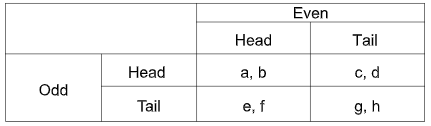
Q1. Matching Pennies Payoff Matrix: What is the value of d?
Background
Topic: Game Theory – Payoff Matrices
This question tests your understanding of how to fill in payoffs in a simultaneous-move game matrix, specifically the matching pennies game. You need to determine the payoff for Even when Odd plays Head and Even plays Tail.
Key Terms and Formulas:
Payoff Matrix: A table that shows the payoffs for each player for every possible combination of strategies.
Matching Pennies: A zero-sum game where one player wins if the pennies match, and the other wins if they do not.
Step-by-Step Guidance
Recall the rules: If the pennies do not match (one Head, one Tail), Odd wins (+1), Even loses (−1).
Identify the cell: Odd plays Head, Even plays Tail. This is the (Head, Tail) cell in the matrix.
Assign the payoffs: Odd gets +1, Even gets −1. The value of d is Even's payoff in this cell.
Try solving on your own before revealing the answer!
Final Answer: d = -1
Even loses when the pennies do not match, so the payoff is -1 for Even in this scenario.
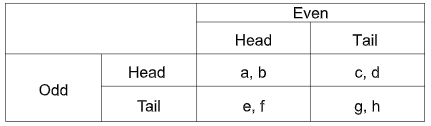
Q2. How many strategies does Odd have in Matching Pennies?
Background
Topic: Game Theory – Strategies
This question checks your understanding of what constitutes a strategy in a simultaneous-move game. Each player chooses between two options: Head or Tail.
Key Terms:
Strategy: A complete plan of action for a player, specifying what they will do in every possible situation.
Step-by-Step Guidance
List Odd's possible actions: Head or Tail.
Count the number of distinct strategies available to Odd.
Try solving on your own before revealing the answer!
Final Answer: 2 strategies
Odd can choose either Head or Tail, so there are two strategies.
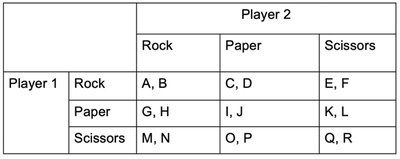
Q3. Rock-Paper-Scissors Payoff Matrix: What is the value of N?
Background
Topic: Game Theory – Payoff Matrices
This question asks you to determine the payoff for Player 2 when Player 1 chooses Scissors and Player 2 chooses Rock in a standard rock-paper-scissors game.
Key Terms and Formulas:
Payoff Matrix: Shows the outcomes for each player for every combination of strategies.
Rock-Paper-Scissors Rules: Rock beats Scissors, Scissors beats Paper, Paper beats Rock. Winner gets +1, loser gets -1, tie is 0.
Step-by-Step Guidance
Identify the cell: Player 1 chooses Scissors, Player 2 chooses Rock.
Apply the rules: Rock beats Scissors, so Player 2 wins (+1), Player 1 loses (−1).
Find the value of N, which is Player 2's payoff in this cell.
Try solving on your own before revealing the answer!
Final Answer: N = 1
Player 2 wins when playing Rock against Scissors, so the payoff is 1.
Q4. What does a dominant strategy produce?
Background
Topic: Dominant Strategies in Game Theory
This question tests your understanding of the definition of a dominant strategy and its implications for payoffs in a game.
Key Terms:
Dominant Strategy: A strategy that yields the highest payoff for a player, no matter what the other players do.
Step-by-Step Guidance
Recall the definition: A dominant strategy is always the best response, regardless of opponents' actions.
Consider what this means for payoffs: It must produce the highest possible payoff for every possible strategy of the other players.
Try solving on your own before revealing the answer!
Final Answer: The highest payoff for every possible strategy of the other players.
A dominant strategy always yields the best outcome for the player, no matter what the opponents do.
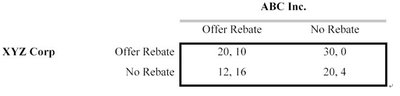
Q5. Which firm has a dominant strategy in the rebate game?
Background
Topic: Dominant Strategies in Oligopoly Pricing Games
This question involves analyzing a payoff matrix for two firms (ABC and XYZ) deciding whether to offer a rebate. You are asked to determine which firm, if any, has a dominant strategy.
Key Terms:
Dominant Strategy: The best action for a player, regardless of what the other player does.
Step-by-Step Guidance
For each firm, compare the payoffs for offering a rebate versus not offering a rebate, given each possible action of the other firm.
Check if one action always yields a higher payoff for a firm, regardless of the other firm's choice.
Repeat for both ABC and XYZ.
Try solving on your own before revealing the answer!
Final Answer: Both ABC and XYZ have a dominant strategy, which is Offer Rebate.
Offering a rebate always gives a higher payoff for both firms, regardless of the other firm's action.
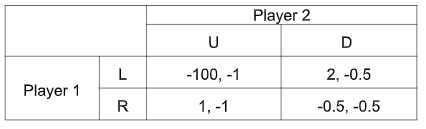
Q6. In the following simultaneous-move game, which statement is correct?
Background
Topic: Identifying Dominant Strategies in Payoff Matrices
This question asks you to analyze a payoff matrix and determine which player, if any, has a dominant strategy.
Key Terms:
Dominant Strategy: The best action for a player, regardless of the other player's choice.
Step-by-Step Guidance
For Player 2, compare the payoffs for choosing U versus D, given each possible action of Player 1.
If one action always yields a higher payoff, that is the dominant strategy.
Repeat for Player 1.
Try solving on your own before revealing the answer!
Final Answer: "D" is a dominant strategy for Player 2.
Player 2 always does better by choosing D, regardless of Player 1's action.
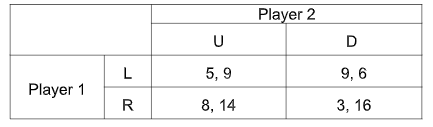
Q7. Which statement is correct about dominant strategies in the following game?
Background
Topic: Dominant Strategies in Simultaneous-Move Games
This question asks you to determine if either player has a dominant strategy in the given payoff matrix.
Key Terms:
Dominant Strategy: The best action for a player, regardless of the other player's choice.
Step-by-Step Guidance
For each player, compare the payoffs for each strategy, given the possible actions of the other player.
If neither player has a strategy that is always best, then neither has a dominant strategy.
Try solving on your own before revealing the answer!
Final Answer: Neither player has a dominant strategy.
Each player's best response depends on the other player's action.
