 Back
BackMicroeconomics: Core Principles, Demand & Supply, and Market Dynamics
Study Guide - Smart Notes
 Tailored notes based on your materials, expanded with key definitions, examples, and context.
Basic Principles of Economics
The Economic Problem
Economics arises from the fundamental problem of scarcity: our wants are unlimited, but resources are limited. This leads to choices about what, how, and for whom goods and services are produced. Incentives—rewards or penalties—play a crucial role in shaping these choices.
Scarcity: The inability to satisfy all wants due to limited resources.
Microeconomics: The study of individual and business choices, market interactions, and government influence.
Macroeconomics: The study of national and global economic performance.
Factors of Production: Land (natural resources), Labour (human effort), Capital (tools, machinery), Entrepreneurship (organization of resources).
Factor Incomes: Land earns rent, labour earns wages, capital earns interest, entrepreneurship earns profit.
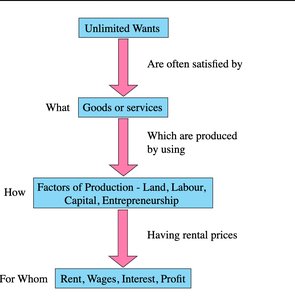
Additional info: This diagram visually summarizes the flow from unlimited wants to the allocation of incomes to the factors of production, clarifying the 'what, how, and for whom' questions in economics.
Opportunity Cost and Trade-offs
Every choice involves a trade-off, which is the opportunity cost—the value of the next best alternative forgone. Rational choices are made by comparing marginal benefits and marginal costs.
Opportunity Cost: The highest-valued alternative forgone when a choice is made.
Marginal Analysis: Decisions are made at the margin, weighing additional benefits against additional costs.
Incentives: Changes in marginal cost or benefit alter incentives and thus choices.
Introductory Economic Models
Production Possibility Frontier (PPF)
The PPF illustrates the maximum combinations of two goods that can be produced with available resources and technology. Points inside the PPF are inefficient, points on the PPF are efficient, and points outside are unattainable.
Trade-offs: Moving along the PPF involves shifting resources between goods, incurring opportunity costs.
Law of Increasing Opportunity Cost: The PPF is typically bowed outward because resources are not equally productive in all uses.
Economic Growth: Achieved through technological change and capital accumulation, shifting the PPF outward.
Comparative and Absolute Advantage
Comparative advantage refers to the ability to produce a good at a lower opportunity cost than others, while absolute advantage refers to higher productivity. Specialization according to comparative advantage and trade increases total production and consumption possibilities.
The Market Forces of Supply and Demand
Demand
Demand represents the quantities of a good consumers are willing and able to buy at various prices, holding other factors constant. The law of demand states that, ceteris paribus, as the price of a good rises, the quantity demanded falls.
Demand vs. Quantity Demanded: A change in price causes movement along the demand curve (quantity demanded), while changes in other factors shift the demand curve.
Determinants of Demand: Prices of related goods (substitutes and complements), expected future prices, income (normal and inferior goods), expected future income, population, and preferences.
Substitution Effect: Higher relative price leads consumers to substitute away from the good.
Income Effect: Higher price reduces real income, lowering quantity demanded (for normal goods).

Additional info: This image demonstrates how the demand curve shifts right (increase) or left (decrease) when non-price determinants change, and provides tabular data for reference.

Additional info: This image illustrates movement along the demand curve due to price changes, reinforcing the distinction between a change in quantity demanded and a change in demand.

Additional info: This image visually explains how the demand curve shifts when factors other than price change, such as income or preferences.
Supply
Supply is the relationship between the price of a good and the quantity producers are willing to sell, ceteris paribus. The law of supply states that as the price increases, the quantity supplied increases.
Determinants of Supply: Prices of factors of production, prices of related goods in production, expected future prices, number of suppliers, technology, and state of nature.
Supply vs. Quantity Supplied: A change in price causes movement along the supply curve (quantity supplied), while changes in other factors shift the supply curve.
Market Equilibrium
Market equilibrium occurs where quantity demanded equals quantity supplied. The equilibrium price is the price at which this occurs, and the equilibrium quantity is the amount bought and sold at this price.
Shortage: Occurs when price is below equilibrium, causing quantity demanded to exceed quantity supplied and upward pressure on price.
Surplus: Occurs when price is above equilibrium, causing quantity supplied to exceed quantity demanded and downward pressure on price.
Shifts in Demand and Supply: Changes in demand or supply shift the equilibrium price and quantity. The direction of change depends on which curve shifts and by how much.
Elasticity
Price Elasticity of Demand
Price elasticity of demand measures the responsiveness of quantity demanded to a change in price, holding other factors constant. It is calculated as:
Formula:
Interpretation: Elasticity > 1 (elastic), Elasticity < 1 (inelastic), Elasticity = 1 (unit elastic).
Determinants: Availability of substitutes, proportion of income spent, and time horizon.
Other Elasticities
Income Elasticity of Demand: Measures responsiveness of quantity demanded to changes in income.
Cross Elasticity of Demand: Measures responsiveness of demand for one good to the price change of another good.
Elasticity of Supply: Measures responsiveness of quantity supplied to price changes.
Consumer and Producer Surplus; Price Ceilings and Floors
Consumer Surplus
The difference between what consumers are willing to pay and what they actually pay. Graphically, it is the area below the demand curve and above the market price.
Producer Surplus
The difference between the price producers receive and the minimum price they are willing to accept. It is the area above the supply curve and below the market price.
Price Ceilings and Floors
Price Ceiling: A legal maximum price. If set below equilibrium, it causes shortages and inefficiency.
Price Floor: A legal minimum price. If set above equilibrium, it causes surpluses and inefficiency.
Active Recall Questions
Why does scarcity create choice?
What is the difference between demand and quantity demanded?
What causes a shortage or surplus in a market?
How do price ceilings and floors affect market outcomes?
