 Back
Microeconomics Exam 3 Sample – Step-by-Step Study Guidance
Study Guide - Smart Notes
 Tailored notes based on your materials, expanded with key definitions, examples, and context.
Q1. Which of the following is NOT a valid way to calculate a firm's total profit?
Background
Topic: Profit Calculation in Microeconomics
This question tests your understanding of the different methods for calculating a firm's total profit, a key concept in firm behavior and cost analysis.
Key Terms and Formulas:
Total Profit (): The difference between total revenue and total cost.
Average Profit per Unit:
Marginal Profit: The change in profit from selling one more unit.
Total Revenue (TR):
Total Cost (TC): All costs incurred in production.
Step-by-Step Guidance
Recall that total profit can be calculated as .
Consider if multiplying average profit per unit by quantity sold gives total profit.
Think about whether multiplying marginal profit by quantity sold is valid for total profit.
Check if gives total profit.
Try solving on your own before revealing the answer!
Final Answer: B) Marginal profit times quantity sold.
Multiplying marginal profit by quantity sold does not generally yield total profit, since marginal profit changes with each unit sold. The other methods are valid ways to calculate total profit.
Q2. When does a perfectly competitive firm earn a profit?
Background
Topic: Perfect Competition and Profitability
This question tests your understanding of the relationship between price and cost curves in perfect competition.
Key Terms and Formulas:
Average Total Cost (ATC):
Profit Condition: A firm earns profit when .
Step-by-Step Guidance
Recall the condition for profit: compare the market price to the firm's average total cost.
Consider what happens if price equals minimum average fixed cost or minimum average variable cost.
Think about the significance of price being above the minimum average total cost.
Review the definitions of each cost curve and their relevance to profit.
Try solving on your own before revealing the answer!
Final Answer: C) Above minimum average total cost.
A perfectly competitive firm earns a profit when the market price is above the minimum point of the average total cost curve.
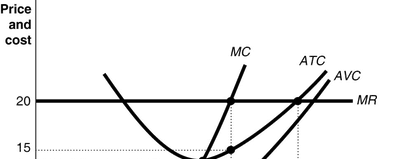
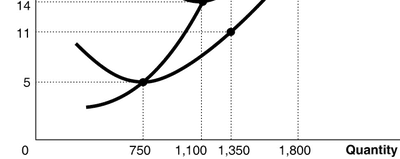
Q3. Refer to Figure 12-5. If the market price is $20, what is the firm's profit-maximizing output?
Background
Topic: Perfect Competition – Profit Maximization
This question asks you to use a cost and revenue diagram to determine the output level where profit is maximized for a perfectly competitive firm.
Key Terms and Formulas:
Marginal Cost (MC): The additional cost of producing one more unit.
Marginal Revenue (MR): The additional revenue from selling one more unit. In perfect competition, .
Profit Maximization Rule: Produce where .
Step-by-Step Guidance
Locate the market price () on the vertical axis of Figure 12-5.
Find the point where the marginal cost (MC) curve intersects the marginal revenue (MR) curve at this price.
Trace down from this intersection to the quantity axis to identify the profit-maximizing output.
Compare the possible output values given in the options to the quantity at this intersection.
Try solving on your own before revealing the answer!
Final Answer: C) 1,350 units
At a market price of $20, the MC curve intersects the MR curve at a quantity of 1,350 units, which is the profit-maximizing output.
Q4. Refer to Figure 12-5. If the market price is $20, what is the amount of the firm's profit?
Background
Topic: Calculating Profit in Perfect Competition
This question tests your ability to calculate total profit using cost and revenue curves.
Key Terms and Formulas:
Total Profit ():
ATC (Average Total Cost): The cost per unit at the profit-maximizing output.
Step-by-Step Guidance
Identify the profit-maximizing output from the previous question.
Find the average total cost (ATC) at this output level using Figure 12-5.
Calculate the difference between price and ATC: .
Multiply this difference by the quantity to find total profit: .
Try solving on your own before revealing the answer!
Final Answer: B) $6,750
Using the formula with the values from the graph, the firm's profit is $6,750.
Q5. When will a firm make a profit?
Background
Topic: Profit Conditions for Firms
This question tests your understanding of the relationship between price and cost curves for determining profit.
Key Terms and Formulas:
Profit Condition: (Price greater than Average Total Cost)
Break-even Condition:
Step-by-Step Guidance
Recall the definition of profit: total revenue exceeds total cost.
Compare the price to the average total cost (ATC) to determine when profit occurs.
Consider the other options and whether they are sufficient for profit (e.g., or ).
Try solving on your own before revealing the answer!
Final Answer: C) P > ATC
A firm makes a profit when the price is greater than the average total cost of production.
