 Back
BackMicroeconomics Exam 5 Review: Oligopoly, Perfect Competition, and Game Theory
Study Guide - Smart Notes
 Tailored notes based on your materials, expanded with key definitions, examples, and context.
Q1. What are the main differences between oligopoly and perfect competition?
Background
Topic: Market Structures
This question tests your understanding of the characteristics and outcomes of two major market structures: oligopoly and perfect competition.
Key Terms and Concepts:
Oligopoly: A market structure with a few large firms, high barriers to entry, and strategic interdependence among firms.
Perfect Competition: A market structure with many small firms, no barriers to entry, identical products, and firms are price takers.
Market Power: The ability of a firm to influence the price of its product.
Entry Barriers: Obstacles that make it difficult for new firms to enter the market.
Long-Run Profits: Economic profits that firms can earn in the long run.
Step-by-Step Guidance
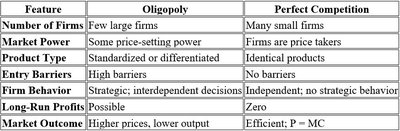
Review the features of each market structure, focusing on the number of firms, market power, product type, entry barriers, firm behavior, long-run profits, and market outcomes.
Compare how firms behave in each structure: Oligopolies make strategic, interdependent decisions, while firms in perfect competition act independently.
Consider the implications for prices and output: Oligopolies tend to have higher prices and lower output, while perfect competition leads to efficient outcomes where price equals marginal cost ().
Think about the role of barriers to entry and how they affect the possibility of long-run profits in each structure.
Try solving on your own before revealing the answer!
Final Answer:
The main differences are: Oligopoly has few large firms, high barriers, some price-setting power, and possible long-run profits; perfect competition has many small firms, no barriers, firms are price takers, and zero long-run profits. Oligopolies are strategic and interdependent, while perfect competition is independent and efficient ().
Q2. Using the payoff matrix, is there a dominant strategy for LimoZeenz?
Background
Topic: Game Theory in Oligopoly
This question tests your ability to analyze strategic interactions between firms using a payoff matrix and to identify dominant strategies.
Key Terms and Concepts:
Payoff Matrix: A table showing the profits each firm earns for every combination of strategies.
Dominant Strategy: A strategy that yields the highest payoff for a firm regardless of what the other firm does.
Step-by-Step Guidance
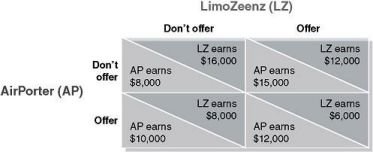
Examine the payoff matrix for LimoZeenz (LZ) and AirPorter (AP). Identify the payoffs for LZ in each scenario.
For each possible action by AirPorter ("Offer" or "Don't offer"), compare LZ's earnings if it "Offers" versus "Doesn't offer" the discount.
Determine if one action always results in a higher payoff for LZ, regardless of AP's choice. If so, that action is the dominant strategy.
If the best choice for LZ depends on AP's action, then LZ does not have a dominant strategy.
Try solving on your own before revealing the answer!
Final Answer:
LimoZeenz does not have a dominant strategy because its best outcome depends on AirPorter's action. The dominant strategy exists only if one action is always best, which is not the case here.
Q3. Using the payoff matrix, is there a dominant strategy for AirPorter?
Background
Topic: Game Theory in Oligopoly
This question tests your ability to analyze the payoff matrix from AirPorter's perspective and identify if a dominant strategy exists.
Key Terms and Concepts:
Dominant Strategy: A strategy that is best for a firm regardless of the other firm's actions.
Step-by-Step Guidance
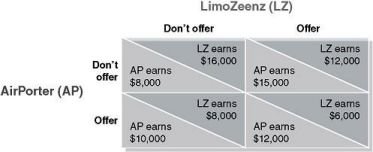
Look at AirPorter's payoffs in the matrix for each possible action by LimoZeenz.
Compare AirPorter's earnings if it "Offers" versus "Doesn't offer" the discount, for each LimoZeenz action.
Check if one action always gives AirPorter a higher payoff, regardless of LimoZeenz's choice.
If AirPorter's best choice depends on LimoZeenz's action, then there is no dominant strategy for AirPorter.
Try solving on your own before revealing the answer!
Final Answer:
AirPorter does not have a dominant strategy because its optimal action depends on LimoZeenz's choice. A dominant strategy would require one action to always be best, which is not the case here.
Q4. What is the Nash equilibrium in this game?
Background
Topic: Nash Equilibrium in Game Theory
This question tests your ability to identify the Nash equilibrium in a strategic game between two firms using a payoff matrix.
Key Terms and Concepts:
Nash Equilibrium: A situation where each firm chooses the best strategy given the other firm's strategy, and neither has an incentive to deviate.
Payoff Matrix: Shows the profits for each combination of strategies.
Step-by-Step Guidance
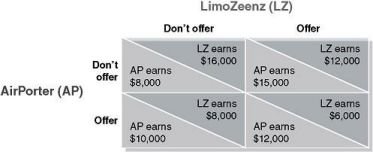
Identify the strategies for both LimoZeenz and AirPorter.
For each possible outcome, check if both firms are choosing their best response given the other firm's action.
Look for the cell(s) in the matrix where neither firm would want to change their strategy unilaterally.
Mark the Nash equilibrium(s) based on these criteria, but stop before stating the exact equilibrium.
Try solving on your own before revealing the answer!
Final Answer:
The Nash equilibrium is where both firms are making their best possible choices given the other's action. In this matrix, it is the cell where neither LimoZeenz nor AirPorter would want to change their strategy unilaterally.
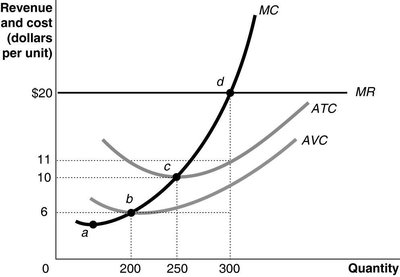
Q5. At price $6, $10, and $20, what is the firm's outcome (profit, loss, or break-even)?
Background
Topic: Cost Curves and Profit Analysis in Perfect Competition
This question tests your ability to interpret cost curves and determine a firm's profit, loss, or break-even point at different prices.
Key Terms and Formulas:
Average Total Cost (ATC): Total cost divided by quantity produced.
Profit:
Break-even: Occurs when
Loss: Occurs when
Profit: Occurs when
Step-by-Step Guidance
Identify the price points ($6, $10, $20) and locate them on the cost curve graph.
Compare each price to the average total cost (ATC) at the corresponding output level.
Determine whether the price is above, below, or equal to ATC for each case.
Use the profit formula to set up the calculation, but stop before computing the final result.
Try solving on your own before revealing the answer!
Final Answer:
At $6, the firm makes a loss; at $10, it breaks even; at $20, it makes a profit. This is determined by comparing price to ATC at each output level.
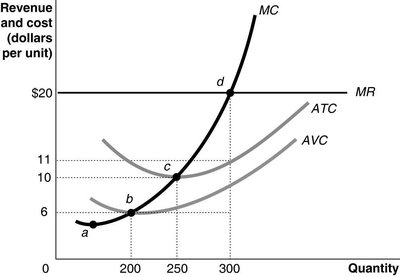
Q6. At the price of $20, what is the profit?
Background
Topic: Profit Calculation in Perfect Competition
This question tests your ability to calculate profit using price, average total cost, and quantity.
Key Terms and Formula:
Profit:
P: Price per unit
ATC: Average total cost per unit
Q: Quantity produced
Step-by-Step Guidance
Identify the price ($20), ATC ($11), and quantity (300) from the graph or data provided.
Set up the profit formula:
Plug in the values: , ,
Prepare to calculate the result, but stop before performing the multiplication.
Try solving on your own before revealing the answer!
Final Answer:
Profit = (20 - 11) × 300 = 2700. The firm earns a profit because price is above average total cost.
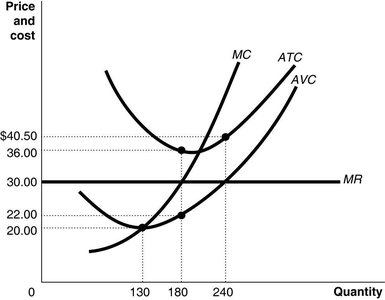
Q7. At the price of $30, what is the profit maximizing output?
Background
Topic: Profit Maximization in Perfect Competition
This question tests your ability to use marginal cost and marginal revenue to determine the profit-maximizing output.
Key Terms and Formula:
Marginal Cost (MC): The cost of producing one more unit.
Marginal Revenue (MR): The revenue from selling one more unit.
Profit Maximizing Condition:
Step-by-Step Guidance
Identify the price ($30), which is also marginal revenue in perfect competition.
Locate the output level where on the cost curve graph.
Check the intersection point and note the corresponding quantity.
Stop before stating the exact output value; set up the process for finding it.
Try solving on your own before revealing the answer!
Final Answer:
The profit maximizing output is where MC equals MR ($30). On the graph, this corresponds to the quantity at the intersection of MC and MR.
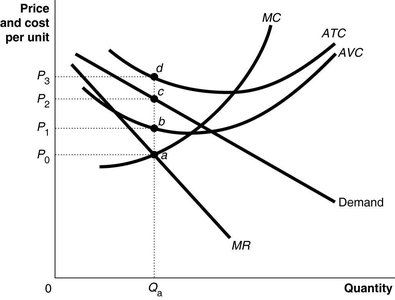
Q8. In a monopolistically competitive market, how do you calculate profit?
Background
Topic: Profit Calculation in Monopolistic Competition
This question tests your ability to use price, average total cost, and quantity to calculate profit for a firm in monopolistic competition.
Key Terms and Formula:
Profit:
P: Price at which the firm sells its product
ATC: Average total cost at the profit-maximizing output
Q: Quantity produced
Step-by-Step Guidance
Identify the relevant prices (e.g., , ) and the output level () from the graph.
Set up the profit formula:
Plug in the values for price and average total cost at the profit-maximizing output.
Stop before performing the calculation; ensure the formula is ready for use.
Try solving on your own before revealing the answer!
Final Answer:
Profit is calculated as (P2 - P3) × Qa, where P2 is the price, P3 is the average total cost, and Qa is the quantity at the profit-maximizing output.
