 Back
BackMicroeconomics Foundations and Models: Chapter 1 Study Guide
Study Guide - Smart Notes
 Tailored notes based on your materials, expanded with key definitions, examples, and context.
Economics: Foundations and Models
Three Key Economic Ideas
Economics is the study of how people make choices to attain their goals, given scarce resources. Three foundational ideas guide economic analysis:
People are rational: Individuals use all available information to achieve their objectives, weighing costs and benefits to make optimal decisions.
People respond to economic incentives: Changes in incentives influence behavior, as seen in policy impacts or market changes.
Optimal decisions are made at the margin: Most choices involve incremental adjustments, analyzed through marginal cost (MC) and marginal benefit (MB).
Example: Apple sets iPhone prices to maximize profit, not randomly. Marginal analysis helps decide whether to study an extra hour or watch TV.
The Economic Problem That Every Society Must Solve
Scarcity means limited resources must be allocated efficiently. Every society faces three fundamental questions:
What goods and services will be produced? Trade-offs are necessary; opportunity cost is the value of the next best alternative forgone.
How will goods and services be produced? Firms choose production methods based on costs and technology.
Who will receive the goods and services produced? Distribution depends on income, government policy, and social goals.
Example: Funding space exploration may require sacrificing cancer research funding.
Centrally Planned Economies vs. Market Economies
Economic systems differ in how resources are allocated:
Centrally planned economy: Government decides allocation.
Market economy: Households and firms interact in markets to allocate resources.
Mixed economy: Combines market mechanisms with government intervention.
The U.S. is best described as a mixed economy.
Efficiency and Equity in Market Economies
Market economies promote:
Productive efficiency: Goods produced at lowest cost.
Allocative efficiency: Production matches consumer preferences; last unit's marginal benefit equals marginal cost.
Voluntary exchange improves well-being for buyers and sellers. However, markets may not always be fully efficient or equitable.
Equity refers to fair distribution of economic benefits, often requiring trade-offs with efficiency.
Economic Models
Economists use models—simplified representations of reality—to analyze events and policies. The process involves:
Deciding on assumptions
Formulating a testable hypothesis
Using data to test the hypothesis
Revising the model if necessary
Retaining the revised model for future analysis
Models rely on behavioral assumptions (e.g., consumers maximize well-being, firms maximize profit).
Positive vs. Normative Analysis
Economics distinguishes between:
Positive analysis: What is (objective, fact-based)
Normative analysis: What ought to be (subjective, value-based)
Most economic research is positive, but policy decisions often require normative judgments.
Microeconomics vs. Macroeconomics
Economics is divided into two main branches:
Microeconomics: Studies individual households, firms, market interactions, and government influence.
Macroeconomics: Examines the economy as a whole, including inflation, unemployment, and growth.
Economic Skills and Careers
Studying economics develops analytical skills valuable in many careers. Economists help businesses and governments make better decisions by describing choices, consequences, and improvements.
Example: Many CEOs of major corporations majored in economics, which may correlate with higher incomes.
Important Economic Terms
Economics uses precise terminology. Key terms include:
Scarcity: Unlimited wants vs. limited resources
Trade-off: Sacrificing one good for another
Opportunity cost: Value of the next best alternative
Technology: Processes used to produce goods/services
Capital: Manufactured goods used for production
Appendix: Using Graphs and Formulas
Graphs in Economics
Graphs are essential tools for visualizing economic relationships. Common types include:
Bar graphs: Compare quantities across categories
Pie charts: Show proportions of a whole
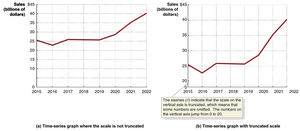
Time-series graphs: Track changes over time
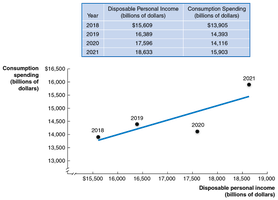
Scatter plots: Show relationships between two variables

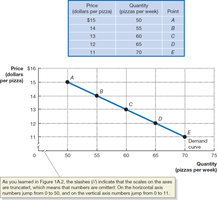
Plotting Price and Quantity
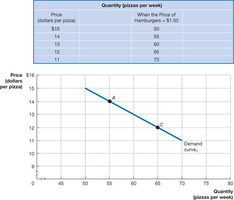
Price and quantity relationships are often illustrated using two-dimensional grids. Each point represents a price-quantity combination, and connecting points shows the relationship (e.g., demand curve).
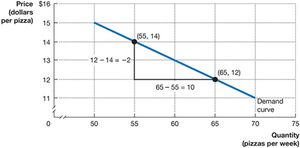
Calculating the Slope of a Line
The slope measures the rate of change between two variables. For a straight line:
Slope formula:
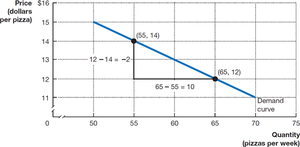
Example: If price decreases from $14 to $12 and quantity increases from 55 to 65:
Change in price:
Change in quantity:
Slope:
Showing Three Variables on a Graph
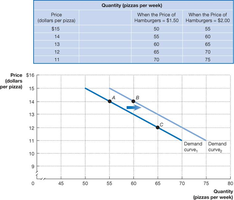
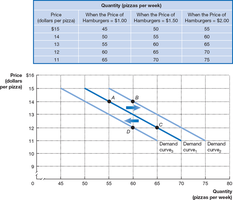
Graphs can illustrate how a third variable affects the relationship between two others, such as how the price of hamburgers affects pizza demand.
Positive and Negative Relationships
A positive relationship means both variables increase together; a negative relationship means one increases as the other decreases.
Cause and Effect in Graphs
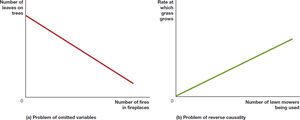
Graphs can suggest relationships but may not prove causality. Problems include omitted variables and reverse causality.
Linear vs. Nonlinear Relationships
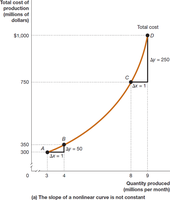
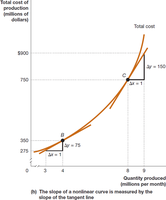
Most economic relationships are not perfectly linear. Nonlinear curves have varying slopes at different points.
Percentage Change Formula
Percentage change measures the relative change in a variable:
Formula:
Example: U.S. real GDP increased from \frac{20,018 - 19,610}{19,610} \times 100\% = 2.1\%$
Graphing Total Revenue
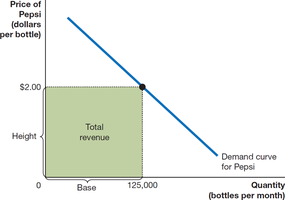
Total revenue is the product of price and quantity, represented as the area of a rectangle under the demand curve.
Formula:
Area of a Triangle
The area of a triangle is useful for calculating surplus or other economic measures:
Formula:
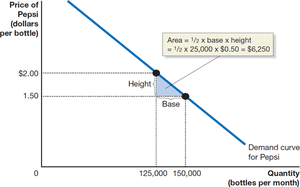
Summary of Using Formulas
When applying formulas in economics:
Understand the concept the formula represents.
Use the correct formula for the problem.
Check that the result is economically reasonable.
Example: Calculating negative revenue indicates a mistake.
