 Back
BackMicroeconomics Foundations: Rationality, Marginality, Incentives, and Economic Systems
Study Guide - Smart Notes
 Tailored notes based on your materials, expanded with key definitions, examples, and context.
Economic Foundations
Big Ideas of Microeconomics
Microeconomics is the study of how individuals and firms make choices under scarcity and how these choices interact in markets. The foundational concepts include rationality, marginality, incentives, and opportunity cost.
Rationality: Economic agents use all available information to make decisions that maximize their benefit relative to cost. The principle is that individuals act when Benefit > Cost.
Marginality: Decisions are made by comparing the additional (marginal) benefit and additional (marginal) cost of an action, relative to the next-best alternative.
Incentives: People respond to incentives, which can be positive (rewards) or negative (penalties). Incentives shape behavior in markets and policy settings.
Opportunity Cost: The value of the next-best alternative that is forgone when a choice is made. This is a central concept in evaluating trade-offs.
Economic Goals
Societies pursue several key economic goals, which often require trade-offs:
Efficiency: Achieving productive efficiency (least-cost methods) and allocative efficiency (production matches consumer preferences).
Equity: Fair distribution of resources and outcomes.
Innovation: Technological progress and improvement in goods and services.
Rationality and Marginality in Decision Making
Rational Decision Making
Individuals make choices by weighing benefits and costs. A rational decision is made when the expected benefit exceeds the expected cost.
Example: The FDA increases standards for drug approval. The benefit is improved safety; the cost may be delayed access to new drugs.
Marginal Analysis
Marginal analysis involves comparing the additional benefit and additional cost of a decision.
Formula: (Marginal Benefit greater than Marginal Cost)
Example: Charter Airline Flight: Costs (Plane Rental $200,000 + Gas/Crew $70,000 = $270,000), Revenue $240,000. Marginal analysis helps decide whether to continue the flight.
Example: Home Renovation: Invest $300,000, price without kitchen remodel $240,000, price with $10,000 kitchen remodel is $275,000. Marginal benefit of remodel is $35,000, marginal cost is $10,000.
Incentives and Moral Hazard
Incentives
Incentives are rewards or penalties that motivate behavior. They are central to economic analysis and policy design.
Example: Nike sources materials from low-wage countries to reduce costs, responding to profit incentives.
Moral Hazard
Moral hazard occurs when individuals do not bear the full consequences of their actions, leading to riskier behavior.
Example: Insurance may reduce incentives to avoid risky behavior if losses are covered.
Economic Assertions: Positive vs. Normative Statements
Types of Economic Statements
Positive Statements: Objective, fact-based statements about "what is."
Normative Statements: Subjective, value-based judgments about "what ought to be."
Fundamental Economic Questions and Systems
The Three Economic Questions
Every economy must answer:
What goods are to be produced?
How are goods to be produced?
For whom are goods produced?
Economic Systems
Market System: Individuals and firms answer the three questions through voluntary exchange.
Central Planning: Government makes decisions about production and distribution.
Mixed Economy: Both individuals and government play roles in answering the three questions.
Classical and Marxist Economic Thought
Adam Smith and the Invisible Hand
Adam Smith argued that individuals acting in their own self-interest promote economic efficiency and wealth through the "invisible hand" of the market. Government's role is limited to protecting property rights and enforcing contracts.
Karl Marx and Das Kapital
Marxist theory critiques capitalism for creating a divide between owners and workers, predicting eventual revolution and transition to socialism. Historical outcomes have included inefficiency and reduced freedoms in centrally planned economies.
Marginal Opportunity Cost
Definition and Application
Marginal opportunity cost is the value of the next-best alternative sacrificed when a choice is made.
Formula:
Example: Sarah earns $1200/month at her job. Vacation to Costa Rica costs $1500. Marginal cost is $1200 (foregone wages) + $1500 (trip expenses) = $2700. If marginal benefit is $2500, she should not go. If $800 of the trip cost is sunk (already paid), marginal cost is $1200 + $700 = $1900; if MB is $2500, she should go.
Economic Freedom and Outcomes
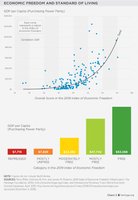
Economic Freedom and Standard of Living
Higher economic freedom is associated with higher GDP per capita, indicating a higher standard of living. Countries with more economic freedom tend to have greater prosperity.
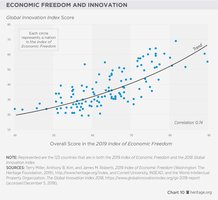
Economic Freedom and Innovation
There is a positive correlation between economic freedom and innovation, as measured by the Global Innovation Index. Economies with greater freedom tend to foster more technological progress.
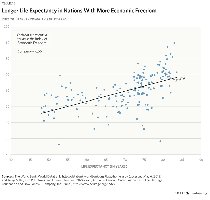
Economic Freedom and Life Expectancy
Countries with higher economic freedom generally have longer life expectancy, suggesting that economic policies can impact health outcomes.
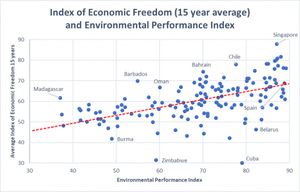
Economic Freedom and Environmental Performance
There is a positive relationship between economic freedom and environmental performance, indicating that freer economies may also achieve better environmental outcomes.
Summary Table: Economic Systems Comparison
System | Who Answers Economic Questions? | Advantages | Disadvantages |
|---|---|---|---|
Market | Individuals/Firms | Efficiency, Innovation | Inequality, Market Failures |
Central Planning | Government | Equity, Stability | Inefficiency, Shortages |
Mixed | Both | Balance of Efficiency and Equity | Complexity, Potential for Conflict |
Key Formulas
Marginal Analysis:
Opportunity Cost:
Additional info:
Expanded examples and definitions were added for clarity and completeness.
Images included are directly relevant to the discussion of economic freedom and its outcomes.
