 Back
BackMicroeconomics Game Theory and Oligopoly Review – Step-by-Step Guidance
Study Guide - Smart Notes
 Tailored notes based on your materials, expanded with key definitions, examples, and context.
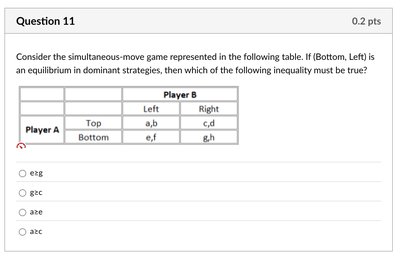
Q1. Dominant Strategy Equilibrium in Simultaneous-Move Game
Background
Topic: Game Theory – Dominant Strategies and Equilibrium
This question tests your understanding of dominant strategies in simultaneous-move games and how to identify the necessary inequalities for a strategy profile to be an equilibrium in dominant strategies.
Key Terms and Formulas:
Dominant Strategy: A strategy that yields a higher payoff for a player, no matter what the other player does.
Equilibrium in Dominant Strategies: Both players choose their dominant strategies, and neither has an incentive to deviate.
Step-by-Step Guidance
For Player A, "Bottom" must be a dominant strategy. This means that for both choices of Player B (Left and Right), the payoff from Bottom must be at least as large as from Top: and .
For Player B, "Left" must be a dominant strategy. This means that for both choices of Player A (Top and Bottom), the payoff from Left must be at least as large as from Right: and .
Combine the above to see which inequality is required for (Bottom, Left) to be an equilibrium in dominant strategies.
Try solving on your own before revealing the answer!
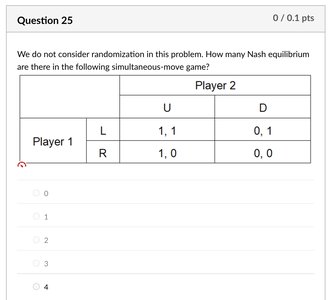
Q2. Counting Nash Equilibria in a Simultaneous-Move Game
Background
Topic: Game Theory – Nash Equilibrium in Pure Strategies
This question asks you to determine how many Nash equilibria exist in a given payoff matrix for a simultaneous-move game, without considering mixed strategies.
Key Terms and Formulas:
Nash Equilibrium: A strategy profile where no player can improve their payoff by unilaterally changing their strategy.
Best Response: The strategy that yields the highest payoff for a player, given the other player's choice.
Step-by-Step Guidance
For each cell in the matrix, check if both players are playing best responses to each other.
Mark the cells where neither player can improve their payoff by switching strategies.
Count the number of such cells to determine the number of Nash equilibria in pure strategies.
Try solving on your own before revealing the answer!
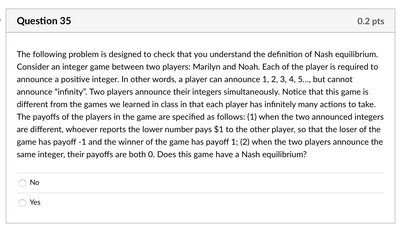
Q3. Nash Equilibrium in an Integer Game
Background
Topic: Game Theory – Nash Equilibrium in Games with Infinite Strategies
This question checks your understanding of Nash equilibrium in a game where each player chooses a positive integer, and payoffs depend on who chooses the lower number.
Key Terms and Formulas:
Nash Equilibrium: No player can improve their payoff by unilaterally changing their strategy.
Simultaneous-Move Game: Both players choose their actions at the same time.
Step-by-Step Guidance
Consider what happens if one player chooses a higher integer than the other. Is the higher-number player playing a best response?
Consider what happens if one player chooses a lower integer. Is the lower-number player playing a best response?
Consider what happens if both players choose the same integer. Are either playing a best response?
Try solving on your own before revealing the answer!
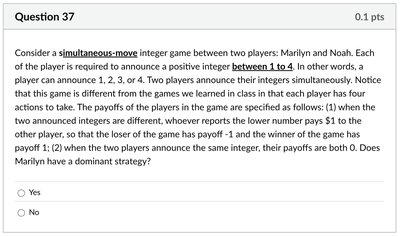
Q4. Dominant Strategy in a Finite Integer Game
Background
Topic: Game Theory – Dominant Strategies in Finite Games
This question asks whether Marilyn has a dominant strategy when both players can only choose integers from 1 to 4.
Key Terms and Formulas:
Dominant Strategy: A strategy that is always the best, regardless of what the other player does.
Finite Game: Each player has a limited set of strategies.
Step-by-Step Guidance
For each possible choice Marilyn can make (1, 2, 3, 4), consider what Noah would do in response.
Determine if there is one choice for Marilyn that always gives her the best possible outcome, regardless of Noah's response.
Check if this choice is better than all other options in every scenario.
Try solving on your own before revealing the answer!
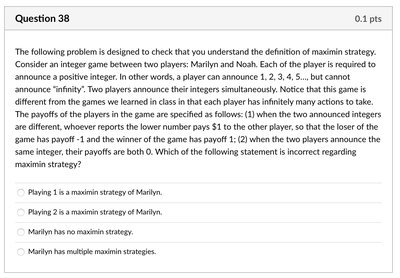
Q5. Maximin Strategies in an Integer Game
Background
Topic: Game Theory – Maximin Strategy
This question tests your understanding of the maximin strategy, which is the strategy that maximizes the minimum possible payoff for a player.
Key Terms and Formulas:
Maximin Strategy: Choose the strategy that gives the highest payoff among the worst-case outcomes.
Worst-Case Payoff: The lowest payoff a player can get when choosing a particular strategy.
Step-by-Step Guidance
For each possible strategy Marilyn can play, determine the worst-case payoff she could receive.
Identify which strategies maximize this worst-case payoff.
Check if there are multiple strategies that achieve the same maximum of the minimum payoffs.
Try solving on your own before revealing the answer!
Q6. Maximin Payoff Profile in a Simultaneous-Move Game
Background
Topic: Game Theory – Maximin Strategies and Payoff Profiles
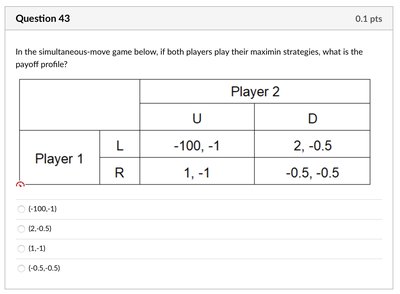
This question asks you to find the payoff profile when both players play their maximin strategies in a simultaneous-move game.
Key Terms and Formulas:
Payoff Profile: The pair of payoffs received by both players for a given strategy profile.
Maximin Strategy: The strategy that maximizes a player's minimum possible payoff.
Step-by-Step Guidance
For each strategy, calculate the worst-case payoff for both Player 1 and Player 2.
Identify the maximin strategy for each player (the strategy with the highest minimum payoff).
Find the payoff profile that results when both players play their maximin strategies.
Try solving on your own before revealing the answer!
Q7. Subgame Perfect Nash Equilibrium in Sequential Integer Game (1–4)
Background
Topic: Game Theory – Subgame Perfect Nash Equilibrium (SPNE) in Sequential Games
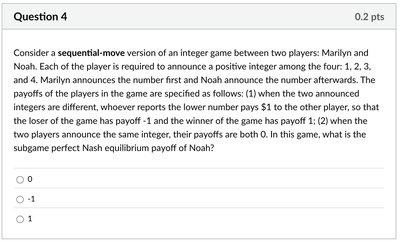
This question asks for the subgame perfect Nash equilibrium payoff for Noah in a sequential-move integer game where each player chooses a number from 1 to 4.
Key Terms and Formulas:
Sequential-Move Game: One player moves first, the other responds.
Subgame Perfect Nash Equilibrium (SPNE): A refinement of Nash equilibrium for sequential games, found by backward induction.
Step-by-Step Guidance
Start by considering Noah's best response to each possible choice Marilyn could make.
Work backwards to determine what Marilyn will choose, anticipating Noah's response.
Identify the resulting payoff for Noah in the equilibrium path.
Try solving on your own before revealing the answer!
Q8. Subgame Perfect Nash Equilibrium in Sequential Integer Game (Infinite Actions)
Background
Topic: Game Theory – SPNE in Sequential Games with Infinite Strategies
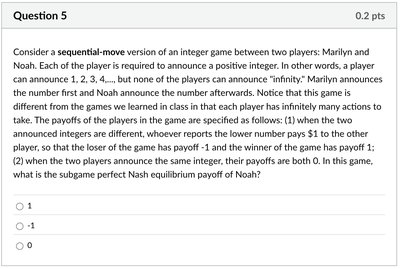
This question asks for the subgame perfect Nash equilibrium payoff for Noah in a sequential-move integer game where each player can choose any positive integer.
Key Terms and Formulas:
Sequential-Move Game: One player moves first, the other responds.
SPNE: Found by backward induction, even with an infinite strategy set.
Step-by-Step Guidance
Consider what Noah can do to always win, given Marilyn's choice.
Analyze what Marilyn will anticipate and how she will respond, knowing Noah's strategy.
Determine the equilibrium payoff for Noah based on this reasoning.
Try solving on your own before revealing the answer!
Q9. Nash Equilibrium in Bertrand Competition with Discrete Pricing
Background
Topic: Oligopoly – Bertrand Competition with Discrete Pricing
This question tests your understanding of Nash equilibrium in a Bertrand competition model where firms can only choose prices in discrete increments, and each firm has a different marginal cost.
Key Terms and Formulas:
Bertrand Competition: Firms compete by setting prices; the firm with the lower price captures the market.
Nash Equilibrium: No firm can increase profit by unilaterally changing its price.
Marginal Cost (MC): The cost of producing one more unit of output.
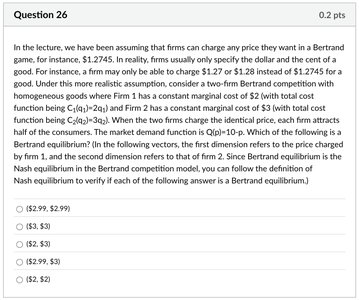
Step-by-Step Guidance
For each price pair, check if either firm can profitably deviate by changing its price by one cent.
Consider whether either firm would make a loss at the given prices, or could increase profit by undercutting the other.
Identify which price pair(s) satisfy the Nash equilibrium condition in this discrete Bertrand setting.
Try solving on your own before revealing the answer!
