 Back
BackMicroeconomics Homework 3 Study Guidance: Production Functions, Returns to Scale, Cost Minimization
Study Guide - Smart Notes
 Tailored notes based on your materials, expanded with key definitions, examples, and context.
Q1. What is the definition of the short run in microeconomics?
Background
Topic: Production Theory – Short Run vs. Long Run
This question tests your understanding of the distinction between the short run and the long run in the context of a firm's production decisions.
Key Terms:
Short run: A period during which at least one input (such as capital) is fixed and cannot be changed by the firm.
Long run: A period in which all inputs can be varied.
Step-by-Step Guidance
Recall that in microeconomics, inputs are resources used in production (e.g., labor, capital).
Think about what it means for an input to be "fixed" versus "variable." Fixed inputs cannot be changed quickly, while variable inputs can be adjusted.
Consider the time frame: The short run is defined by the presence of at least one fixed input, not by a specific number of months or years.
Review the options and identify which one best matches the economic definition of the short run.
Try solving on your own before revealing the answer!
Final Answer: The short run is a time period in which at least one input is fixed.
This is the standard microeconomic definition. It is not defined by a specific length of time, but by the flexibility of inputs.
Q2. Given the production function F(L,K) = 5KL, what is the maximum number of autos produced with K = 10 robots and L = 10 workers?
Background
Topic: Production Functions
This question tests your ability to apply a production function to calculate output given specific input values.
Key formula:
Where:
= labor input (number of workers)
= capital input (number of robots)
Step-by-Step Guidance
Identify the values given: , .
Plug these values into the production function: .
Multiply the numbers to find the total output, but stop before the final calculation.
Try solving on your own before revealing the answer!
Final Answer: 500 units
By substituting the values, you find the maximum output possible with the given inputs.
Q3. For the production function with , what is the expression for the average product of labor?
Background
Topic: Average Product of Labor
This question tests your ability to derive the average product of labor from a production function when capital is fixed.
Key formula:
Where:
= average product of labor
= production function
= labor input
= capital input (fixed at 1)
Step-by-Step Guidance
Substitute into the production function: .
Simplify to 1, so .
Apply the formula for average product: .
Simplify the expression further, but stop before the final form.
Try solving on your own before revealing the answer!
Final Answer:
By simplifying , you get .
Q4. For the same production function with , what is the expression for the marginal product of labor?
Background
Topic: Marginal Product of Labor
This question tests your ability to calculate the marginal product of labor by differentiating the production function with respect to labor.
Key formula:
Where:
= marginal product of labor
= production function
= labor input
= capital input (fixed at 1)
Step-by-Step Guidance
Recall the simplified production function: .
Differentiate with respect to : .
Apply the power rule for differentiation: .
Multiply by the constant 10 and write the expression, but stop before the final form.
Try solving on your own before revealing the answer!
Final Answer:
By differentiating , you get .
Q5. What is the Marginal Rate of Technical Substitution (MRTS) and how is it defined?
Background
Topic: Marginal Rate of Technical Substitution (MRTS)
This question tests your understanding of the MRTS, which describes how a firm can substitute between inputs while keeping output constant.
Key Terms:
MRTS: The rate at which one input can be substituted for another while holding output constant.
Isoquant: A curve representing all combinations of inputs that yield the same output.
Key formula:
(along an isoquant)
Step-by-Step Guidance
Recall that the MRTS is the slope of the isoquant, which shows the trade-off between labor and capital.
Understand that the mathematical definition is the ratio of marginal products: .
Consider the economic interpretation: MRTS tells you how much capital can be reduced when labor increases by one unit, keeping output constant.
Review the options and match them to the definitions above.
Try solving on your own before revealing the answer!
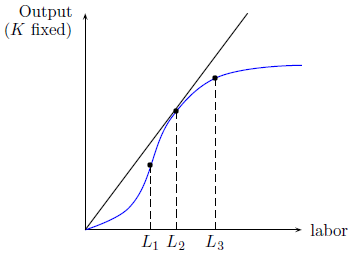
Q6. Consider the following graph of a production function when capital is fixed. What is the relationship between average product (AP) and marginal product (MP) at different levels of labor?
Background
Topic: Average Product vs. Marginal Product
This question tests your ability to interpret the relationship between AP and MP using a graph of the production function.
Key Terms:
Average Product (AP): Output per unit of labor.
Marginal Product (MP): Additional output from one more unit of labor.
Step-by-Step Guidance
Examine the graph to see how the slope (MP) compares to the line from the origin (AP) at different points.
Recall that when the tangent (MP) is steeper than the line from the origin (AP), .
Identify the points , , and compare the slopes at these points.
Use the visual information to determine the correct relationship, but stop before stating the final answer.
Try solving on your own before revealing the answer!
