 Back
Microeconomics Midterm Exam Study Guidance
Study Guide - Smart Notes
 Tailored notes based on your materials, expanded with key definitions, examples, and context.
Q1. In a world characterized by scarcity:
Background
Topic: Scarcity and Opportunity Cost
This question tests your understanding of the fundamental economic problem of scarcity and how it leads to opportunity costs and choices among alternatives.
Key Terms:
Scarcity: The condition that arises because resources are limited while wants are unlimited.
Opportunity Cost: The value of the next best alternative forgone when making a choice.
Step-by-Step Guidance
Recall the definition of scarcity and how it affects decision-making in economics.
Think about what scarcity forces individuals and societies to do regarding their wants and available resources.
Consider how opportunity cost is related to the concept of scarcity.
Review the answer choices and eliminate any that do not directly relate to the effects of scarcity.
Try solving on your own before revealing the answer!
Final Answer: b. people must make choices among alternatives.
Scarcity means that resources are limited, so individuals and societies must make choices about how to allocate them, leading to opportunity costs.
Q2. Grace advertises her bicycle for sale for $100 but is willing to accept $90. The best offer she receives is $100. Why does she not feel buyer's remorse?
Background
Topic: Consumer and Producer Surplus
This question examines your understanding of producer surplus and the concept of reservation price in voluntary exchange.
Key Terms:
Producer Surplus: The difference between the price a seller receives and the minimum price they are willing to accept.
Reservation Price: The lowest price at which a seller is willing to sell a good or service.
Step-by-Step Guidance
Identify Grace's reservation price and the price she actually receives.
Recall the definition of producer surplus and how it applies to this situation.
Think about why a seller would not regret selling at a price above their reservation price.
Review the answer choices and select the one that best explains Grace's lack of buyer's remorse.
Try solving on your own before revealing the answer!
Final Answer: c. She received more than her reservation price.
Grace is happy because she sold the bicycle for more than the minimum amount she was willing to accept, resulting in a producer surplus.
Q3. The graph shows the marginal social cost, demand, and supply curves in the salad dressing market. In this market, the socially optimal quantity and the market-determined output are:
Background
Topic: Market Equilibrium and Social Optimum
This question tests your ability to interpret supply, demand, and marginal social cost curves to determine both the market equilibrium and the socially optimal output.
Key Terms and Formulas:
Market Equilibrium: The point where the supply and demand curves intersect.
Socially Optimal Quantity: The quantity where the marginal social cost curve intersects the demand curve.
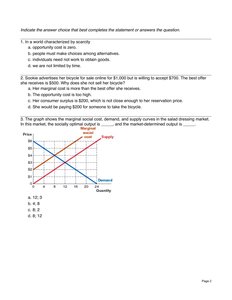
Step-by-Step Guidance
Locate the intersection of the supply and demand curves to find the market equilibrium quantity.
Find the intersection of the marginal social cost curve and the demand curve to determine the socially optimal quantity.
Compare the two quantities to see if the market overproduces or underproduces relative to the social optimum.
Review the answer choices and match them to your findings from the graph.
Try solving on your own before revealing the answer!
Final Answer: a. 6, 8
The market equilibrium is at quantity 8 (where supply and demand intersect), while the socially optimal quantity is at 6 (where marginal social cost and demand intersect).
Q4. The table shows the quantity demanded and quantity supplied of kombucha at various prices. If the government imposes a price ceiling of $3 per bottle of kombucha, the quantity of kombucha supplied will be ____ bottles.
Background
Topic: Price Ceilings and Market Outcomes
This question tests your understanding of how a price ceiling affects the quantity supplied in a market.
Key Terms:
Price Ceiling: A legal maximum price that can be charged for a good or service.
Quantity Supplied: The amount of a good that producers are willing to sell at a given price.
Step-by-Step Guidance
Find the row in the table where the price is $3 per bottle.
Look at the corresponding quantity supplied at that price.
Remember that a price ceiling set below equilibrium can create shortages.
Review the answer choices and select the quantity supplied at the price ceiling.
Try solving on your own before revealing the answer!
Final Answer: 4 bottles
At a price of $3, the table shows that the quantity supplied is 4 bottles.
