 Back
BackMicroeconomics Practice Exam Guidance
Study Guide - Smart Notes
 Tailored notes based on your materials, expanded with key definitions, examples, and context.
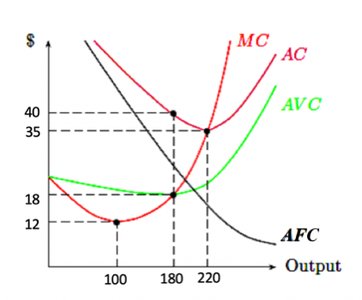
Q9. Consider the competitive firm whose MC, AC, AVC, AFC functions are shown in the following graph. If the market price is equal to $15, then the firm maximizes profits by producing _____?
Background
Topic: Perfect Competition & Cost Curves
This question tests your understanding of how a competitive firm determines its profit-maximizing output using cost curves and market price.
Key Terms and Formulas:
Marginal Cost (MC): The additional cost of producing one more unit of output.
Average Cost (AC): The total cost divided by the quantity produced.
Average Variable Cost (AVC): The variable cost divided by the quantity produced.
Average Fixed Cost (AFC): The fixed cost divided by the quantity produced.
Profit Maximization Rule: In perfect competition, firms maximize profit where and is rising.
Step-by-Step Guidance
Examine the graph and identify the MC, AC, AVC, and AFC curves. Note the output levels where these curves intersect.
Locate the market price () on the vertical axis and draw a horizontal line at this price level.
Find the output level(s) where the MC curve intersects the price line (). These are potential profit-maximizing quantities.
Check if the price is above the AVC at these output levels. If , the firm will produce; otherwise, it will shut down.
Compare the output levels to see which range matches the answer choices (e.g., more than 0 but less than 100 units, more than 100 but less than 180 units, etc.).
Try solving on your own before revealing the answer!
Final Answer: more than 0 but less than 100 units
At , the MC curve intersects the price line at an output level less than 100 units, and is above AVC, so the firm produces in this range.
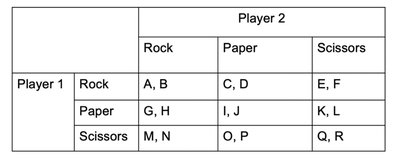
Q11. Rock-paper-scissors game is a two-player game, in which each player simultaneously forms one of three shapes with an outstretched hand. These shapes are "rock", "paper", and "scissors". A player playing rock will beat another player playing chosen scissors, but will lose to one playing paper; a play of paper will lose to a play of scissors. If both players choose the same shape, the game is tied. Suppose the winner receives a payoff of 1 and the loser receives the payoff of -1. Both players receive zero payoff under a tie. We use letters A to R to denote payoffs. Then K=?
Background
Topic: Game Theory – Payoff Matrix
This question tests your ability to interpret a payoff matrix and assign payoffs based on the rules of a classic game theory example: rock-paper-scissors.
Key Terms and Formulas:
Payoff Matrix: A table showing the outcomes (payoffs) for each player depending on their choices.
Winner: Receives payoff of 1.
Loser: Receives payoff of -1.
Tie: Both receive payoff of 0.
Step-by-Step Guidance
Review the rules: Rock beats Scissors, Paper beats Rock, Scissors beats Paper.
Locate the cell in the matrix where Player 1 chooses Paper and Player 2 chooses Scissors (this is where K, L are the payoffs).
Determine who wins in this scenario: Player 2 (Scissors) beats Player 1 (Paper).
Assign payoffs: Winner gets 1, loser gets -1. So K (Player 1's payoff) should be -1.
Try solving on your own before revealing the answer!
Final Answer: -1
Player 1 loses when choosing Paper against Player 2's Scissors, so K = -1.
