 Back
BackMicroeconomics Practice Final Exam – Step-by-Step Study Guidance
Study Guide - Smart Notes
 Tailored notes based on your materials, expanded with key definitions, examples, and context.
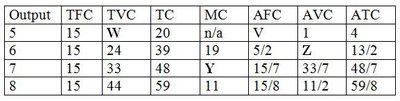
Q3. What is the value of W in the table above?
Background
Topic: Cost Concepts in Microeconomics
This question tests your understanding of how to calculate total variable cost (TVC) and total cost (TC) for a firm at different output levels. It also requires you to use relationships between cost components.
Key Terms and Formulas:
Total Fixed Cost (TFC): Costs that do not change with output.
Total Variable Cost (TVC): Costs that change with output.
Total Cost (TC): The sum of TFC and TVC.
Key formula:
Step-by-Step Guidance
Identify the values for TFC and TC at the output level where W appears (output = 5).
Recall that , so you can rearrange to solve for TVC: .
Plug in the values for TC and TFC from the table for output = 5.
Set up the equation for W and simplify, but do not solve for the final value yet.
Try solving on your own before revealing the answer!
Final Answer: W = 5
W represents the total variable cost at output 5, which is calculated by subtracting total fixed cost from total cost.
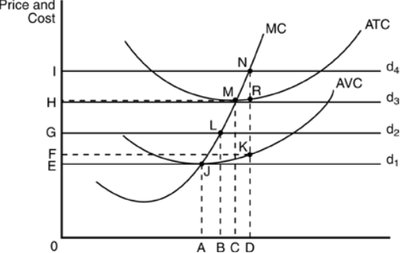
Q14. In Figure X above, the break-even point is:
Background
Topic: Break-even Analysis in Cost Curves
This question tests your ability to interpret cost curves and identify the break-even point, where a firm earns zero economic profit.
Key Terms and Formulas:
Break-even Point: The output and price at which total revenue equals total cost, so economic profit is zero.
Average Total Cost (ATC): Total cost divided by output.
Price: The amount received per unit sold.
Key formula:
Step-by-Step Guidance
Locate the ATC curve and the price lines in Figure X.
Identify the point where the price equals the average total cost (ATC).
Find the corresponding output level and price label (J, K, L, M, N) at this intersection.
Set up the reasoning for why this point represents the break-even point, but do not state the final label yet.
Try solving on your own before revealing the answer!
Final Answer: L
The break-even point occurs where the price line intersects the ATC curve, which is labeled L in Figure X.
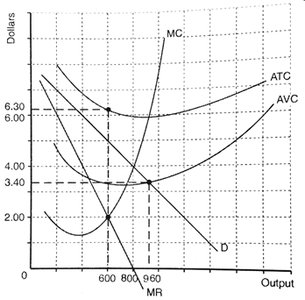
Q22. In the figure above, what is the total cost associated with producing 600 units of output?
Background
Topic: Cost Curves and Output Decisions
This question tests your ability to read cost curves and determine total cost at a specific output level.
Key Terms and Formulas:
Total Cost (TC): The sum of all costs incurred in producing a given level of output.
Average Total Cost (ATC): Total cost divided by output.
Key formula:
Step-by-Step Guidance
Locate the output level of 600 units on the horizontal axis of the graph.
Find the corresponding value of ATC at 600 units by reading the ATC curve.
Multiply the ATC value by the output (600 units) to set up the calculation for total cost.
Write out the multiplication, but do not compute the final value yet.
Try solving on your own before revealing the answer!
Final Answer: $3,780.00
We used the ATC value at 600 units and multiplied by the output to find total cost.
Q23. In the figure above, what is the economic profit associated with producing 600 units of output?
Background
Topic: Economic Profit Calculation
This question tests your ability to calculate economic profit using total revenue and total cost at a specific output level.
Key Terms and Formulas:
Total Revenue (TR): Price times quantity sold.
Total Cost (TC): The sum of all costs incurred in production.
Economic Profit: Total revenue minus total cost.
Key formula:
Step-by-Step Guidance
Find the price at which 600 units are sold by reading the demand curve at 600 units.
Calculate total revenue: .
Recall the total cost at 600 units from the previous question.
Set up the equation for economic profit, but do not compute the final value yet.
Try solving on your own before revealing the answer!
Final Answer: loss of $780
The firm incurs a loss because total cost exceeds total revenue at 600 units.
