 Back
Microeconomics Practice Midterm Study Guidance
Study Guide - Smart Notes
 Tailored notes based on your materials, expanded with key definitions, examples, and context.
Q1. Amy and Brad produce apples and pears. Explain how to use comparative advantage to assign production.
Background
Topic: Comparative Advantage
This question tests your understanding of how comparative advantage determines which individual should specialize in producing which good.
Key Terms and Formulas:
Comparative Advantage: The ability to produce a good at a lower opportunity cost than another producer.
Opportunity Cost: The value of the next best alternative foregone.
Step-by-Step Guidance
Identify the opportunity cost for Amy and Brad for producing apples and pears.
Compare the opportunity costs for each good between Amy and Brad.
Determine who has the lower opportunity cost for apples and who has the lower opportunity cost for pears.
Assign production so that each person specializes in the good for which they have a comparative advantage.
Try solving on your own before revealing the answer!
Final Answer:
Amy should specialize in producing apples, and Brad should specialize in producing pears, based on their comparative advantages.
This assignment ensures that total production is maximized by minimizing opportunity costs.
Q2. Characteristics of a Command Economy
Background
Topic: Economic Systems
This question tests your knowledge of the features that define a command economy.
Key Terms:
Command Economy: An economic system where the government makes all decisions about production and allocation of resources.
Public Ownership: The government owns the means of production.
Step-by-Step Guidance
Recall the main features of a command economy, such as central planning and government ownership.
Identify which options describe government control versus private ownership.
Focus on the option that directly refers to public ownership of the means of production.
Try solving on your own before revealing the answer!
Final Answer:
Public ownership of the means of production is a defining characteristic of a command economy.
In command economies, production decisions are made by central planners, not by private individuals.
Q3. Characteristics of Market Economies
Background
Topic: Market Economy
This question tests your understanding of how goods and services are allocated in a market economy.
Key Terms:
Market Economy: An economic system where decisions are made by individuals and firms interacting in markets.
Supply and Demand: Prices and quantities are determined by the interaction of buyers and sellers.
Step-by-Step Guidance
Recall that in a market economy, prices are determined by supply and demand.
Identify the option that describes allocation based on voluntary exchange between buyers and sellers.
Eliminate options that refer to central planning or government control.
Try solving on your own before revealing the answer!
Final Answer:
Allocation in a market economy is determined by voluntary exchange between buyers and sellers.
Prices and quantities are set by the forces of supply and demand.
Q4. Shifts in the Production Possibilities Curve (PPC)
Background
Topic: Production Possibilities Curve (PPC)
This question tests your understanding of what causes the PPC to shift outward, representing economic growth.
Key Terms:
PPC: A curve showing the maximum possible output combinations of two goods.
Economic Growth: An outward shift of the PPC.
Step-by-Step Guidance
Recall that the PPC shifts outward when resources or technology increase.
Identify which option describes an increase in productive resources (such as labor or capital).
Eliminate options that refer to changes in demand or allocation between goods.
Try solving on your own before revealing the answer!
Final Answer:
An increase in the amount of labor available for production will shift the PPC outward.
This represents economic growth and greater production capacity.
Q5. Trade allows consumption beyond PPC
Background
Topic: Gains from Trade
This question tests your understanding of how trade enables countries to consume outside their own production possibilities.
Key Terms:
Production Possibilities Curve (PPC): Shows the maximum output combinations possible without trade.
Trade: Allows countries to specialize and exchange goods, increasing total consumption.
Step-by-Step Guidance
Recall that trade enables countries to specialize based on comparative advantage.
Understand that specialization and exchange allow consumption beyond the PPC.
Identify the option that describes consumption outside the production possibilities curve.
Try solving on your own before revealing the answer!
Final Answer:
Trade allows countries to consume outside their production possibilities curve.
This is possible because specialization and exchange increase total output and consumption.
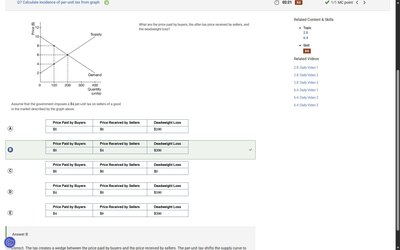
Q6. Estimate incidence of per-unit tax from graph
Background
Topic: Tax Incidence
This question tests your ability to interpret supply and demand graphs to determine how a tax is shared between buyers and sellers.
Key Terms and Formulas:
Tax Incidence: The division of the burden of a tax between buyers and sellers.
Deadweight Loss: The reduction in total surplus due to the tax.
Step-by-Step Guidance
Examine the supply and demand graph to identify the equilibrium price and quantity.
Locate the price paid by buyers and the price received by sellers after the tax is imposed.
Calculate the difference between these prices to determine the tax incidence.
Identify the deadweight loss area on the graph.
Try solving on your own before revealing the answer!
Final Answer:
Price paid by buyers: $8; Price received by sellers: $6; Deadweight loss: $200.
The tax creates a wedge between the price buyers pay and the price sellers receive, resulting in deadweight loss.
Q7. Draw price elasticity
Background
Topic: Price Elasticity of Demand
This question tests your understanding of how price elasticity affects the quantity demanded of a good.
Key Terms and Formulas:
Price Elasticity of Demand: Measures how much quantity demanded changes in response to a change in price.
Elasticity Formula:
Step-by-Step Guidance
Recall that elasticity greater than 1 means demand is elastic.
Identify the option that describes a large change in quantity demanded when price changes.
Eliminate options that describe inelastic demand (small change in quantity).
Try solving on your own before revealing the answer!
Final Answer:
A 1.8 percent decrease in price causes a 4.1 percent increase in quantity demanded, indicating elastic demand.
Elastic demand means consumers are highly responsive to price changes.
