 Back
BackMicroeconomics: Preliminaries and Introduction to Markets and Prices
Study Guide - Smart Notes
 Tailored notes based on your materials, expanded with key definitions, examples, and context.
Chapter 1: Preliminaries
1.1 The Themes of Microeconomics
Microeconomics is the branch of economics that studies the behavior of individual economic units such as consumers, firms, workers, and investors, as well as the markets they form. In contrast, macroeconomics focuses on aggregate economic variables like national output, interest rates, unemployment, and inflation.
Trade-Offs: Economic agents face trade-offs in their decisions.
Consumers: Must choose between more of some goods and less of others, and between current and future consumption.
Workers: Decide between different jobs and the trade-off between labor and leisure.
Firms: Decide what to produce and which resources to use in production.
Prices and Markets: Trade-offs are influenced by prices, which are determined differently in centrally planned economies (by the government) and market economies (by interactions in markets).
Theories and Models: Economics uses models—mathematical representations based on theory—to explain and predict phenomena. These models are tested using statistics and econometrics, but are always simplifications of reality.
Positive vs. Normative Analysis:
Positive analysis: Describes cause-and-effect relationships ("what is").
Normative analysis: Examines what ought to be, often involving value judgments.
1.2 What Is a Market?
A market is a collection of buyers and sellers whose interactions determine the price of a product or set of products. Defining a market involves identifying the relevant buyers, sellers, and products.
Arbitrage: The practice of buying at a low price in one location and selling at a higher price in another.
Competitive vs. Noncompetitive Markets:
Perfectly competitive market: Many buyers and sellers, none of whom can influence the price.
Noncompetitive market: Fewer producers, or producers with enough power to affect prices.
Market Price: The prevailing price in a competitive market. In noncompetitive markets, prices may differ among firms.
Market Definition—Extent of a Market: The boundaries of a market, both geographically and in terms of product range, are crucial for understanding competition and for public policy.
Example: The Market for Sweeteners
When Archer-Daniels-Midland acquired Clinton Corn Processing, the U.S. Department of Justice challenged the merger, arguing it would create a dominant producer of corn syrup. The debate centered on whether sugar and corn syrup were part of the same market, as they are used interchangeably in many products.
Example: Markets for Bicycles
There are distinct markets for bicycles, differentiated by the type of store and price range. Mass market bicycles are sold by large retailers at lower prices, while dealer bicycles are sold by specialty stores at higher prices.
Type of Bicycle | Companies and Prices (2011) |
|---|---|
Mass Market Bicycles | Huffy: $90–$140, Schwinn: $140–$240, Mantis: $129–$140, Mongoose: $120–$280 |
Dealer Bicycles | Trek: $400–$2500, Cannondale: $500–$2000, Giant: $500–$2500, Gary Fisher: $600–$2000, Mongoose: $700–$2000, Ridley: $1300–$2500, Scott: $1000–$3000, Ibis: $2000 and up |

1.3 Real versus Nominal Prices
Understanding the difference between nominal and real prices is essential for analyzing price changes over time.
Nominal Price: The absolute price of a good, unadjusted for inflation.
Real Price: The price of a good relative to an aggregate measure of prices (adjusted for inflation).
Consumer Price Index (CPI): Measures the aggregate price level for consumers.
Producer Price Index: Measures the aggregate price level for intermediate and wholesale goods.
Calculating Real Price:
The real price in year X (in year Y dollars) is calculated as:
Example: To compare the price of butter in 2015 to 1970, use the CPI values for those years. If the nominal price of butter in 2015 is $3.48, CPI in 1970 is 38.8, and CPI in 2015 is 237.0:
Although the nominal price increased, the real price (relative to overall inflation) actually fell.
Table: Real Prices of Eggs and College Education
1970 | 1980 | 1990 | 2000 | 2016 | |
|---|---|---|---|---|---|
Consumer Price Index | 38.8 | 82.4 | 130.7 | 172.2 | 241.7 |
Nominal Price (Eggs) | $0.61 | $0.84 | $1.01 | $0.91 | $2.47 |
Nominal Price (College) | $1,784 | $3,499 | $7,602 | $12,922 | $25,694 |
Real Price (Eggs, $1970) | $0.61 | $0.40 | $0.30 | $0.21 | $0.40 |
Real Price (College, $1970) | $1,784 | $1,624 | $2,239 | $2,912 | $4,125 |
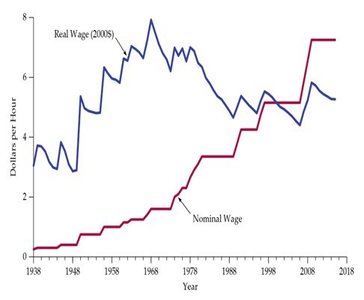
Example: The Minimum Wage
It is the real minimum wage that matters for purchasing power. While the nominal minimum wage has increased over time, its real value (adjusted for inflation) has declined since the 1970s.
Example: Health Care and College Textbooks
The prices of health care and college textbooks have risen much faster than overall inflation, especially textbook prices, which have increased about three times as fast as the CPI.

1.4 Why Study Microeconomics?
Microeconomics is essential for both corporate decision-making and public policy design.
Corporate Decision Making: For example, Toyota's introduction of the Prius involved economic analysis of consumer preferences, production costs, profit maximization, pricing, and competitive strategy.
Public Policy Design: Designing fuel efficiency standards (like CAFE) requires evaluating the impact on consumers, production costs, and understanding why market outcomes may not solve all problems related to oil consumption.
Applications: Microeconomics helps clarify trade-offs, inform debates, and guide both business and government decisions.
