 Back
Microeconomics Study Guide: Canadian Business System and Market Structures
Study Guide - Smart Notes
 Tailored notes based on your materials, expanded with key definitions, examples, and context.
Introduction to Microeconomics
The Idea of Business and Profit
Microeconomics examines how individuals and firms make decisions regarding the allocation of resources and the pricing of goods and services. Understanding the concepts of revenue, costs, and profit is fundamental to analyzing business operations within a market economy.
Revenue: The total income a company receives from selling goods or services to customers.
Costs: The expenses incurred in the process of producing and selling goods or services, including rent, salaries, supplies, and transportation.
Profit: The financial gain remaining after all costs have been deducted from revenue. If costs exceed revenue, the business experiences a loss.
Formula:
Example: If a company earns $100,000 in revenue and incurs $80,000 in costs, its profit is $20,000.



Introductory Economic Models
Economic Systems Around the World
Economic systems determine how resources are allocated and how economic activity is organized. The main types are market economies, command economies, and mixed economies.
Market Economy: Driven by supply and demand, with minimal government intervention. Capitalism is the political basis, encouraging private ownership and entrepreneurship.
Command Economy: The government controls the factors of production and makes all economic decisions. Examples include socialism and communism.
Mixed Economy: Combines elements of both market and command economies. Most modern economies, including Canada, are mixed.
Example: The People's Republic of China is transitioning from a command economy to a mixed market economy.
Supply and Demand
Market Mechanism and Price Determination
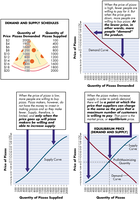
Supply and demand are fundamental concepts in microeconomics, determining the price and quantity of goods in a market. The interaction between buyers and sellers establishes the equilibrium price.
Supply: The quantity of a good that producers are willing to sell at various prices.
Demand: The quantity of a good that consumers are willing to buy at various prices.
Equilibrium: The point where supply equals demand, setting the market price.
Shortage: Occurs when quantity demanded exceeds quantity supplied, driving prices up.
Surplus: Occurs when quantity supplied exceeds quantity demanded, driving prices down.
Formula: is where
Example: If concert tickets are sold out but demand remains high, prices increase due to shortage.
Private Enterprise and Competition
Market Structures
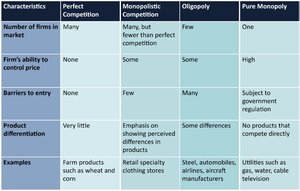
Market structure describes the competitive environment in which firms operate. The main types are perfect competition, monopolistic competition, oligopoly, and monopoly.
Perfect Competition: Many sellers, identical products, easy entry, no control over price.
Monopolistic Competition: Many sellers, differentiated products, some control over price.
Oligopoly: Few large suppliers, high barriers to entry, similar products, prices gravitate toward a common market price.
Monopoly: One producer, unique product, complete control over price, no competitors.
Duopoly: Two producers dominate the market, unique product, intense price competition.
Example: The Canadian banking sector is an oligopoly, while utilities like Toronto Hydro are monopolies.
Characteristics | Perfect Competition | Monopolistic Competition | Oligopoly | Pure Monopoly |
|---|---|---|---|---|
Number of firms in market | Many | Many, but fewer than perfect competition | Few | One |
Firm's ability to control price | None | Some | Some | High |
Barriers to entry | Few | Few | Many | Subject to government regulation |
Product differentiation | Very little | Emphasis on differences in products | Some differences | No products that compete directly |
Examples | Farm products (wheat, corn) | Retail specialty clothing stores | Steel, automobiles, airlines | Utilities (gas, water, cable TV) |
The Factors of Production
Resources Used by Firms
Factors of production are the resources businesses use to produce goods and services. These include natural resources, capital, human resources (labour), entrepreneurs, and information resources.
Natural Resources: Raw materials from nature, such as land, minerals, and water.
Capital: Machinery, tools, and buildings used in production.
Human Resources: The labour and skills provided by workers.
Entrepreneurs: Individuals who organize production and take risks.
Information Resources: Data and knowledge used to make business decisions.
Interactions Between Business and Government
Government Roles in the Economy
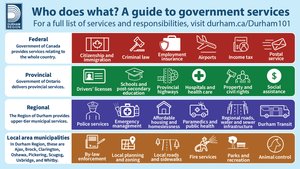
Governments interact with businesses in multiple ways, including regulation, taxation, provision of incentives, and essential services. These interactions shape the business environment and influence economic outcomes.
Regulator: Ensures healthy competition, protects consumers, achieves social goals, and protects the environment.
Taxation Agent: Collects revenue through taxes (income, property, HST, restrictive taxes).
Provider of Incentives: Offers financial aid and incentives to stimulate growth.
Provider of Essential Services: Supplies infrastructure and public services such as highways, postal service, money, military, education, health, sanitation, and emergency services.
Quick-Check Questions and Applications
Applying Microeconomic Concepts
Understanding microeconomic principles is essential for analyzing real-world scenarios. The following questions illustrate key concepts:
Shortage Example: Sold-out concert tickets with high demand lead to higher prices (quantity demanded exceeds quantity supplied).
Market Economy: Capitalism allows private ownership and profit incentives.
Command vs. Market Economy: The main difference is who controls the factors of production.
Oligopoly Example: Markets for laundry detergents, soft drinks, and cars are dominated by a few producers.
Canadian Economic System: Best described as a mixed market economy.
Additional info: These notes expand on the original content by providing definitions, examples, and formulas for key microeconomic concepts, ensuring a comprehensive and self-contained study guide.
