 Back
BackMicroeconomics Study Guide: Competitive, Monopoly, and Monopolistic Competition Markets
Study Guide - Smart Notes
 Tailored notes based on your materials, expanded with key definitions, examples, and context.
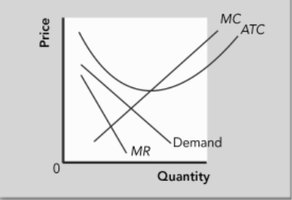
Q5. If the monopolistic competitor described by the exhibit is producing at the profit-maximizing (loss-minimizing) level of output, it _______.
Background
Topic: Monopolistic Competition – Short Run Profit or Loss
This question tests your understanding of how monopolistically competitive firms determine profit or loss in the short run, using cost curves and demand curves.
Key Terms and Formulas
Profit-maximizing output: The quantity where marginal revenue () equals marginal cost ().
Average Total Cost (): The average cost per unit produced.
Profit or Loss: Determined by comparing the price (from the demand curve at the profit-maximizing quantity) to at that quantity.
Step-by-Step Guidance
Identify the profit-maximizing quantity by finding where the curve intersects the curve.
At this quantity, move up vertically to the demand curve to find the price the firm can charge.
Compare this price to the at the same quantity. If price is above , the firm earns a profit; if price is below $ATC$, the firm incurs a loss.
Examine the graph to see whether the price at the profit-maximizing quantity is above or below the curve.
Try solving on your own before revealing the answer!
Final Answer: The firm is generating losses.
At the profit-maximizing quantity, the price from the demand curve is below the curve, indicating losses in the short run.
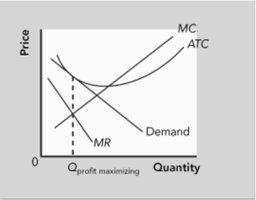
Q6. The monopolistically competitive market shown in the exhibit will, in the long run, _______.
Background
Topic: Monopolistic Competition – Long Run Adjustments
This question tests your understanding of how entry and exit of firms affect demand and profits in the long run for monopolistically competitive markets.
Key Terms and Formulas
Long run: Period in which firms can enter or exit the market.
Economic profit: If firms are making losses, some will exit; if making profits, new firms will enter.
Demand faced by incumbent firms: Entry or exit shifts the demand curve for existing firms.
Step-by-Step Guidance
Determine whether the firm is making profits or losses in the short run by comparing price and at the profit-maximizing quantity.
If firms are making losses, some will exit the market, which affects the demand curve faced by remaining firms.
Understand that exit of firms will shift the demand curve for incumbent firms to the right, increasing their market share and potentially restoring profits to zero in the long run.
Consider the adjustment process: as firms exit, the remaining firms' demand curves become less elastic and shift rightward.
Try solving on your own before revealing the answer!
Final Answer: Cause producers to exit the market, which will shift the demand faced by incumbent firms to the right.
Losses in the short run lead to exit, shifting the demand curve for remaining firms rightward until zero economic profit is achieved.
