 Back
BackMicroeconomics Study Guide: Input Markets and Market Structures
Study Guide - Smart Notes
 Tailored notes based on your materials, expanded with key definitions, examples, and context.
Input Demand: The Labor and Land Markets
Derived Demand and Marginal Revenue Product of Labor (MRPL)
In microeconomics, the demand for inputs such as labor and land is derived from the demand for the final goods and services produced. The Marginal Revenue Product of Labor (MRPL) is a key concept, representing the additional revenue generated by employing one more unit of labor.
MRPL Formula: where MPL is the marginal product of labor and P_X is the price of the product.
Diminishing MRPL: As more labor is employed, the marginal product of labor typically decreases, leading to diminishing MRPL.
Profit-Maximizing Labor: In the short run, firms hire labor up to the point where (wage rate).
Multiple Variable Inputs and Profit Maximization
When firms use more than one variable input (e.g., labor and capital), changes in the wage rate affect both labor and capital demand. The profit-maximizing condition requires equalizing the marginal product per dollar spent across inputs.
Profit-Maximizing Condition:
If , the firm should use more labor and less capital until equality is restored.
Market Structures
Perfect Competition
Perfect competition is characterized by many sellers offering identical products. Firms are price takers with no market power, and the demand curve they face is perfectly elastic.
Key Features: Many sellers, identical products, free entry and exit, zero economic profit in the long run.
Price and Output:
Firms produce at the lowest average total cost (ATC).
Monopoly
A monopoly exists when there is only one seller with no close substitutes. Monopolists have market power and are price makers, often due to barriers to entry.
Key Features: One seller, barriers to entry, market power, .
Profit Maximization: Output where ; price is set from the demand curve.
Long-Run Profits: Monopolists can earn positive economic profits in the long run.
Social Cost: Monopoly leads to higher prices and lower quantities than perfect competition, creating deadweight loss.
The Welfare Cost of Monopoly
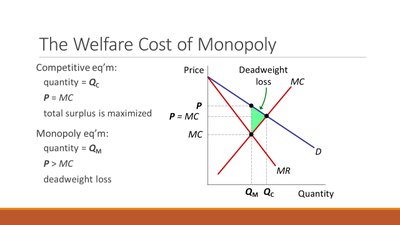
Monopoly reduces total surplus and creates deadweight loss compared to perfect competition.
Competitive Equilibrium: , , total surplus maximized.
Monopoly Equilibrium: , , deadweight loss occurs.
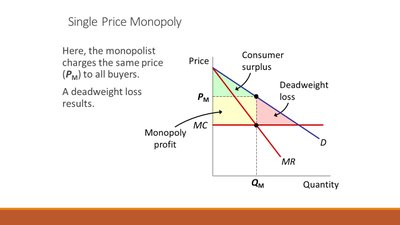
Single Price Monopoly
In a single price monopoly, the monopolist charges the same price to all buyers, resulting in consumer surplus, monopoly profit, and deadweight loss.
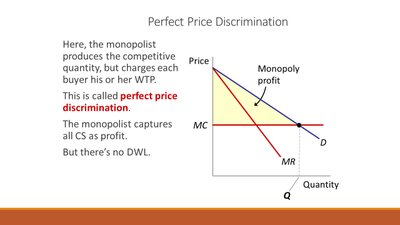
Perfect Price Discrimination
With perfect price discrimination, the monopolist charges each buyer their maximum willingness to pay, capturing all consumer surplus as profit and eliminating deadweight loss.
Oligopoly
Oligopoly is a market structure with a few sellers offering similar or identical products. Firms engage in strategic behavior, often analyzed using game theory.
Key Features: Few sellers, high concentration ratio, strategic behavior.
Game Theory: Used to find dominant strategies and Nash equilibrium.
Collusion: Firms may collude to act as a monopolist, but incentives to cheat exist.
As the number of firms increases, the market becomes more competitive and price approaches marginal cost.
Monopolistic Competition
Monopolistic competition features many sellers offering differentiated products. Firms have some market power but face competition due to free entry and exit.
Key Features: Many sellers, differentiated products, some market power.
Short Run: Firms behave like monopolists.
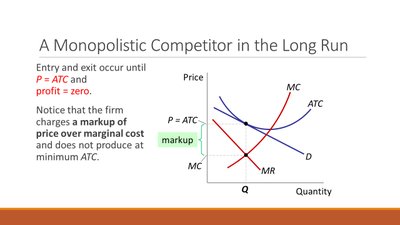
Long Run: Free entry and exit lead to zero economic profit, similar to perfect competition.
Efficiency: Monopolistic competition is less efficient than perfect competition due to excess capacity and markup over marginal cost.
Comparison of Market Structures
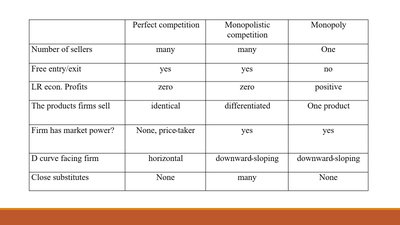
Characteristics Table
The following table summarizes the main characteristics of perfect competition, monopolistic competition, and monopoly:
Perfect competition | Monopolistic competition | Monopoly | |
|---|---|---|---|
Number of sellers | many | many | One |
Free entry/exit | yes | yes | no |
LR econ. Profits | zero | zero | positive |
The products firms sell | identical | differentiated | One product |
Firm has market power? | None, price-taker | yes | yes |
D curve facing firm | horizontal | downward-sloping | downward-sloping |
Close substitutes | None | many | None |
Additional info: The notes cover chapters 10, 13, 14, and 15, which are directly relevant to microeconomics topics such as input markets and market structures. All images included are directly relevant to the explanations provided.
