 Back
BackMicroeconomics Study Guide: Production, Costs, Market Structures, and Market Power
Study Guide - Smart Notes
 Tailored notes based on your materials, expanded with key definitions, examples, and context.
Production and Cost Concepts
Production Functions and Product Curves
The production function describes the relationship between inputs (such as labor and capital) and the output produced by a firm. Key product curves include:
Total Product (TP): The total quantity of output produced for a given quantity of inputs.
Marginal Product (MP): The additional output produced by using one more unit of an input, holding other inputs constant.
Average Product (AP): The output per unit of input.
Formulas:
Example: If adding one more worker increases output from 10 to 15 units, the marginal product of labor is 5.
Law of Diminishing Returns
The law of diminishing returns states that as more units of a variable input are added to fixed inputs, the additional output from each new unit will eventually decrease.
Application: This principle helps firms determine the optimal level of input usage.
Short-Run and Long-Run Costs
Costs are categorized based on the time frame:
Short-run: At least one input is fixed; includes fixed and variable costs.
Long-run: All inputs are variable; firms can adjust all factors of production.
Key Cost Concepts:
Total Cost (TC):
Average Total Cost (ATC):
Average Variable Cost (AVC):
Average Fixed Cost (AFC):
Marginal Cost (MC):
Example: If total cost increases from $100 to $120 when output increases from 10 to 12 units, marginal cost is $10 per unit.
Profit Maximization and Competitive Supply
Profit Maximization Rule
Firms maximize profit by producing the quantity where marginal cost equals marginal revenue ().
In perfect competition: (price), so profit maximization occurs where .
Short-Run and Long-Run Decisions
Short-run: Firms may continue to operate even if making losses, as long as price covers average variable cost ().
Long-run: Firms will exit the market if they cannot cover total costs ().
Market Structures
Perfect Competition
Characteristics of perfect competition include many firms, identical products, and free entry and exit. Firms are price takers.
Short-run equilibrium: Firms can earn profits or losses.
Long-run equilibrium: Firms earn zero economic profit as entry and exit drive profits to normal levels.
Monopoly and Market Power
A monopoly is a market with a single seller and high barriers to entry. Monopolists are price makers and face the market demand curve.
Profit maximization: Occurs where .
Monopoly pricing: Price is set above marginal cost, leading to deadweight loss and reduced market efficiency.
Monopolistic Competition and Oligopoly
Monopolistic competition: Many firms sell differentiated products; free entry and exit.
Oligopoly: Few firms dominate the market; strategic interactions are important (game theory applies).
Market Efficiency and Government Policy
Market Efficiency
Perfectly competitive markets maximize total surplus (consumer plus producer surplus). Monopolies and other market structures can lead to inefficiency.
Government Intervention
Price floors/ceilings: Government-imposed limits on prices can cause surpluses or shortages.
Taxes and subsidies: Affect market equilibrium, consumer and producer surplus, and deadweight loss.
Tariffs and quotas: Affect international trade and domestic market outcomes.
Comparisons and Graphical Analysis
Comparing Market Structures
The following table summarizes key differences between perfectly competitive firms, monopolies, and firms with monopoly power:
Market Structure | Number of Firms | Product Type | Price Setting Power | Long-Run Profit |
|---|---|---|---|---|
Perfect Competition | Many | Identical | None (Price Taker) | Zero |
Monopoly | One | Unique | High (Price Maker) | Possible |
Monopolistic Competition | Many | Differentiated | Some | Zero |
Oligopoly | Few | Identical or Differentiated | Some/High | Possible |
Graphical Analysis
Be able to draw and interpret cost curves (MC, ATC, AVC, AFC), product curves (TP, MP, AP), and demand/supply curves for different market structures.
Graph and explain the demand curves facing a monopoly, a firm with monopoly power, and a perfectly competitive firm.
Additional Topics
Explain the impact of government policies (taxes, subsidies, tariffs, quotas) on market outcomes.
Understand the relationship between market structure and market efficiency.
Apply game theory to analyze strategic interactions in oligopoly markets.
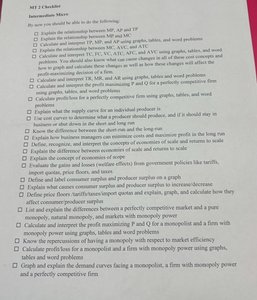
Additional info: This checklist covers core microeconomics topics relevant to chapters on production, costs, market structures, market power, and government intervention. Students should be able to apply concepts using graphs, tables, and real-world examples.
