 Back
Microeconomics Study Guide: Supply, Demand, Elasticity, and Market Efficiency
Study Guide - Smart Notes
 Tailored notes based on your materials, expanded with key definitions, examples, and context.
Core Economic Concepts
Scarcity and Resource Allocation
Scarcity is a fundamental concept in economics, referring to the limited nature of resources relative to unlimited human wants. This scarcity necessitates choices about how resources are allocated, leading to trade-offs and opportunity costs.
Scarcity: The condition where resources are insufficient to satisfy all wants and needs.
Opportunity Cost: The value of the next best alternative forgone when a choice is made.
Example: Allocating wheat for bread versus beer production.
Supply and Demand
Supply and demand are the primary forces determining prices and quantities in a market. The interaction between buyers and sellers establishes the equilibrium price and quantity.
Demand: The willingness and ability of consumers to purchase a product at a given price.
Law of Demand: As price decreases, quantity demanded increases (inverse relationship).
Factors Shifting Demand: Income changes, tastes, prices of related goods, advertising, population, legislation.
Supply: The amount of a product suppliers offer to the market at a given price.
Law of Supply: As price increases, quantity supplied increases (direct relationship).
Factors Shifting Supply: Production costs, weather, technology, legislation, expectations, number of suppliers.
Equilibrium: The point where quantity demanded equals quantity supplied; market clears.
Exceptions to the Law of Demand
Giffen Goods: Goods for which higher prices lead to higher demand due to strong income effects.
Veblen Goods: Goods for which higher prices increase demand due to their status symbol nature.
Elasticity
Price Elasticity of Demand (PED)
Price elasticity of demand measures how responsive the quantity demanded is to a change in price. It is crucial for business pricing strategies and understanding market dynamics.
Formula:
Elastic Demand: PED > 1; quantity demanded changes more than price.
Inelastic Demand: PED < 1; quantity demanded changes less than price.
Determinants: Number of substitutes, necessity, competition, brand loyalty.
Effect on Revenue: For elastic demand, price increase lowers total revenue; for inelastic demand, price increase raises total revenue.
Income Elasticity of Demand (YED)
Formula:
Elastic YED: Luxury goods; demand rises more than income.
Inelastic YED: Necessities; demand rises less than income.
Negative YED: Inferior goods; demand falls as income rises.
Tax Incidence and Elasticity
Tax Incidence: The division of the tax burden between buyers and sellers.
Elasticity and Burden: The less elastic side of the market bears more of the tax burden.
Government Policies and Market Outcomes
Price Controls
Governments may intervene in markets by setting price ceilings or floors to address perceived unfairness or market failures.
Price Ceiling: Legal maximum price; binding ceilings cause shortages and non-price rationing.
Price Floor: Legal minimum price; binding floors cause surpluses and non-price rationing.
Examples: Rent control, minimum wage, agricultural supports.
Taxes
Purpose: Raise revenue for public projects.
Impact: Reduces market activity; buyers and sellers share the burden.
Curve Shifts: Taxes shift demand downward for buyers, supply upward for sellers.
Distinctions and Market Structures
Microeconomics vs. Macroeconomics
Microeconomics: Studies individual markets and economic units.
Macroeconomics: Studies the economy as a whole (GDP, inflation, unemployment).
Change in Quantity Demanded/Supplied vs. Change in Demand/Supply
Movement Along Curve: Caused by price changes (change in quantity).
Shift of Curve: Caused by non-price determinants (change in demand/supply).
Market Economy, Command Economy, Mixed Economy
Market Economy: Allocation based on prices and voluntary exchange.
Command Economy: Allocation based on government decisions.
Mixed Economy: Combination of market and government intervention.
Efficiency and Equilibrium in Competitive Markets
Definition and Characteristics of Efficiency
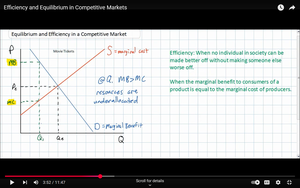
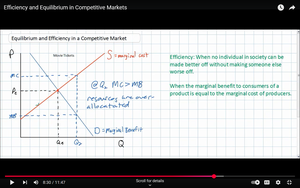
Efficiency in economics is achieved when no individual can be made better off without making someone else worse off. In a market, efficiency exists when the marginal benefit to consumers equals the marginal cost to producers, maximizing total surplus.
Marginal Benefit (MB): The additional benefit received by consumers from consuming one more unit.
Marginal Cost (MC): The additional cost incurred by producers from producing one more unit.
Equilibrium: at equilibrium quantity and price .
Consumer Surplus: The difference between what consumers are willing to pay and what they actually pay.
Producer Surplus: The difference between the price received and the minimum price at which producers are willing to sell.
Deadweight Loss (DWL): The loss of total welfare when the market operates at an inefficient quantity.
Example: At a quantity less than equilibrium (), marginal benefit exceeds marginal cost (), indicating under-allocation of resources and inefficiency. Increasing output towards equilibrium improves efficiency.
General Equilibrium and Pareto Efficiency
General equilibrium analysis considers all markets simultaneously, making opportunity costs explicit and clarifying the conditions for economic efficiency. Pareto efficiency is achieved when no one can be made better off without making someone else worse off.
First Welfare Theorem: Competitive equilibrium is Pareto efficient under standard assumptions.
Second Welfare Theorem: Any efficient allocation can be achieved via redistribution and markets.
Conditions: Equality of marginal rates of substitution (MRS), marginal rate of transformation (MRT), and no externalities.
Limitations: Efficiency does not address ethical issues of distribution.
Perfect Competition
Characteristics of Perfect Competition
Perfect competition is a theoretical market structure used as a benchmark in economic analysis. It features numerous buyers and sellers, identical products, perfect information, and no barriers to entry or exit.
Large and Homogeneous Market: Many buyers and sellers; identical products.
Price Takers: Firms cannot influence market price; prices determined by supply and demand.
Perfect Information: All participants have full information about prices and products.
No Barriers to Entry/Exit: Firms can freely enter or exit the market.
Perfect Mobility of Resources: Capital and labor can move freely.
Efficient Transportation: No significant costs or delays in moving goods.
Example: Farmers' markets and unbranded goods approximate elements of perfect competition.
Comparison: Perfect vs. Imperfect Competition
Perfect Competition: Idealized, theoretical; prices set by market forces; zero long-term profits.
Imperfect Competition: Real-world markets; product differentiation, branding, barriers to entry, and market power.
Additional info:
Some explanations and context were expanded for clarity and completeness, including definitions, formulas, and welfare theorems.
