 Back
BackMonopolistic Competition: Structure, Differentiation, and Efficiency
Study Guide - Smart Notes
 Tailored notes based on your materials, expanded with key definitions, examples, and context.
Monopolistic Competition
Industry Characteristics
Monopolistic competition is a common market structure characterized by many firms, easy entry and exit, and product differentiation. Unlike perfect competition, firms in monopolistic competition do not produce identical goods, allowing them some degree of market power.
Large Number of Firms: Many firms compete in the market, each with a small market share.
No Barriers to Entry: Firms can freely enter or exit the industry in the long run.
Product Differentiation: Each firm offers a product that is slightly different from its competitors, either through quality, features, branding, or other attributes.
Definition: Monopolistic competition is a market structure with many firms, free entry and exit, and differentiated products.
Comparison of Market Structures:
Market Structure | Number of Firms | Product Type | Price Control | Entry | Examples |
|---|---|---|---|---|---|
Perfect Competition | Many | Homogeneous | No | Easy | Wheat farmer, Textile firm |
Monopoly | One | Unique | Yes | Blocked | Public utility, Patented drug |
Monopolistic Competition | Many | Differentiated | Yes, limited | Easy | Restaurants, Hand soap |
Oligopoly | Few | Either | Yes | Limited | Automobiles, Aluminum |
Industry Concentration: The percentage of market share held by the largest firms varies by industry, reflecting the degree of competition and differentiation.
Product Differentiation and Advertising
Product differentiation is a strategy where firms make their products distinct from competitors to gain market power. This can be achieved through physical differences, branding, quality, or customer service. Advertising plays a crucial role in informing consumers about these differences and building brand loyalty.
Horizontal Differentiation: Products differ in ways that make them preferable to different consumers (e.g., flavors, colors).
Vertical Differentiation: Products differ in quality, with some universally considered better than others.
Behavioral Economics: Examines how psychological factors influence consumer choices, including the value placed on variety and the use of commitment devices to influence future behavior.
Example: In the haircare industry, firms differentiate products based on hair type, color, and other attributes. Smart products, such as a hairbrush with sensors and app connectivity, further differentiate offerings and promote related products.

Advertising:
Informative Role: Advertising provides information about product differences, availability, and prices, helping consumers make informed choices.
Persuasive Role: Advertising can create perceived differences and brand loyalty, sometimes beyond actual product attributes.
Debate: While advertising and differentiation can enhance market vitality and consumer choice, critics argue they may be wasteful, raise costs, and act as barriers to entry.
Example: Celebrity endorsements, such as those by well-known figures, can significantly boost sales for specific products without increasing overall market demand.

Price and Output Determination in Monopolistic Competition
Firms in monopolistic competition face a downward-sloping demand curve due to product differentiation. This gives them some control over price, but the presence of close substitutes makes demand more elastic than in monopoly, but less elastic than in perfect competition.
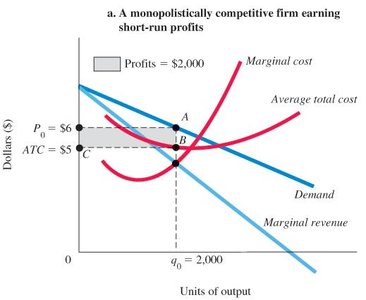
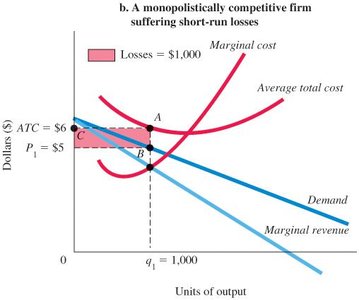
Short Run: Firms maximize profit where marginal revenue (MR) equals marginal cost (MC). They may earn profits or incur losses depending on demand and cost conditions.
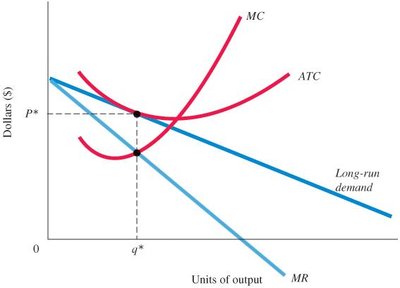
Long Run: Free entry and exit drive economic profits to zero. The firm's demand curve becomes tangent to its average total cost (ATC) curve, and only normal profit is earned.
Key Equations:
Profit maximization:
Zero economic profit in long run: at the profit-maximizing output
Graphical Analysis:
Short-run profit: The price is above ATC at the profit-maximizing output.
Short-run loss: The price is below ATC at the profit-maximizing output.
Long-run equilibrium: The demand curve is tangent to the ATC curve at the profit-maximizing output.
Economic Efficiency and Resource Allocation
Monopolistic competition is efficient in the sense that economic profits are eliminated in the long run due to free entry. However, two main inefficiencies persist:
Price Above Marginal Cost: Firms have some market power, so price exceeds marginal cost, leading to allocative inefficiency.
Excess Capacity: Firms do not produce at the minimum point of their ATC curve, resulting in unused capacity and higher average costs.
Despite these inefficiencies, product differentiation can increase consumer welfare by providing greater variety and innovation.
Key Terms and Concepts
Monopolistic Competition: Market structure with many firms, differentiated products, and free entry/exit.
Product Differentiation: Making a product distinct from competitors to gain market power.
Horizontal Differentiation: Differences that appeal to different consumer preferences.
Vertical Differentiation: Differences in quality, with some products universally preferred.
Behavioral Economics: Study of psychological influences on economic decision-making.
Commitment Device: Actions taken to influence future behavior (e.g., gym memberships).
