Back
BackMonopolistic Competition: Structure, Pricing, and Efficiency
Study Guide - Smart Notes
 Tailored notes based on your materials, expanded with key definitions, examples, and context.
Monopolistic Competition
Introduction to Monopolistic Competition
Monopolistic competition is a market structure characterized by many firms selling similar but not identical products, with low barriers to entry. Unlike perfect competition, where products are identical, monopolistically competitive firms differentiate their products, leading to a downward-sloping demand curve for each firm.
Many firms: Numerous sellers compete in the market.
Product differentiation: Each firm offers a product that is slightly different from its competitors.
Low barriers to entry: New firms can enter the market easily, driving long-run profits to zero.
Example: Coffeehouses like Blue Bottle differentiate their coffee from competitors through quality, branding, or customer experience.
Demand and Marginal Revenue in Monopolistic Competition
Firms in monopolistic competition face a downward-sloping demand curve because their products are differentiated. This means that if a firm raises its price, it will lose some, but not all, customers to competitors. The marginal revenue (MR) curve lies below the demand curve because selling additional units requires lowering the price on all units sold.
Demand curve: Shows the relationship between price and quantity demanded for a firm's product.
Marginal revenue: The additional revenue from selling one more unit, always less than the price for firms with downward-sloping demand.
Output effect: Revenue gained from selling an additional unit.
Price effect: Revenue lost from lowering the price on all previous units sold.
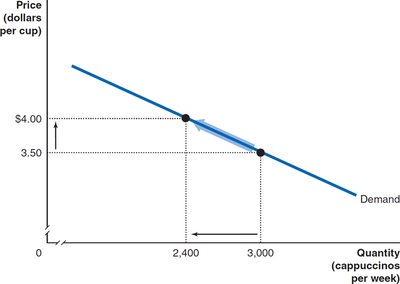
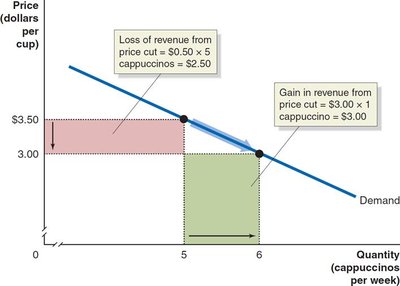
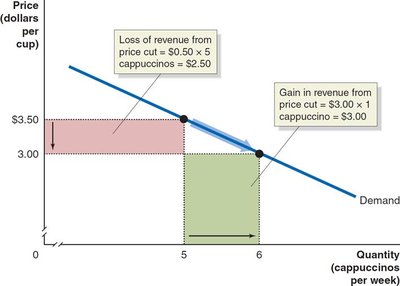
Table: Demand, Revenue, and Cost Data
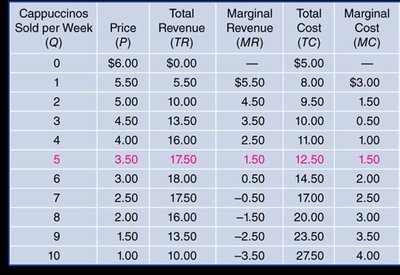
The following table illustrates how price, total revenue, marginal revenue, total cost, and marginal cost change as the quantity of cappuccinos sold increases. Marginal revenue becomes negative as price reductions are required to sell more units.
Q | P | TR | MR | TC | MC |
|---|---|---|---|---|---|
0 | 6.00 | 0.00 | — | 5.00 | — |
1 | 5.50 | 5.50 | 5.50 | 8.00 | 3.00 |
2 | 5.00 | 10.00 | 4.50 | 9.50 | 1.50 |
3 | 4.50 | 13.50 | 3.50 | 10.00 | 0.50 |
4 | 4.00 | 16.00 | 2.50 | 11.00 | 1.00 |
5 | 3.50 | 17.50 | 1.50 | 12.50 | 1.50 |
6 | 3.00 | 18.00 | 0.50 | 14.50 | 2.00 |
7 | 2.50 | 17.50 | -0.50 | 17.00 | 2.50 |
8 | 2.00 | 16.00 | -1.50 | 20.00 | 3.00 |
9 | 1.50 | 13.50 | -2.50 | 23.50 | 3.50 |
10 | 1.00 | 10.00 | -3.50 | 27.50 | 4.00 |
Profit Maximization in Monopolistic Competition
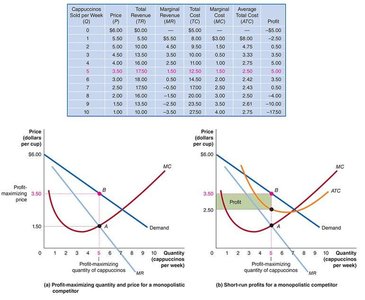
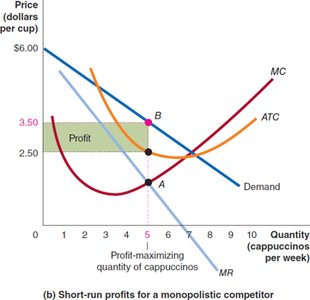
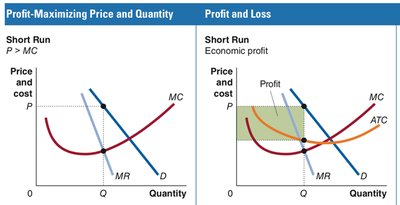
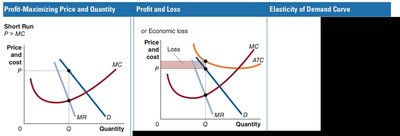
To maximize profit, a monopolistically competitive firm produces the quantity where marginal revenue equals marginal cost (). The corresponding price is found on the demand curve, and profit is the area between price and average total cost (ATC) at the profit-maximizing quantity.
Profit-maximizing rule:
Profit calculation:
Short-run outcome: The firm may earn positive economic profit, break even, or incur a loss.
Short-Run and Long-Run Outcomes
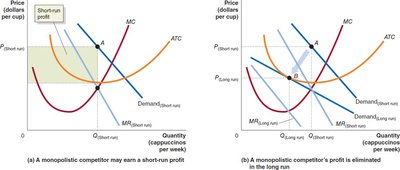
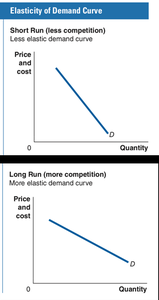
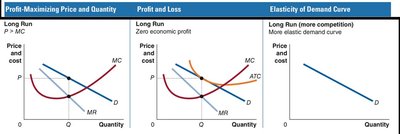
In the short run, monopolistically competitive firms can earn profits or losses. In the long run, entry and exit of firms drive economic profit to zero. The demand curve becomes more elastic (flatter) as consumers have more substitutes, and the ATC curve becomes tangent to the demand curve at the profit-maximizing quantity.
Short run: Firms may earn profits or losses.
Long run: Entry and exit ensure zero economic profit; demand is more elastic.
Adjustment process: Profits attract entry, reducing demand for existing firms; losses cause exit, increasing demand for remaining firms.
Product Differentiation and Marketing
Firms attempt to maintain profits in the long run through product differentiation and marketing. Successful differentiation can be achieved through innovation, quality improvements, or effective advertising and brand management.
Marketing: Activities to sell a product, including advertising and promotion.
Brand management: Actions to maintain product differentiation over time.
Advertising: Increases demand and can make demand more inelastic, allowing higher prices and profits in the short run.
Brand defense: Protecting a brand name from becoming generic or misused by others.
Efficiency in Monopolistic Competition vs. Perfect Competition
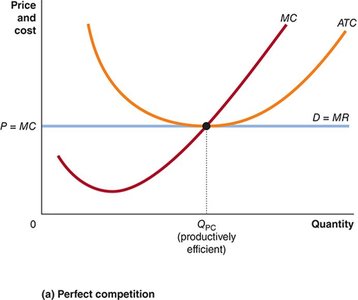
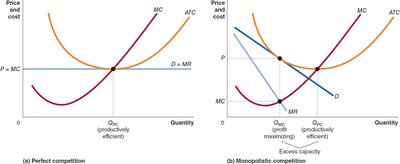
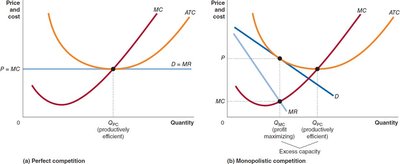
Monopolistic competition does not achieve productive or allocative efficiency. In perfect competition, firms produce at the lowest possible cost and where price equals marginal cost. In monopolistic competition, firms have excess capacity and price exceeds marginal cost.
Productive efficiency: Producing at the lowest possible cost (minimum ATC).
Allocative efficiency: Producing where marginal benefit equals marginal cost ().
Excess capacity: Firms could lower average cost by increasing output.

Consumer Benefits and Firm Success
Despite inefficiency, monopolistic competition can benefit consumers through product variety and differentiation. Many consumers are willing to pay higher prices for products that better match their preferences. A firm's success depends on its ability to differentiate its product and produce at lower cost than competitors, as well as factors beyond its control.
Consumer benefit: Greater variety and products tailored to preferences.
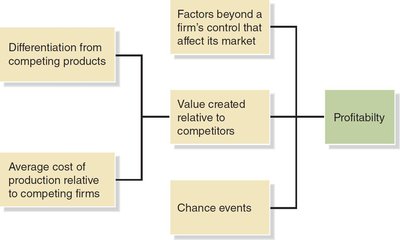
Firm profitability: Determined by differentiation, cost structure, market factors, and chance events.