 Back
BackCh.15 Monopoly and Antitrust Policy: Microeconomics Study Notes
Study Guide - Smart Notes
 Tailored notes based on your materials, expanded with key definitions, examples, and context.
Monopoly and Antitrust Policy
Introduction to Monopoly
Monopoly represents one extreme of market structure, where a single firm is the sole seller of a good or service with no close substitutes. Understanding monopoly is crucial for analyzing market power, economic efficiency, and government regulation.
15.1 Is Any Firm Ever Really a Monopoly?
Definition and Real-World Examples
Monopoly: A firm that is the only seller of a good or service for which there is not a close substitute.
Monopolies are rare, but some firms have significant market power due to lack of close substitutes.
Firms may collude to act like a monopoly, making it important to understand monopoly behavior.
Market power allows firms to raise prices and earn economic profits.
Example: The U.S. Postal Service (USPS) historically held a legal monopoly on mail delivery, but competition from private firms and electronic communication has eroded its dominance.

15.2 Where Do Monopolies Come From?
Barriers to Entry
Monopolies arise due to barriers that prevent other firms from entering the market. The four main sources are:
Government Restrictions on Entry: Patents, copyrights, trademarks, and public franchises legally protect firms from competition.
Control of a Key Resource: Ownership or control over essential resources can prevent entry (e.g., ALCOA's control of bauxite).
Network Externalities: The value of a product increases as more people use it, creating a self-reinforcing monopoly (e.g., social networks, operating systems).
Natural Monopoly: When economies of scale are so large that one firm can supply the entire market at a lower cost than multiple firms.
Example: Hasbro's trademark on the Monopoly board game prevents other firms from using the same name, maintaining its monopoly in that market.

15.3 How Does a Monopoly Choose Price and Output?
Profit Maximization for a Monopolist
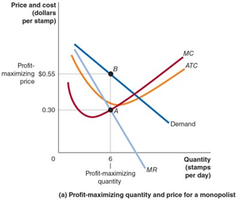
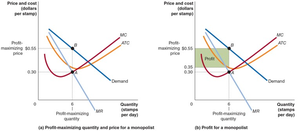
Monopolists maximize profit by producing the quantity where marginal revenue (MR) equals marginal cost (MC). Unlike perfect competitors, monopolists face a downward-sloping demand curve and can set prices above marginal cost.
Profit-Maximizing Rule: Produce where .
The price is determined by the demand curve at the profit-maximizing quantity.
Barriers to entry allow monopolists to earn long-run economic profits.
15.4 Does Monopoly Reduce Economic Efficiency?
Monopoly vs. Perfect Competition
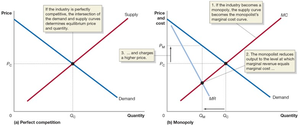
Monopolies reduce economic efficiency compared to perfectly competitive markets. They produce less output at a higher price, resulting in a deadweight loss to society.
Consumer Surplus: Decreases under monopoly due to higher prices.
Producer Surplus: Increases for the monopolist but does not offset the loss in consumer surplus.
Deadweight Loss: The reduction in total economic surplus due to fewer trades.
15.5 Price Discrimination: Charging Different Prices for the Same Product
How Firms Increase Profits through Price Discrimination
Price discrimination occurs when a firm charges different prices to different customers for the same product, not based on cost differences. This strategy increases profits by capturing more consumer surplus.
Conditions for Price Discrimination:
Market power
Identifiable groups with different willingness to pay
Prevention of resale (arbitrage)
Examples: Student and senior discounts at movie theaters, airline ticket pricing based on booking time and stay duration.
Perfect Price Discrimination: Charging each consumer their maximum willingness to pay eliminates consumer surplus but can increase efficiency by eliminating deadweight loss.
15.6 Government Policy Toward Monopoly
Antitrust Laws and Regulation
Governments regulate monopolies to protect consumer welfare and promote competition. Antitrust laws prohibit collusion and restrict mergers that reduce competition.
Collusion: Agreements among firms to avoid competition are illegal.
Antitrust Laws: Laws such as the Sherman Act and Clayton Act aim to prevent anti-competitive practices.
Merger Guidelines: The Department of Justice and Federal Trade Commission evaluate mergers based on market definition, concentration (using the Herfindahl-Hirschman Index), and potential efficiency gains.
Regulating Natural Monopolies: Governments may set prices to allow zero economic profit, balancing efficiency and firm viability.
Additional info: These notes cover all major aspects of monopoly and antitrust policy as outlined in a standard microeconomics curriculum, including definitions, sources of monopoly power, profit maximization, efficiency implications, price discrimination, and government regulation. All images included are directly relevant to the explanations provided and reinforce key concepts.
