 Back
BackChapter 15
Study Guide - Smart Notes
 Tailored notes based on your materials, expanded with key definitions, examples, and context.
Monopoly and Antitrust Policy
Definition and Characteristics of Monopoly
A monopoly is a market structure where a single firm is the sole seller of a good or service with no close substitutes. This unique position gives the firm significant market power.
Single seller: Only one firm supplies the product.
Single product: The product has no close substitutes.
High barriers to entry: Other firms cannot easily enter the market.
Examples: Google (search engines), Microsoft (software), Intel (microchips), Sirius/XM radio (satellite radio). However, the degree of monopoly power depends on how broadly the market is defined.
Elasticity of Demand: Even monopolies face demand elasticity. If substitutes exist in a broader market, the monopoly's pricing power is limited.
Close Substitutes
A close substitute is a product that can attract customers away from the monopoly by offering a lower price. For example, candles are not a close substitute for electric lights because consumers will not switch regardless of price.
Sources of Monopoly Power
Monopolies arise due to several key factors:
Government Barriers: The government may block entry through patents, copyrights, public franchises, or by operating as a public enterprise.
Patent: Exclusive right to produce a product for 20 years.
Copyright: Exclusive right to creative works for the creator's life plus 70 years for heirs.
Public Franchise: Government designates a single legal provider (e.g., utilities).
Public Enterprise: Government itself is the sole provider.
Control of Key Resources: Ownership or control of essential resources (e.g., International Nickel Company, major sports leagues).
Network Externalities: The value of a product increases as more people use it (e.g., Microsoft, eBay).
Natural Monopoly: Economies of scale are so significant that one firm can supply the entire market at a lower average total cost (ATC) than multiple firms.
Natural Monopoly Example: Utility companies often exhibit natural monopoly characteristics due to high fixed costs and declining ATC over a large output range.
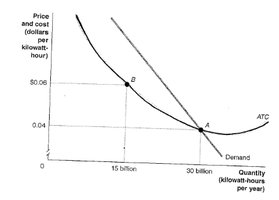
Monopoly Pricing and Output Decisions
Unlike perfectly competitive firms (price takers), monopolies are price makers and face a downward-sloping demand curve. They maximize profit by producing the quantity where marginal revenue (MR) equals marginal cost (MC):
Monopolies can set prices above marginal cost, but higher prices reduce quantity demanded.
Comparison to Monopolistic Competition
In monopolistic competition, firms can earn short-run profits, but entry of new firms erodes these profits in the long run, leading to zero economic profit.
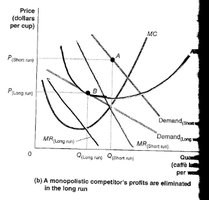
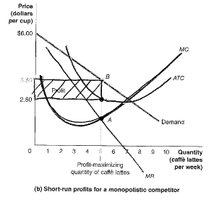
In contrast, monopolies maintain long-run economic profits due to barriers to entry.
Monopoly Profits and Efficiency
Monopolies are less efficient than perfectly competitive markets. They produce less and charge higher prices, resulting in:
Reduction in consumer surplus
Increase in producer surplus
Deadweight loss (loss of economic efficiency)
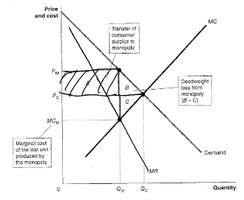
Monopolies produce where , not where , causing deadweight loss and transferring some consumer surplus to the producer.
Market Power
Market power is the ability of a firm to set prices above marginal cost, enabled by barriers to entry.
Antitrust Policy and Regulation
Governments use antitrust laws to prevent monopolies and collusion, and to promote competition. Examples include:
Sherman Antitrust Act (1890)
Clayton Act (1914)
Federal Trade Commission Act (1914)
Natural monopolies are often regulated through price ceilings to prevent excessive pricing.
Summary of Monopoly Effects
Monopolies reduce consumer surplus and economic efficiency.
Producer surplus increases under monopoly.
Deadweight loss represents the inefficiency caused by monopoly pricing.
Antitrust laws and regulation aim to mitigate these negative effects.
Conclusion: While some firms have monopoly-like power, competition in most markets helps limit efficiency losses and keeps markets functioning effectively.
