 Back
BackMonopoly: Structure, Pricing, and Welfare in Microeconomics
Study Guide - Smart Notes
 Tailored notes based on your materials, expanded with key definitions, examples, and context.
The Monopolistic Firm
Definition and Characteristics
A monopoly is a market structure where a single firm is the sole producer and seller of a good or service with no close substitutes. This firm has significant control over the market price and faces unique barriers to entry.
Sole Seller: The monopolist is the only provider of a particular product.
No Close Substitutes: Consumers cannot easily switch to another product.
Barriers to Entry: Entry is restricted by legal (patents, regulation) or natural (high costs, control of key resources) barriers.
Price Maker: The monopolist can set the price, unlike firms in competitive markets.
Example: Google in search engine traffic (90% market share in the UK), Tesco in UK groceries (30%), and firms with patents.
Monopoly in Different Countries
UK: Monopoly power is defined as >25% market share.
Israel: Defined as >50% market share.
US: Defined as >70% market share.
Public Perception of Monopolists
The term "monopolist" often carries negative connotations due to higher prices and lower quantities supplied compared to competitive markets. Monopolists earn higher profits, often at the expense of consumer surplus. However, not all monopolists are inherently harmful; some may provide essential goods efficiently.
Profit Maximization under Uniform Pricing
Key Assumptions
One producer, no close substitutes.
Entry is restricted.
The seller is a price-maker.
All firms aim to maximize profits.
Monopolist's Strategy
The monopolist observes the entire market demand curve and chooses a single (uniform) price for all units sold. Price discrimination is not allowed at this stage.
Uniform Pricing: All units are sold at the same price.
Profit Maximization: The monopolist selects the price and quantity combination that maximizes profit.
The Revenue Curve and Trade-Offs
The monopolist faces a downward-sloping demand curve. Increasing price reduces quantity demanded, and at very high prices, quantity demanded may fall to zero, resulting in zero or negative profit. The monopolist must balance earning more on inframarginal units against selling fewer units overall.
Trade-Off: Higher prices yield more profit per unit but reduce total sales.
Choice Constraint: The monopolist can choose either price or quantity, but not both independently.
Demand Curves: Perfect Competition vs. Monopoly
Comparison of Demand Perception
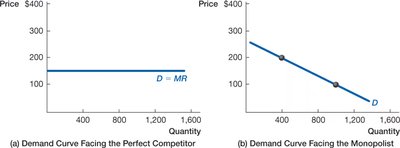
In perfect competition, each firm faces a perfectly elastic demand curve at the market price, meaning price equals marginal revenue (MR). In monopoly, the firm faces the entire market demand, which is downward sloping, so price does not equal marginal revenue.
Perfect Competition: Price = Marginal Revenue ()
Monopoly: Price > Marginal Revenue ()
Table: Demand Curve Comparison
Market Structure | Demand Curve | Marginal Revenue |
|---|---|---|
Perfect Competition | Horizontal (Perfectly Elastic) | |
Monopoly | Downward Sloping |
Graphical Illustration
The following image illustrates the difference between the demand curve facing a perfect competitor and a monopolist:
Additional Info
Marginal Revenue Formula for Monopoly:
Monopolists must consider the effect of changing price on total revenue, unlike competitive firms.
