 Back
BackChapter 14
Study Guide - Smart Notes
 Tailored notes based on your materials, expanded with key definitions, examples, and context.
Oligopolies – Firms in Less Competitive Markets
Introduction to Oligopolies
Oligopolies are market structures characterized by a small number of interdependent firms competing with one another. This structure lies between perfect competition (many firms) and monopoly (one firm). Oligopolies are notable for their strategic interactions, high barriers to entry, and the significant influence each firm has on the market.
Few firms dominate the market.
Selling similar or differentiated products.
High barriers to entry prevent new competitors from easily entering the market.
Examples include the computer market (e.g., Microsoft and Apple) and OPEC in the oil industry.
Why Standard Graphs Are Not Sufficient
Unlike perfect and monopolistic competition, oligopolies require more complex analysis than simply using demand and cost curves. This is because:
Firms' strategies are interdependent; each firm's actions can significantly affect the market and its rivals.
Demand and marginal revenue (MR) curves are difficult to construct due to this interdependence.
Therefore, economists use game theory to analyze oligopolistic behavior.
Measuring Market Concentration
The concentration ratio (often the four-firm concentration ratio, or C4) measures the percentage of industry sales accounted for by the four largest firms. A C4 above 40% typically indicates an oligopoly.
Barriers to Entry in Oligopolies
Barriers to entry are crucial for the existence of oligopolies. The main types are:
Economies of scale: Large firms have lower average total costs (ATC) than smaller firms, limiting the number of firms that can profitably operate.
Ownership of a key input: Control over essential resources (e.g., DeBeers and diamonds, Ocean Spray and cranberries) can prevent new entrants.
Government-imposed barriers: Patents, licensing, and trade restrictions protect incumbent firms.
Patents are especially important in industries like pharmaceuticals, as they incentivize research and development by granting exclusive rights for 20 years.
Game Theory and Oligopoly Behavior
Introduction to Game Theory
Game theory studies strategic decision-making where the outcome for each participant depends on the actions of others. In oligopolies, firms must anticipate and respond to rivals' strategies.
Rules: Define allowable actions.
Strategies: Plans to achieve objectives.
Payoffs: Outcomes resulting from the combination of strategies.
Payoff Matrix Example: Pricing in a Duopoly
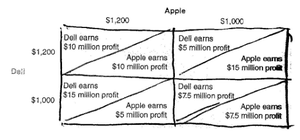
Consider Apple and Dell, each choosing between a high price ($1,200) and a low price ($1,000) for computers. The profits depend on both firms' choices.
Key Points:
If both charge $1,200, each earns $10 million.
If one charges $1,000 and the other $1,200, the low-price firm earns $15 million, the other $5 million.
If both charge $1,000, each earns $7.5 million.
This matrix illustrates the strategic interdependence in oligopolies.
Dominant Strategy and Nash Equilibrium
Dominant strategy: The best strategy for a firm, regardless of what the other does.
Nash equilibrium: A situation where each firm chooses the best strategy given the other’s choice, and no firm can improve its outcome by changing its own strategy unilaterally.
In the Apple-Dell example, both firms have a dominant strategy to charge $1,000, leading to a Nash equilibrium with lower profits than if they cooperated.
Cooperative vs. Non-Cooperative Equilibrium
Cooperative equilibrium: Firms cooperate to maximize joint profits (e.g., both charge $1,200).
Non-cooperative equilibrium: Firms act in their own self-interest, often leading to lower profits for all (e.g., both charge $1,000).
This situation is known as the prisoner’s dilemma, where rational strategies lead to a worse outcome for all participants.
Payoff Matrix Example: Advertising Decisions
Consider Pepsi and Coca-Cola deciding whether to advertise. The profits depend on both firms' choices.
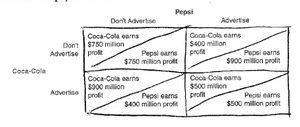
Both firms have a dominant strategy to advertise, leading to a Nash equilibrium where both earn lower profits than if neither advertised.
Cartels and Collusion
A cartel is a group of firms that collude to restrict output and increase prices and profits (e.g., OPEC). However, collusion is illegal in the U.S. and difficult to sustain because individual members have incentives to cheat.
Payoff Matrix Example: OPEC Cartel
Consider Saudi Arabia and Nigeria deciding on oil output levels. The profits depend on both countries' choices.
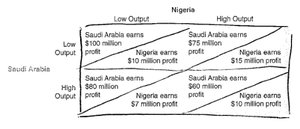
Saudi Arabia’s dominant strategy is to produce at a low output; Nigeria’s is to produce at a high output.
Cooperation is difficult to sustain, leading to fluctuating oil prices.
Repeated Games and Implicit Collusion
In real markets, games are often repeated, allowing for strategies like retaliation and implicit collusion (e.g., price-matching guarantees) that can sustain higher prices without explicit agreements.
Sequential Games in Oligopoly
Entry Deterrence
Firms can deter entry by setting prices low enough to make entry unattractive for potential competitors. This is analyzed using decision trees (sequential games).
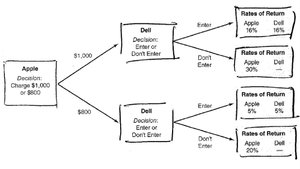
If Apple sets a high price, Dell may enter, reducing profits for both.
If Apple sets a lower price, Dell may stay out, allowing Apple to maintain higher profits.
Bargaining Between Firms
Firms often negotiate with suppliers or buyers. Decision trees help analyze bargaining strategies and outcomes.
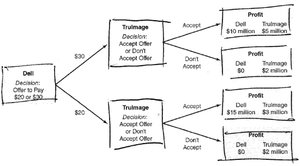
Firms may bluff or threaten to reject offers, but rational analysis can reveal the best strategy.
The Five Competitive Forces Model
Overview
Besides the number of firms, five forces determine the level of competition and profitability in an industry:
Competition from existing firms: More firms mean more competition and lower profits.
Threat from potential entrants: The possibility of new entrants can limit profits and prompt defensive strategies.
Competition from substitute goods or services: New products can reduce demand for existing ones.
Bargaining power of buyers: Powerful buyers can demand lower prices or higher quality, reducing profits.
Bargaining power of suppliers: Powerful suppliers can demand higher prices for inputs, reducing profits.
These forces are dynamic and can change over time, affecting the competitive landscape.
Key Terms and Concepts
Oligopoly: Market with a few interdependent firms.
Concentration ratio (C4): Percentage of sales by the four largest firms.
Barrier to entry: Obstacles preventing new firms from entering a market.
Game theory: Study of strategic interactions.
Payoff matrix: Table showing payoffs for each combination of strategies.
Dominant strategy: Best strategy regardless of rivals’ actions.
Nash equilibrium: No firm can improve its outcome by changing strategy unilaterally.
Cartel: Group of firms colluding to restrict output and raise prices.
Sequential game: Game where players move in sequence, not simultaneously.
Summary
Oligopolies are defined by strategic interdependence, high barriers to entry, and the use of game theory to analyze firm behavior. Understanding payoff matrices, dominant strategies, Nash equilibrium, and the five competitive forces is essential for analyzing competition and profitability in oligopolistic markets.
