 Back
BackOligopoly and Monopolistic Competition: Market Structures and Strategic Firm Behavior
Study Guide - Smart Notes
 Tailored notes based on your materials, expanded with key definitions, examples, and context.
Oligopoly and Monopolistic Competition
Introduction to Market Structures
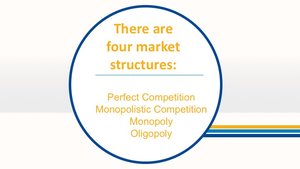
Market structures describe the organization and characteristics of markets, primarily based on the number of firms, product differentiation, and barriers to entry. The four main market structures are: perfect competition, monopolistic competition, monopoly, and oligopoly. This lecture focuses on the latter two forms of imperfect competition: monopolistic competition and oligopoly.
Perfect Competition: Many firms, identical products, free entry and exit.
Monopolistic Competition: Many firms, differentiated products, free entry and exit.
Monopoly: One firm, unique product, high barriers to entry.
Oligopoly: Few firms, products may be identical or differentiated, significant barriers to entry.
Monopolistic Competition
Characteristics and Equilibrium
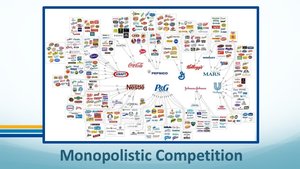
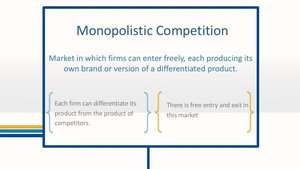
Monopolistic competition is a market structure where many firms sell products that are similar but not identical. Each firm differentiates its product and faces a downward-sloping demand curve. Entry and exit are free, so economic profits are driven to zero in the long run.
Product Differentiation: Each firm offers a slightly different product, making each a price maker.
Free Entry and Exit: Firms can enter or leave the market without restriction, ensuring zero economic profit in the long run.
Examples: Restaurants, books, movies, and consumer goods brands.
Short-Run and Long-Run Outcomes
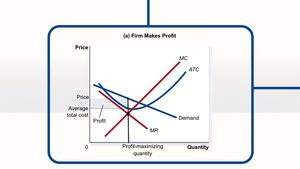
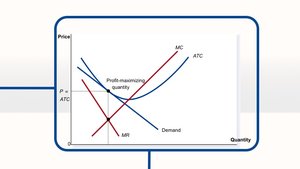
Short Run: Firms may earn positive or negative economic profits. The demand curve is downward sloping, and price can exceed average total cost (ATC).
Long Run: Entry or exit of firms shifts the demand curve until price equals ATC, resulting in zero economic profit. However, price still exceeds marginal cost (MC), leading to inefficiency and deadweight loss.
Comparison with Perfect Competition
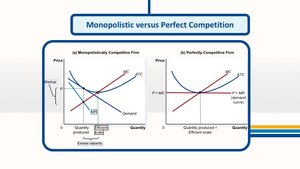
Excess Capacity: Monopolistically competitive firms do not produce at minimum ATC, resulting in excess capacity.
Markup: Price exceeds MC, unlike perfect competition where P = MC.
Product Diversity: Consumers benefit from variety, but at the cost of some inefficiency.
Oligopoly
Definition and Features
An oligopoly is a market structure in which a small number of firms dominate the market. Products may be homogeneous or differentiated, and barriers to entry are significant. Firms are interdependent, meaning each firm's actions affect the others.
Few Firms: Only a handful of firms control the majority of market output.
Barriers to Entry: High, due to economies of scale, patents, or control of resources.
Examples: Automobiles, steel, oil, and airlines.
Equilibrium in Oligopolistic Markets: Nash Equilibrium
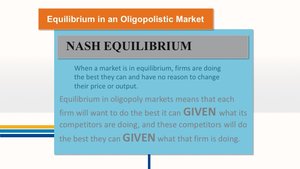
In oligopoly, firms must consider the likely reactions of their competitors when making decisions. The concept of Nash equilibrium is central: each firm chooses its best strategy given the strategies of others, and no firm has an incentive to deviate unilaterally.
Nash Equilibrium: A set of strategies where each firm does the best it can, given the actions of its rivals.
Implication: Oligopoly outcomes typically fall between monopoly and perfect competition in terms of price and output.
Oligopoly Models
Overview of Models
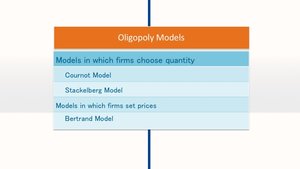
There are several models to analyze firm behavior in oligopoly, depending on whether firms compete in quantities or prices.
Cournot Model: Firms choose quantities simultaneously.
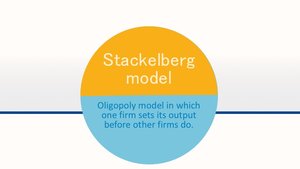
Stackelberg Model: One firm (the leader) chooses quantity first, the other follows.
Bertrand Model: Firms compete by setting prices simultaneously.
Cournot Model
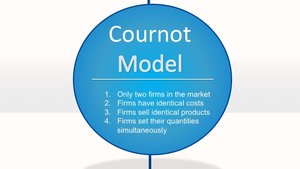
The Cournot model describes a duopoly where each firm chooses its output level assuming the other firm's output is fixed. The equilibrium is reached when both firms' expectations are correct.
Assumptions: Two firms, identical costs, identical products, simultaneous quantity setting.
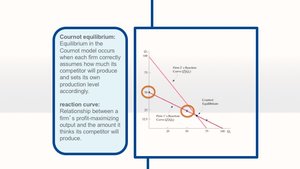
Reaction Curves: Each firm's optimal output as a function of the other firm's output.
Cournot Equilibrium: Intersection of reaction curves; neither firm wants to change its output unilaterally.
Example: Linear Demand Curve
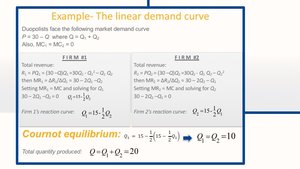
Suppose market demand is , with and . Each firm's reaction function is:
Solving simultaneously:
Total output:
Collusion and Competitive Outcomes
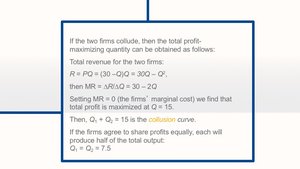
Collusion: If firms collude, they act as a monopoly, maximizing joint profit. Total output is , each firm produces if profits are shared equally.
Competitive Equilibrium: If firms act as perfect competitors, and output is higher, profits are zero.
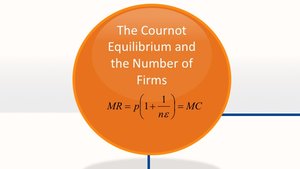
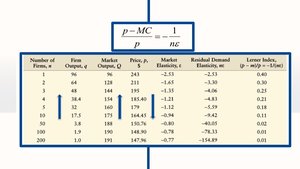
Cournot Equilibrium and Number of Firms
As the number of firms increases, the Cournot equilibrium approaches the competitive outcome. The profit-maximizing condition is:
Where is the number of firms and is the price elasticity of demand. As $n$ increases, the market becomes more competitive.
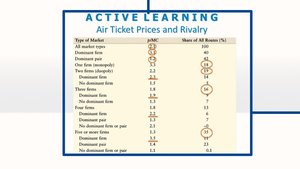
Active Learning: Air Ticket Prices and Rivalry
This application shows how market structure affects air ticket prices relative to marginal cost. Fewer dominant firms lead to higher prices above marginal cost, while more competition drives prices closer to marginal cost.
Stackelberg Model
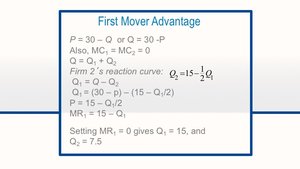
In the Stackelberg model, one firm (the leader) chooses its output first, and the other firm (the follower) responds. The leader can secure a first-mover advantage, producing more and earning higher profits.
First Mover Advantage: The leader anticipates the follower's reaction and chooses output to maximize its own profit.
Example: With , , the leader produces , the follower .
Bertrand Model
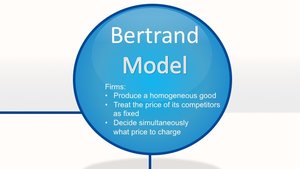
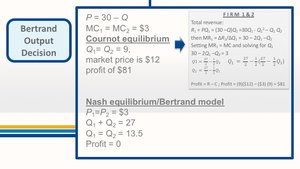
The Bertrand model analyzes price competition between firms producing a homogeneous good. Firms set prices simultaneously, and the Nash equilibrium results in prices equal to marginal cost, with zero economic profit.
Assumptions: Homogeneous product, simultaneous price setting, each firm treats rival's price as fixed.
Outcome: Price competition drives price down to marginal cost, even with only two firms.
Cartels
Definition and Persistence
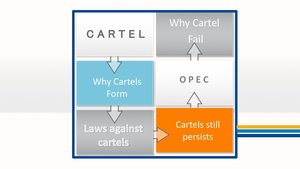
A cartel is a group of firms that collude to set prices or output to maximize joint profits, acting like a monopoly. Cartels are illegal in many countries but may persist due to legal loopholes, international scope, or tacit coordination.
Why Cartels Form: To increase profits by reducing competition.
Why Cartels Fail: Incentives to cheat, entry of non-cartel firms, or legal enforcement.
Example: OPEC (Organization of Petroleum Exporting Countries).
Cartel Example and Monopoly Pricing
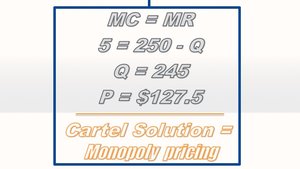
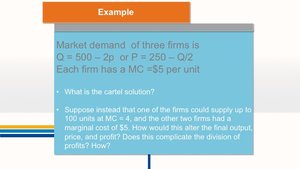
Suppose three firms face and each has . The cartel solution sets monopoly output and price:
Set to find and .
If one firm has lower marginal cost, profit division becomes more complex.
Summary Table: Market Structures
Market Structure | Number of Firms | Product Type | Entry Barriers | Price Setting Power | Long-Run Profit |
|---|---|---|---|---|---|
Perfect Competition | Many | Identical | None | None (Price Taker) | Zero |
Monopolistic Competition | Many | Differentiated | Low | Some | Zero |
Oligopoly | Few | Identical or Differentiated | High | Significant | Possible |
Monopoly | One | Unique | Very High | Complete | Possible |
