 Back
BackCh.14 Oligopoly: Firms in Less Competitive Markets – Study Notes
Study Guide - Smart Notes
 Tailored notes based on your materials, expanded with key definitions, examples, and context.
Oligopoly: Firms in Less Competitive Markets
Introduction to Oligopoly
Oligopoly is a market structure characterized by a small number of large, interdependent firms. Unlike perfect or monopolistic competition, oligopolists recognize their actions affect one another, and barriers to entry prevent new firms from easily entering the market. This chapter explores the defining features of oligopoly, the role of game theory, and strategic business behavior.
14.1 Oligopoly and Barriers to Entry
Identifying Oligopolies
Oligopoly: A market structure with a few large firms dominating the market.
Four-firm concentration ratio: The percentage of industry sales accounted for by the four largest firms. A ratio above 40% typically indicates an oligopoly.
Limitations: Does not account for foreign competition, may not reflect local market conditions, and market definitions can be ambiguous.
Barriers to Entry
Economies of scale: When long-run average costs decrease as output increases, making it difficult for new, smaller firms to compete.
Ownership of key inputs: Control over essential resources (e.g., bauxite for aluminum, diamonds, cranberries) can restrict entry.
Government-imposed barriers: Patents, occupational licensing, tariffs, and quotas can legally restrict entry.
Patent: Grants exclusive rights to produce a product for 20 years from the filing date.
Example: Occupational licensing for professions such as doctors is intended to protect consumers, but can also limit competition in less risky professions (e.g., yoga instructors).

14.2 Game Theory and Oligopoly
Introduction to Game Theory
Game theory analyzes strategic interactions where the outcome for each participant depends on the actions of others. It is essential for understanding oligopolistic behavior, where firms' profits are interdependent.
Rules: Define allowable actions.
Strategies: Plans of action to achieve objectives.
Payoffs: Outcomes resulting from the combination of strategies.
Payoff Matrix and Dominant Strategies
A payoff matrix shows the profits for each firm under different strategy combinations. A dominant strategy is the best action for a firm, regardless of what the other firm does.
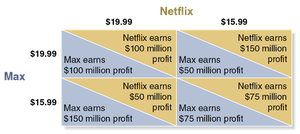
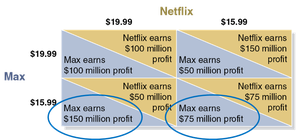
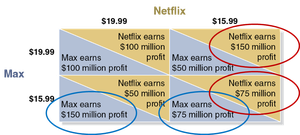
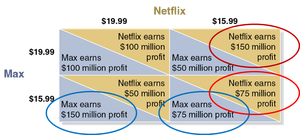
For both Netflix and Max, charging $15.99 is a dominant strategy, as it yields higher profits regardless of the competitor's choice.
Nash Equilibrium
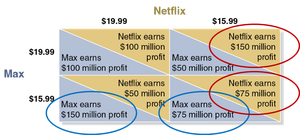
A Nash equilibrium occurs when each firm chooses the best strategy given the other firm's choice. In the Netflix-Max example, both charging $15.99 is the Nash equilibrium.
Collusion and Cooperative Equilibrium
Collusion: Firms agree to restrict competition (e.g., set higher prices), which is illegal in many countries.
Cooperative equilibrium: Players coordinate actions to increase mutual payoffs.
Noncooperative equilibrium: Players act independently, pursuing their own interests.
Prisoner's Dilemma
The prisoner's dilemma illustrates how rational strategies can lead to suboptimal outcomes for all players. Even when cooperation would yield better results, dominant strategies may lead to noncooperation and lower payoffs.
Repeated Games and Enforcement Mechanisms
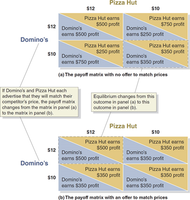
In repeated interactions, firms can use strategies like price match guarantees or price leadership to sustain higher prices and avoid destructive competition.
Price leadership: One firm sets the price, and others follow, often resulting in higher prices and reduced competition.
Cartels and Collusion Challenges
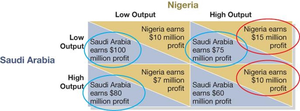
Cartel: A group of firms that collude to restrict output and raise prices (e.g., OPEC in the oil market).
Collusion is difficult to maintain due to incentives to cheat and differences in member interests. (Combined profits is the highest on the payoff matrix)

14.3 Sequential Games and Business Strategies
Sequential Games and Decision Trees
In sequential games, firms make decisions one after another, observing previous actions. These are analyzed using decision trees, which map out choices and consequences at each stage.
Subgame-perfect equilibrium: An outcome where no player can improve their result by changing their decision at any stage of the game.
Example: A firm may set a low price to deter entry by a competitor, or anticipate acceptance of a low offer in bargaining situations.
14.4 The Five Competitive Forces Model
Porter's Five Forces
Michael Porter's model identifies five forces that shape competition in an industry:
Competition from existing firms: Rivalry among current competitors.
Threat from potential entrants: The possibility of new firms entering the market.
Competition from substitutes: Availability of alternative products or services.
Bargaining power of buyers: Buyers' ability to negotiate lower prices.
Bargaining power of suppliers: Suppliers' ability to demand higher prices.
Example: The rise of digital cameras replaced film cameras, and smartphones are now replacing digital cameras. Large buyers like Walmart can force suppliers to lower prices, while dominant suppliers like Microsoft can charge higher prices as their market power grows.
Industry Dynamics and Firm Survival
Even large firms with high market power can be displaced by new entrants, technologies, or products over time.
Barriers to entry may erode, leading to increased competition and turnover among leading firms.
