 Back
BackOligopoly: Firms in Less Competitive Markets – Study Notes
Study Guide - Smart Notes
 Tailored notes based on your materials, expanded with key definitions, examples, and context.
Oligopoly: Firms in Less Competitive Markets
Introduction to Oligopoly
An oligopoly is a market structure characterized by a small number of interdependent firms whose decisions affect one another. Unlike perfect or monopolistic competition, oligopolies require unique analytical tools due to their strategic interactions and barriers to entry.
Key Features: Few large firms, interdependence, and significant barriers to entry.
Examples: Streaming services (Netflix, Disney+), automobile manufacturers, and oil producers.
14.1 Oligopoly and Barriers to Entry
Barriers to entry are crucial in explaining the existence and persistence of oligopolies. These barriers prevent new firms from entering the market and competing away profits.
Four-Firm Concentration Ratio: Measures the percentage of industry sales accounted for by the four largest firms. A ratio above 40% typically indicates an oligopoly.
Limitations: Does not account for foreign competition, local markets, or ambiguous market definitions.
Economies of Scale: When long-run average costs decrease as output increases, large firms can dominate, making entry difficult for smaller firms.
Other Barriers:
Ownership of Key Inputs: Control over essential resources (e.g., bauxite for aluminum, diamonds, cranberries).
Government-Imposed Barriers: Patents, occupational licensing, tariffs, and quotas can restrict entry.
Example: Occupational licensing for professions such as doctors is justified for public safety, but excessive licensing (e.g., for yoga instructors) may serve to limit competition rather than protect consumers.

14.2 Game Theory and Oligopoly
Game theory is the primary tool for analyzing strategic interactions in oligopolistic markets. It studies how firms make decisions when their outcomes depend on the actions of others.
Key Elements of a Game:
Rules: Define allowable actions.
Strategies: Plans of action to achieve objectives.
Payoffs: Outcomes resulting from the combination of strategies.
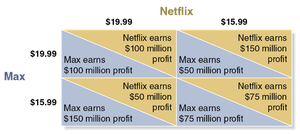
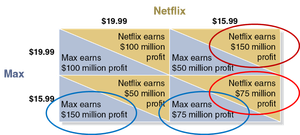
Payoff Matrix: A table showing the profits (payoffs) for each firm under different strategy combinations.
Dominant Strategy and Nash Equilibrium
A dominant strategy is the best action for a firm, regardless of what the other firm does. A Nash equilibrium occurs when each firm chooses the best strategy given the other’s choice.
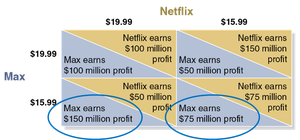
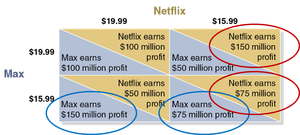
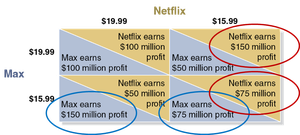
In the Netflix-Max example, both firms have a dominant strategy to charge $15.99, leading to a Nash equilibrium.
Collusion and Cooperative Equilibrium
Firms can achieve higher profits through collusion (illegal in many countries), where they agree not to compete. A cooperative equilibrium arises when firms coordinate actions to increase mutual payoffs, while a noncooperative equilibrium results from firms acting independently.
Prisoner’s Dilemma
The prisoner’s dilemma illustrates how rational strategies can lead to suboptimal outcomes for all players. Even when cooperation would yield better results, dominant strategies may lead to noncooperation and lower payoffs.
Repeated Games and Enforcement Mechanisms
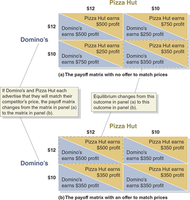
When games are repeated, firms can use strategies like price match guarantees or price leadership to avoid destructive competition and sustain higher profits.
Price Match Guarantee: Firms commit to matching competitors’ prices, discouraging price cuts.
Price Leadership: One firm sets the price, and others follow, often resulting in higher prices and reduced competition.
Cartels and Collusion
A cartel is a group of firms that collude to restrict output and raise prices. The Organization of Petroleum Exporting Countries (OPEC) is a classic example, though maintaining collusion is challenging due to incentives to cheat.


14.3 Sequential Games and Business Strategies
In sequential games, firms make decisions one after another, observing previous actions. These are analyzed using decision trees, which map out choices and consequences at each stage.
Subgame-Perfect Equilibrium: An outcome where no player can improve their result by changing their decision at any stage of the game.
Example: A firm may set a low price to deter entry by a competitor, or offer a low price in bargaining, anticipating acceptance.
14.4 The Five Competitive Forces Model
Michael Porter’s Five Competitive Forces Model analyzes the intensity of competition in an industry. The five forces are:
Competition from Existing Firms: More competitors usually mean lower prices and profits.
Threat from Potential Entrants: New firms can erode profits unless barriers to entry are high.
Competition from Substitutes: Availability of alternative products limits pricing power.
Bargaining Power of Buyers: Large buyers can negotiate lower prices.
Bargaining Power of Suppliers: Powerful suppliers can demand higher prices for inputs.
Example: The rise of digital cameras replaced film cameras, and smartphones are now replacing digital cameras. Large firms like Walmart can force suppliers to lower prices, while dominant suppliers like Microsoft can charge higher prices as their market power grows.
Industry Dynamics and Firm Survival
Even large firms with significant market power are not guaranteed survival. New entrants, technological change, and evolving consumer preferences can erode barriers to entry and displace established firms over time.
Of the 1955 Fortune 500, only a small fraction remain today, illustrating the dynamic nature of competition.
