 Back
BackOligopoly: Firms in Less Competitive Markets – Study Notes
Study Guide - Smart Notes
 Tailored notes based on your materials, expanded with key definitions, examples, and context.
Chapter 14: Oligopoly – Firms in Less Competitive Markets
Introduction to Oligopoly
An oligopoly is a market structure characterized by a small number of interdependent firms whose profitability depends on their interactions with each other. Unlike perfect competition or monopolistic competition, oligopolistic firms must consider not only price and output decisions but also strategies involving advertising, technology adoption, and supplier relationships. The complexity of these interactions means traditional demand and cost curve analysis is less useful, and economists often turn to game theory to analyze firm behavior in these markets.
Oligopoly and Barriers to Entry
Defining Oligopoly and Measuring Competition
Oligopoly: A market structure with a small number of interdependent firms.
Concentration Ratio: Measures the fraction of industry sales accounted for by the largest firms (commonly the four-firm concentration ratio).
A four-firm concentration ratio above 40% typically indicates an oligopoly.
Limitations: Concentration ratios may not account for foreign competition, local competition, or competition across industries.
Herfindahl-Hirschman Index (HHI): An alternative measure that sums the squares of market shares of all firms in the industry.
Barriers to Entry
Barriers to entry are factors that prevent new firms from entering an industry where existing firms are earning economic profits. The main barriers include:
Economies of Scale: When long-run average costs fall as output increases, large firms can produce at lower costs, deterring entry by smaller firms.
Ownership of a Key Input: Control over essential resources can block new entrants (e.g., Alcoa's control of bauxite for aluminum production).
Government-Imposed Barriers: Patents, tariffs, quotas, and occupational licensing can restrict entry and competition.
Game Theory and Oligopoly
Introduction to Game Theory
Game theory studies decision-making in situations where outcomes depend on the interactions of multiple decision-makers (players). In oligopoly, firms' profits depend on the strategies of their rivals. Key elements of a game include:
Rules: Define allowable actions.
Strategies: Plans to achieve objectives.
Payoffs: Outcomes resulting from the combination of strategies.
Duopoly Game: Price Competition
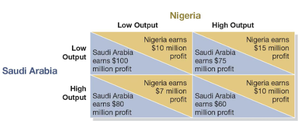
Consider a duopoly where two firms (e.g., Netflix and Max) choose between two prices. The payoff matrix summarizes the profits for each combination of strategies.
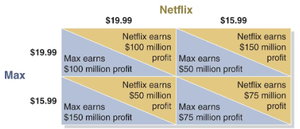
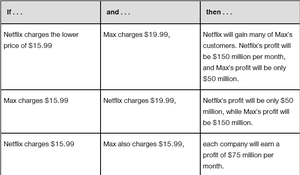
Dominant Strategy: The best strategy for a firm, regardless of what the other firm does.
Nash Equilibrium: Each firm chooses the best strategy given the strategy of the other; no firm has an incentive to deviate unilaterally.
The Prisoner's Dilemma in Oligopoly
The prisoner's dilemma illustrates how rational strategies can lead to suboptimal outcomes for all players. In oligopoly, firms may both choose low prices (dominant strategy), resulting in lower profits than if they cooperated and kept prices high.
Cooperative Equilibrium: Firms cooperate to increase mutual payoffs.
Noncooperative Equilibrium: Firms pursue self-interest, leading to lower profits.
Escaping the Prisoner's Dilemma: Repeated Games and Price Leadership
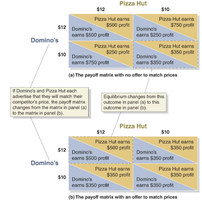
When games are repeated, firms can use strategies like price matching or retaliation to encourage cooperation and sustain higher profits. Price leadership is a form of implicit collusion where one firm sets a price and others follow.
Cartels: The Case of OPEC
A cartel is a group of firms that collude to restrict output and raise prices. OPEC is a well-known example, coordinating oil production among member countries to influence world oil prices.
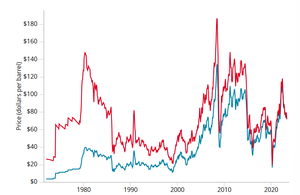
OPEC's effectiveness is limited by members exceeding quotas and competition from non-OPEC producers.
Game theory explains why cartels are unstable: individual members have incentives to cheat for higher profits.
Sequential Games
Deterring Entry
In sequential games, one firm moves first and others respond. Firms can use strategies to deter entry, such as setting prices that make entry unattractive for potential competitors.
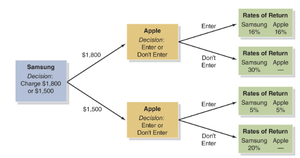
Decision trees illustrate the sequence of decisions and possible outcomes.
Firms may set prices to discourage entry and maintain market power.
Bargaining Between Firms
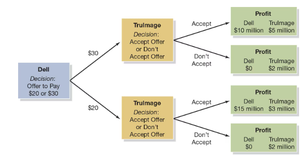
Firms often negotiate with suppliers or buyers over prices and contracts. The outcome depends on the sequence of offers and responses, which can be analyzed using decision trees.
The Five Competitive Forces Model
Porter's Five Forces
Michael Porter's model identifies five forces that determine the level of competition and profitability in an industry:
Competition from Existing Firms: Intense rivalry can lower prices and profits.
Threat from Potential Entrants: New entrants can increase competition; firms may deter entry through advertising, innovation, or pricing strategies.
Competition from Substitutes: Alternative products can reduce demand and profitability.
Bargaining Power of Buyers: Powerful buyers can demand lower prices or higher quality.
Bargaining Power of Suppliers: Suppliers with few competitors can charge higher prices, reducing firm profits.
Summary Table: Examples of Oligopolies
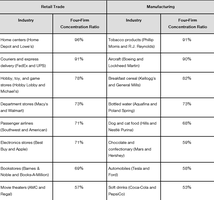
The following table provides examples of oligopolistic industries in retail trade and manufacturing, along with their four-firm concentration ratios.
Industry | Four-Firm Concentration Ratio | Industry | Four-Firm Concentration Ratio |
|---|---|---|---|
Home centers (Home Depot and Lowe's) | 96% | Tobacco products (Philip Morris and R.J. Reynolds) | 91% |
Coffee and espresso dealers (Starbucks) | 91% | Aircraft (Boeing and Lockheed Martin) | 90% |
Holiday, toy, and game stores (Hobby Lobby and Michaels) | 81% | Breakfast cereal (Kellogg's and General Mills) | 78% |
Department stores (Macy's and Dillard's) | 71% | Bottled water (PepsiCo and Nestlé) | 68% |
Shoe stores (Foot Locker and Designer Brands) | 71% | Dog and cat food (Hill's Pet and Nestlé Purina) | 60% |
Bookstores (Barnes & Noble and Books-A-Million) | 60% | Chocolate and confectionary (Mars and Hershey) | 50% |
Movie theaters (AMC and Regal) | 57% | Automobiles (Tesla and Ford) | 50% |
Soft drinks (Coca-Cola and PepsiCo) | 52% |
