 Back
BackOligopoly: Firms in Less Competitive Markets – Study Notes
Study Guide - Smart Notes
 Tailored notes based on your materials, expanded with key definitions, examples, and context.
Oligopoly: Firms in Less Competitive Markets
Introduction to Oligopoly
An oligopoly is a market structure characterized by a small number of interdependent firms whose decisions affect each other. Unlike perfect or monopolistic competition, oligopolies require unique analytical tools due to their strategic interactions and barriers to entry.
Interdependence: Firms are large enough that their actions influence rivals' profits.
Barriers to Entry: These prevent new firms from entering and competing away profits.
14.1 Oligopoly and Barriers to Entry
Identifying Oligopolies
Economists use the four-firm concentration ratio to identify oligopolies. This ratio measures the percentage of industry sales accounted for by the four largest firms. A ratio above 40% typically indicates an oligopoly.
Limitations: Does not account for foreign competition, may not reflect local markets, and depends on how the market is defined.
Barriers to Entry
Barriers to entry are crucial for the existence of oligopolies. They include:
Economies of Scale: When long-run average costs decrease as output increases, large firms can produce at lower costs, deterring new entrants.
Ownership of Key Inputs: Control over essential resources (e.g., bauxite for aluminum, diamonds, cranberries) can block entry.
Government-Imposed Barriers: Patents, occupational licensing, tariffs, and quotas can legally restrict entry.
Patent: An exclusive right to a product for 20 years from the filing date.
Example: Occupational licensing for professions such as doctors, electricians, and even yoga instructors can serve as a barrier to entry.

14.2 Game Theory and Oligopoly
Game Theory Basics
Game theory analyzes strategic interactions where the outcome for each participant depends on the actions of others. In oligopoly, firms must consider rivals' responses when making decisions.
Rules: Define allowable actions (e.g., production functions, market demand).
Strategies: Plans of action to achieve objectives (e.g., pricing decisions).
Payoffs: Outcomes resulting from the combination of strategies (e.g., profits).
Payoff Matrix and Dominant Strategy
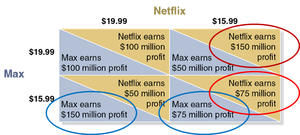
A payoff matrix shows the profits for each firm under different strategy combinations. A dominant strategy is the best action for a firm, regardless of what rivals do.
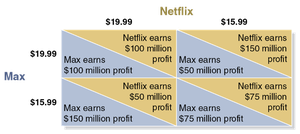
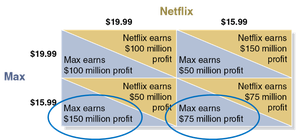
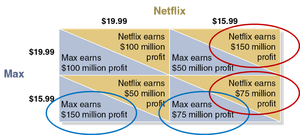
Example: Both Netflix and Max earn higher profits by charging $15.99, regardless of the other firm's choice. Thus, $15.99 is a dominant strategy for both.
Nash Equilibrium
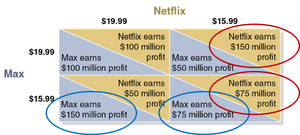
A Nash equilibrium occurs when each firm chooses the best strategy given the other's choice. Neither firm can improve its outcome by changing its own strategy alone.
Collusion and Cooperative Equilibrium
Firms may be tempted to collude (agree on prices or output) to increase profits, but such behavior is illegal in many countries. A cooperative equilibrium arises when firms coordinate actions for mutual benefit, while a noncooperative equilibrium involves independent, self-interested strategies.
Prisoner's Dilemma
The prisoner's dilemma illustrates how rational strategies can lead to worse outcomes for all players. Even when cooperation would yield better results, dominant strategies may lead to noncooperation and lower payoffs.
Repeated Games and Enforcement Mechanisms
When games are repeated, firms can use strategies like price match guarantees or price leadership to avoid destructive competition and sustain higher profits.
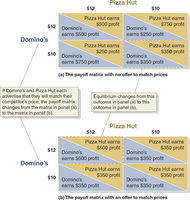
Price Leadership: One firm sets prices, and others follow, often resulting in higher prices and less competition.
Cartels and Collusion
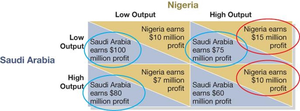
A cartel is a group of firms that collude to restrict output and raise prices. The Organization of Petroleum Exporting Countries (OPEC) is a well-known example, though maintaining collusion is challenging over time.

Unequal Cartel Members
When cartel members differ in size or cost, their incentives to cooperate may diverge, making collusion unstable. For example, Saudi Arabia and Nigeria in OPEC have different optimal strategies due to their production capacities.
14.3 Sequential Games and Business Strategies
Sequential Games
In sequential games, firms make decisions one after another, observing previous actions. These are analyzed using decision trees, which map out choices and consequences at each stage.
Subgame-Perfect Equilibrium: An outcome where no player can improve their result by changing decisions at any stage.
Example: A firm may set a low price to deter entry by a potential competitor, as shown in entry deterrence games.
14.4 The Five Competitive Forces Model
Porter's Five Forces
Michael Porter's model identifies five forces that shape competition in an industry:
Competition from Existing Firms: Rivalry among current firms can limit prices and profits.
Threat from Potential Entrants: New firms can erode profits unless barriers to entry are high.
Competition from Substitutes: Alternative products can reduce demand for an industry's goods.
Bargaining Power of Buyers: Large buyers can negotiate lower prices.
Bargaining Power of Suppliers: Powerful suppliers can demand higher prices for inputs.
Example: The rise of digital cameras replaced film cameras, and smartphones are now replacing digital cameras.
Industry Dynamics
Even large firms with high barriers to entry can be displaced over time by new entrants, technologies, or products. The Fortune 500 list changes significantly over decades, illustrating the dynamic nature of competition.
Additional info: Sequential games and decision trees are covered in more detail in advanced microeconomics courses. The concept of subgame-perfect equilibrium is essential for understanding credible threats and commitments in strategic business decisions.
