 Back
BackOligopoly: Kinked Demand Curve, Price Leadership, and Cartels
Study Guide - Smart Notes
 Tailored notes based on your materials, expanded with key definitions, examples, and context.
Chapter 12: The Kinked Demand Curve & Price Leadership Model
The Kinked Demand Curve
The kinked demand curve model is used to explain price rigidity in oligopolistic markets, where a few firms dominate and are reluctant to change prices even when costs or demand shift. This model highlights the strategic interdependence among firms in an oligopoly.
Price Rigidity: Oligopolistic firms often avoid changing prices to maintain market stability, fearing that competitors will not follow price increases but will match price decreases.
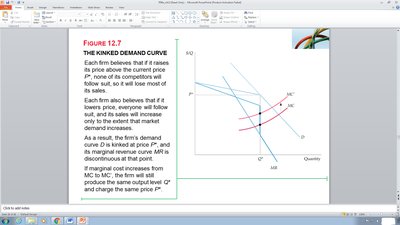
Kinked Demand Curve: The demand curve faced by each firm has a 'kink' at the current market price. Above this price, demand is highly elastic because competitors will not follow a price increase, leading to a loss of market share. Below this price, demand is inelastic because competitors will match price decreases, resulting in little gain in market share but lower profits for all.
Marginal Revenue (MR): The MR curve is discontinuous at the kink, which explains why prices tend to remain stable even if marginal costs change within a certain range.
Limitations: While the model describes price rigidity, it does not fully explain how the initial price is set in oligopolistic markets.
Example: If marginal cost increases from MC to MC', the firm will still produce the same output and charge the same price due to the discontinuity in MR.
Price Leadership Model
The price leadership model describes a form of implicit collusion in oligopolistic markets, where one firm (the leader) sets the price and other firms (followers) match it. This model helps explain how prices can be coordinated without explicit agreements, which are often illegal.
Price Signaling: A firm announces a price change (e.g., via press release) hoping others will follow, signaling a desire for coordinated pricing.
Price Leadership: One firm, often the largest or most influential, sets the price, and others follow. This avoids direct collusion but achieves similar outcomes.
Example: Three firms charge $10. If collusion were legal, they would set $20. Instead, Firm A raises its price to $15 and announces it publicly, prompting Firms B and C to follow.
The Dominant Firm Model
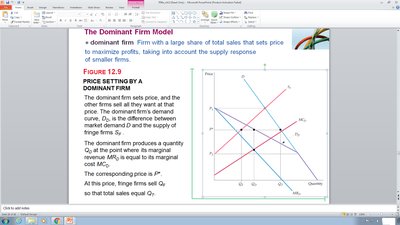
In some oligopolistic markets, a single large firm (the dominant firm) sets the market price, while smaller firms act as price takers. The dominant firm maximizes its profit by considering the supply response of the smaller firms.
Dominant Firm: Sets the price that maximizes its profit, taking into account the total market demand and the supply provided by smaller firms.
Residual Demand: The dominant firm's demand curve is the market demand minus the supply of the smaller firms at each price.
Profit Maximization: The dominant firm produces where its marginal revenue equals its marginal cost (), and sets the corresponding price.
Example: At the profit-maximizing price, the dominant firm sells quantity , and the fringe firms supply the remainder so that total market quantity is .
Cartels
A cartel is a formal agreement among competing firms to coordinate prices and output, effectively acting as a monopoly. Cartels are often international and can be unstable due to incentives for individual members to cheat.
Definition: A cartel is a group of producers that explicitly agree to cooperate in setting prices and output levels.
Conditions for Success:
A stable organization with members who adhere to agreed prices and output levels.
The potential for monopoly power, allowing the cartel to restrict output and raise prices.
Challenges: Cartels often fail because members have incentives to cheat by secretly lowering prices or increasing output.
Example: OPEC is a well-known international cartel in the oil industry.
