 Back
BackOligopoly: Structure, Models, and Game Theory in Microeconomics
Study Guide - Smart Notes
 Tailored notes based on your materials, expanded with key definitions, examples, and context.
Oligopoly
Introduction to Oligopoly
An oligopoly is a market structure characterized by a small number of large firms that dominate the industry. These firms may produce either homogenous or differentiated products. Oligopolists compete not only in price but also through product development, marketing, advertising, and complementary goods. Most real-world industries fall between the extremes of perfect competition and monopoly, making oligopoly a common market structure.
Market Structure in an Oligopoly
Characteristics of Oligopolistic Industries
Few Dominant Firms: A small number of firms control a large share of the market.
Interdependence: Firms must consider the potential reactions of rivals when making decisions.
Barriers to Entry: High barriers, such as economies of scale, patents, and brand loyalty, prevent new firms from entering easily.
Product Differentiation: Products may be identical (homogenous) or varied (differentiated).
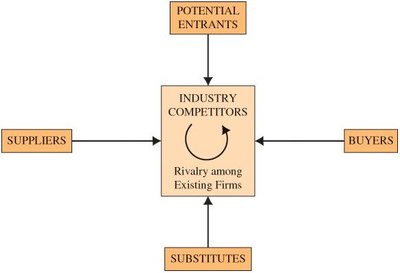
The Five Forces Model
The Five Forces model, developed by Michael Porter, analyzes the competitive forces that shape industry profitability:
Threat of new entrants
Bargaining power of suppliers
Bargaining power of buyers
Threat of substitute products
Rivalry among existing firms
Concentration Ratios and Contestable Markets
Concentration Ratio: The percentage of market output produced by the largest firms. High ratios indicate oligopoly.
Contestable Markets: Markets where entry and exit are easy, keeping prices competitive even if few firms exist.
Industry | Four Largest Firms (%) | Eight Largest Firms (%) | Number of Firms |
|---|---|---|---|
Primary copper | 99 | 100 | 10 |
Cigarettes | 95 | 99 | 15 |
Household laundry equipment | 93 | 100 | 13 |
Breweries | 90 | 94 | 344 |
Motor vehicles | 81 | 91 | 308 |
Oligopoly Models
The Collusion Model
Cartel: A group of firms that coordinate price and output decisions to maximize joint profits. Cartels are often illegal due to their negative impact on consumers.
Tacit Collusion: Implicit agreements among firms to avoid competitive practices, such as price wars, without explicit communication.
The Price-Leadership Model
Price Leadership: One dominant firm sets the price, and other firms follow its lead.
The Cournot Model
Duopoly: A special case of oligopoly with only two firms.
Each firm chooses output to maximize profit, assuming the other firm's output is fixed.
Total industry output under duopoly is higher than monopoly but lower than perfect competition.
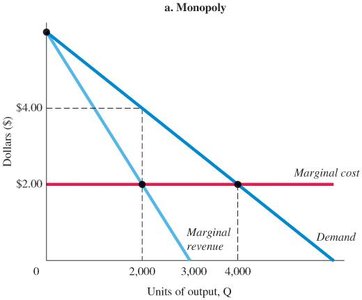
Example: In the Cournot model, if two firms face the same demand and marginal cost, each will produce less than in perfect competition but more than a monopolist would.
Game Theory in Oligopoly
Basic Concepts
Game Theory: The study of strategic interactions where the outcome for each participant depends on the actions of others.
Dominant Strategy: A strategy that yields the best outcome for a player, regardless of what others do.
Payoff Matrix and Dominant Strategies
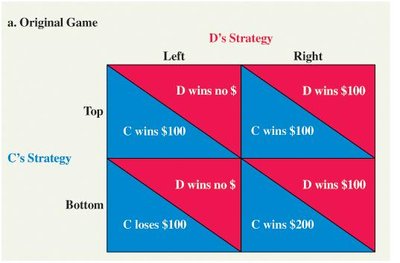
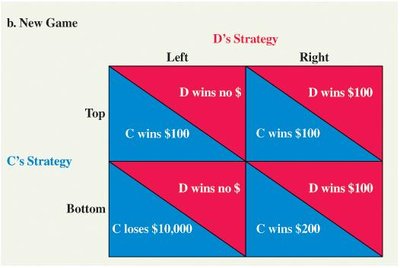
A payoff matrix shows the profits or losses for each firm based on their chosen strategies.
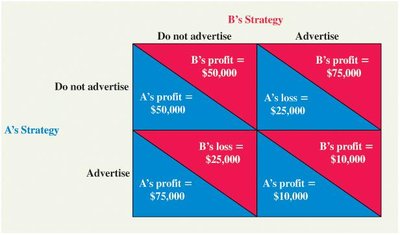
Example: In the advertising game, both firms have a dominant strategy to advertise, even though mutual non-advertising would yield higher profits.
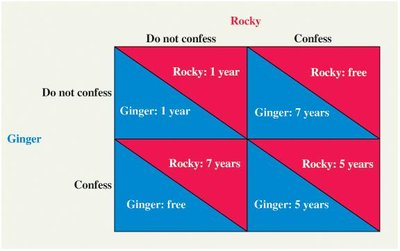
The Prisoners’ Dilemma
A classic example where two players acting in their own self-interest reach a worse outcome than if they had cooperated.
Each has a dominant strategy that leads to a suboptimal result for both.
Nash Equilibrium and Other Strategies
Nash Equilibrium: A situation where each player chooses the best strategy given the strategies of others; no player can benefit by changing their strategy unilaterally.
Maximin Strategy: Choosing a strategy to maximize the minimum gain possible.
Repeated Games and Tit-for-Tat
Tit-for-Tat Strategy: In repeated games, a player mimics the opponent’s previous action, encouraging cooperation over time.
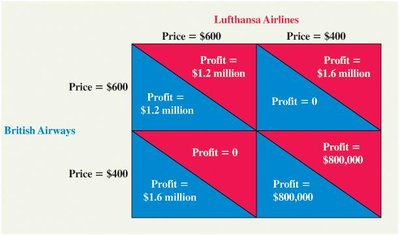
Application: Airline Pricing Game
Oligopolists often face repeated interactions, as in airline pricing. Both firms may have dominant strategies that lead to lower profits than if they cooperated.
Oligopoly and Economic Performance
Pricing, Output, and Innovation
Oligopolies typically set prices above marginal cost and produce less than the socially optimal output, except in highly contestable markets.
However, competition among oligopolists can drive innovation and product variety.
Industrial Concentration and Technological Change
Some economists argue that concentrated industries may innovate more rapidly due to greater resources for research and development.
The Role of Government in Oligopoly
Regulation of Mergers
Celler-Kefauver Act: Extended government authority to regulate mergers that may reduce competition.
Herfindahl-Hirschman Index (HHI): Measures market concentration by summing the squares of the market shares of all firms in the industry.
Industry | HHI |
|---|---|
Beer | 3,525 |
Ethanol | 326 |
Las Vegas gaming | 1,497 |
Critical care patient monitors | 2,661 |
HHI is calculated as:
where is the market share percentage of firm .
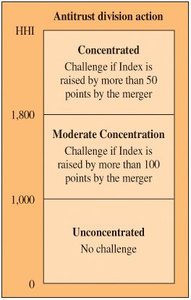
Guidelines: The Department of Justice challenges mergers based on the change in HHI and the level of concentration.
Antitrust Policy and International Competition
Governments may block or approve mergers to prevent excessive market power.
Firms that dominate domestic markets may still face intense competition internationally.
Key Terms and Concepts
Cartel: A group of firms coordinating actions to maximize joint profits.
Concentration Ratio: Share of market output by top firms.
Contestable Markets: Markets with easy entry and exit.
Dominant Strategy: Best strategy regardless of rivals’ actions.
Duopoly: Oligopoly with two firms.
Game Theory: Study of strategic decision-making.
Herfindahl-Hirschman Index (HHI): Measure of market concentration.
Nash Equilibrium: No player can benefit by changing strategy alone.
Price Leadership: One firm sets price, others follow.
Prisoners’ Dilemma: Game where dominant strategies lead to suboptimal outcomes.
Tacit Collusion: Implicit coordination among firms.
Tit-for-Tat Strategy: Repeated game strategy of reciprocation.
